Successful 'Students as Partners' concept bears fruit
Students actively support the digitalization of studies and teaching

Implementing Digitalization in Academic Disciplines in a Participatory Manner - Competencies Connected (D2C2) — is a collaborative project funded by the Foundation for Innovation in Higher Education in which Zittau/Görlitz University of Applied Sciences is participating. Coordinated by the Saxon Center for Higher Education Pedagogy (HDS), the HSZG subproject of the collaborative initiative is based at the Centre for Knowledge Transfer and Education under the direction of the Vice President for Education and International Affairs, Prof. Dr. Sophia Keil. The goal is evidence-based instructional development in the field of digital teaching, for which subject-area networks are being established to facilitate knowledge exchange, and faculty are being supported in the implementation of digital methods and tools. Further information on the collaborative project can be found on the HDS website.
In order to provide needs-based services to promote good teaching, the network's portfolio focuses on the following areas:
- SUBJECT-SPECIFIC PROFESSIONAL LEARNING COMMUNITIES: SUBJECT COMMUNITIES
- FOCAL POINTS: DIGITAL TURNING POINTS
- ON-SITE SUPPORT
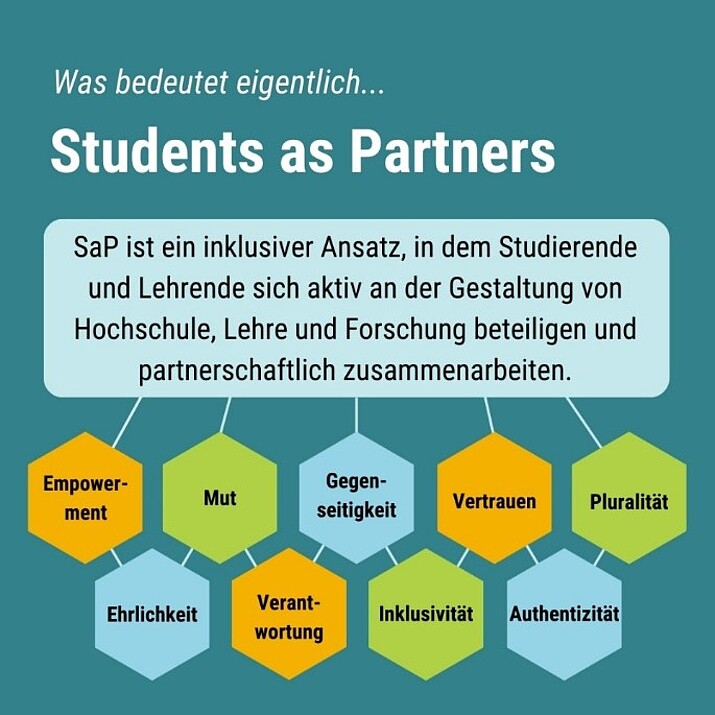
D2C2 works according to the "Students as Partners" approach and actively incorporates the student perspective into the project work. This gives students the opportunity to participate in the design of subject-specific teaching, e.g. through surveys or active participation in teaching-learning scenarios, but also to develop their personal skills by working in multidisciplinary, cross-location teams and tackling a wide range of current issues in the context of digitalization.
Theresa L. (student partner, MK faculty):
“I wanted to help the HSZG improve its teaching, which is why I’m participating in this project. Currently, my work on the project mainly involves researching approaches to promote digital skills among students and providing feedback on existing formats from a student’s perspective. In particular, artificial intelligence approaches can support us students in our learning and make many tasks easier. In the project, I’m helping to create micro-courses designed to help students acquire skills. It’s great to see how my perspective is being taken into account to improve teaching. I would also like to see more opportunities for involvement outside of the project. By incorporating the student perspective into teaching and learning processes, the design is much more attuned to students’ needs. I highly recommend that my fellow students seize this opportunity and get involved as “student partners.” There are many benefits: Not only do you often have the chance to earn money for your studies, but you also gain subject-specific knowledge and insights into project work. For example, I was able to learn a lot about AI—its capabilities, functions, and areas of application.”
Christian B. (student partner, EI faculty):
“I wanted to broaden my horizons and saw participating in this didactics project as a challenge. The prospect of positively influencing teaching for future generations of students motivated me to get involved in the project, and I found the collaboration on an equal footing—as well as the opportunity to contribute my own ideas—to be extremely rewarding. Highlights for me were the project meetings of the Saxon consortium, where I was able to connect with other departments and gain diverse perspectives on the project topic. The diversity of the individual focus areas was interesting. It became clear to me that the challenges of digitizing universities are complex and that there is no “one” solution. Different teaching approaches exist from one university to another and even within faculties. The higher education system thrives on this diversity, and it should be preserved. Time and again, it becomes clear that the faculty at HSZG are very dedicated and eager to share knowledge even beyond the scope of their classes / courses. With regard to opportunities to help shape your academic experience and teaching, my advice to students is: Ask questions! In lectures or seminars…it doesn’t matter. That’s the easiest way to have a direct impact. As a former member of the Study Commission, I recommend that if you’re interested in the further development of teaching, you consider serving on the Commission as a student representative. I’ve worked with many digital tools as part of the project, and in this era of advancing digitalization, I can easily imagine applying this knowledge in the future.
Esther P. (student partner, faculty N)
“Digitalization is becoming increasingly relevant, especially in students’ everyday lives—whether it’s doing research, completing assignments, and so on. That’s why I’m interested in improving teaching concepts and wanted to actively support the project. I’m currently helping develop electronic exercises for students. Here, I have the opportunity to help design assessment tasks and thus bring my perspective—the student’s viewpoint—into the process, making learning easier for my fellow students because I know which topics still need to be explained in a different way or which ones are difficult to understand. That’s where an explanation from a student’s perspective can help. I’m glad there are projects like this where students can participate in shaping teaching and learning processes. It’s a win-win for both sides—teachers and students—to be able to engage in dialogue and improve teaching. This way, instructors can identify which topics and/or concepts aren’t working and gain new ideas from students on how to improve them. I therefore advise other students to take seriously their opportunities to help shape academic processes—and especially the module evaluations—and to offer constructive criticism in order to improve teaching.”
Ferenc T. (student partner, EI faculty)
“I wanted to gain project experience in the field of digitalization and didactics and expand my experience beyond the engineering field. The project gave me the opportunity to act as a bridge between students and professors or staff members in order to positively influence teaching for future cohorts. The focus was on advising faculty on teaching approaches (from a student’s perspective) as well as testing and implementing digital tools designed not only to support day-to-day teaching but also to make classes more interesting and educational. As part of the project, I was able to meet a wide variety of people and gain insights into different fields of study. Through the insights gained from working with the network of Saxon colleges and universities, it became clear to me once again that the smaller class sizes at HSZG’s Zittau campus offer many advantages for teaching. What struck me in particular was the comparatively close relationship between students and faculty at the HSZG, who are highly committed to continuously improving their teaching. If I hadn’t already completed my degree, I would also be happy to support other areas by offering my perspective as a student.”
Tina G. (student partner, faculty N)
“I was motivated to become part of the project because I saw an opportunity to actively contribute to shaping university teaching. At the start of the project, I participated in focus group interviews and helped evaluate them. The goal was to identify support services for faculty members. Currently, I’m working on audio response systems to increase interaction between students and instructors in the classroom. One challenge for me was collaborating with project team members from other universities who were located in different places. Because we work entirely online, building a sense of teamwork and getting to know colleagues from other universities is a bit different than when everyone is always on-site. One of my highlights is the digital exchange format supported by the project. Every two weeks, a faculty member presents their teaching method, discusses the advantages and challenges of the method with colleagues, and they support one another. This provides a fascinating behind-the-scenes look at teaching at the university. Overall, I appreciate the personal aspect of our university. It has a close-knit, family-like atmosphere, and the staff go out of their way to adapt classes / courses to students’ needs—as long as you communicate with them. Projects like D2C2 are an important cog in this system. I would like to see such opportunities for student involvement expanded even further. It is very beneficial for teaching—and thus for the university—when students are actively involved in shaping their own learning environment. However, this also requires a sufficient number of interested students, and the smaller a university is, the more difficult I find it to find motivated students who, in addition to their classes and leisure activities, are willing to contribute to the university’s further development.”
In addition to the wide range of results that have already emerged from the project, the HSZG’s current set of initiatives focuses, for example, on…
- …the transfer of good teaching practices at HSZG
D2C2 is organizing an exchange forum on digitally supported teaching at HSZG. (Read the article) - …a quiz app for engineering
Mittweida University of Applied Sciences, in collaboration with Zittau/Görlitz University of Applied Sciences, is developing a learning app for engineering students. (more on this) - …measures to promote a digital identity
Following the peer-to-peer strategy consultation, HSZG is continuing to implement measures to digitize studies and teaching through a participatory process. (Read the article) - …the Engineering Education Network
The project supports the education of a Saxony-wide, teaching-focused network within the engineering departments. (Details) - …the transfer of teaching and learning concepts
D2C2 led the development of innovative approaches to the use of digital tools and to the research of one’s own teaching practices. (Example)
On behalf of the University Executive Board, Vice President Prof. Dr. Sophia Keil extends her gratitude to the student partners who have so actively supported the D2C2 project, as well as to everyone who, through their participation in the project’s accompanying activities, took advantage of the opportunity to get involved and share knowledge in order to advance the digitization of higher education. This has made it possible to create an alliance of various experts, which would have been nearly impossible to achieve without such a network.
We are therefore pleased to announce that, due to its successful work, the project will be extended by one year until December 31, 2025. You are cordially invited to participate in the available opportunities .
The HSZG Digital Teaching Exchange will enter its next phase in the 2024 summer semester. The program features a variety of exchange sessions focusing on digital teaching formats, methods, and tools; e-assessments; future skills; as well as challenges and tips for the digitization of academic studies and teaching. We look forward to lively discussions and are eager to hear the insights from our faculty.
We cordially invite you to join us!
You can find all the dates for the exchange meetings, access to the online platform, and further information on methods, tools, best practices, and events related to digital teaching here.

1st floor

First floor