
Success Story of Saxony's Universities Celebrated
Joint ceremony marking the 25th anniversary of Saxony's universities in Zwickau.
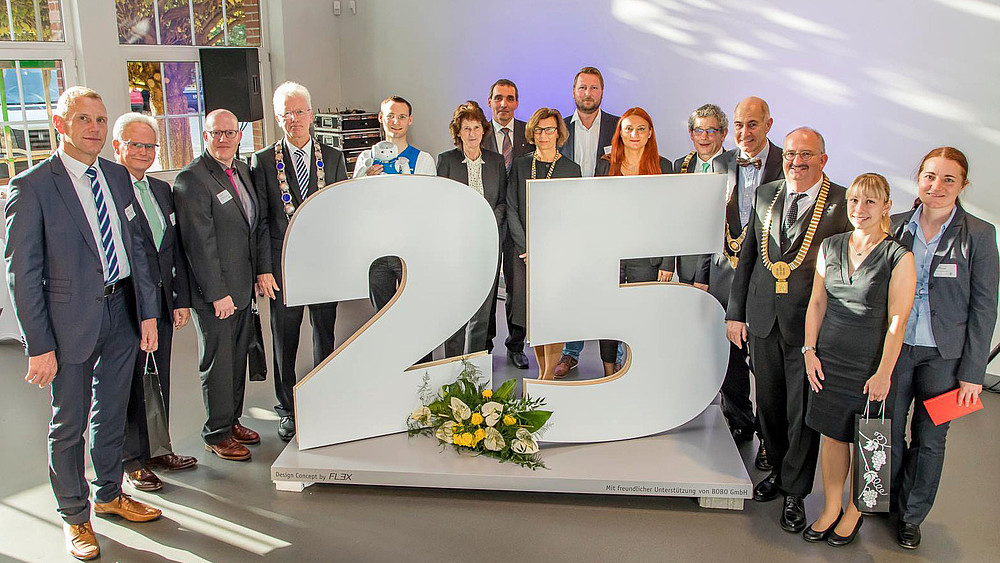
On Monday, October 16, 2017, the founding of the five universities of applied sciences in Saxony was celebrated with a ceremony at the August Horch Museum in Zwickau.
Together with high-ranking guests from academia, research, politics, professional associations, and the business community, the five Saxon universities of applied sciences (HAW) celebrated 25 years of success with a joint ceremony. Dr. Eva-Maria Stange, Minister of State for Science and the Arts, delivered the welcoming address on behalf of the Prime Minister of Saxony.
During the celebration, the rectors of the five Saxon HAWs focused primarily on the various current aspects of science and research. To this end, they had invited expert panelists.
The exemplary career of Prof. Dr.-Ing. Jan Höntschel—who studied at the Dresden University of Applied Sciences (HTW) and is now a manager at Globalfoundries Dresden and an honorary professor—was discussed, as was a current look at studying at the Leipzig University of Applied Sciences (HTWK) by graduate Hannes Hinerasky, as well as the importance of universities of applied sciences (HAWs) as a central pillar in ensuring the supply of skilled engineers for Saxony’s economy, as seen from the perspective of Dr.-Ing. Jens Walther, chairman of the Saxony Regional Association of the Association of German Engineers (VDI). Katharina Müller-Eppendorfer studied at Mittweida University of Applied Sciences (HSMW) and, as a former competitive athlete and mother of two children, was particularly able to highlight the university’s role as a source of support in all stages of life. The fifth panelist was Prof. Dr. Matthias Richter, former Prorector for Research at the West Saxon University of Applied Sciences in Zwickau (WHZ). The discussion with him focused on the strength of universities of applied sciences in the field of research and their importance for Saxony’s economy.
Following the collaborative roundtable discussion, the universities engaged in a linguistic competition. In a Science Slam, each university sent a representative to compete, with the goal of winning the trophy for best slammer through their interpretation of a scientific topic.
1st floor