
"A harmonious ensemble of buildings"
On June 1, Building Z I in Zittau—a modern educational facility with a historic exterior—was officially handed over.
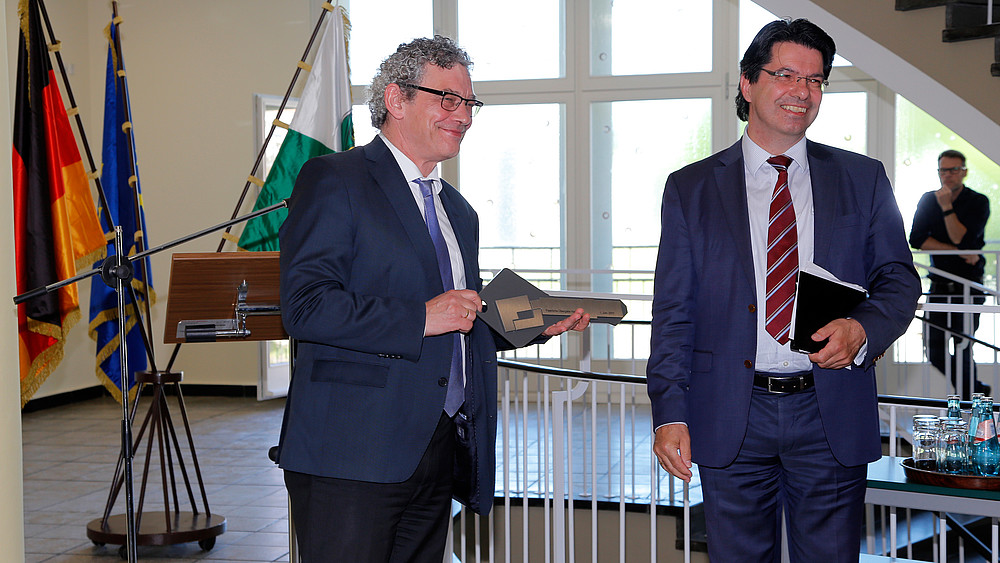
Finance Minister Prof. Dr. Georg Unland today presented the keys to the completed Building Z I at Zittau/Görlitz University of Applied Sciences to Dr. Ronald Werner, department head at the Ministry of Science, in Zittau. Dr. Werner immediately passed the keys on to the Rector of Zittau/Görlitz University of Applied Sciences, Prof. Dr. phil. Friedrich Albrecht.
Finance Minister Prof. Dr. Georg Unland: “Education is one of Saxony’s most important competitive advantages. This also includes providing adequate facilities for the state’s universities. With today’s handover, Zittau/Görlitz University of Applied Sciences gains a modern teaching and administrative building with a historic façade at its Zittau campus.”
Minister of State Prof. Dr. Unland added: “I am particularly pleased that we have succeeded in preserving the existing, historically protected building structure and harmoniously integrating it with a new building to form a unified ensemble. The building complex thus also serves as a reminder of the more than 180-year history of Zittau as a university town.”
The construction project included the restoration of the existing buildings along Hochwaldstraße in accordance with historic preservation guidelines, the demolition of the old laboratory building followed by the construction of a replacement structure, and the demolition of Building Z III, which was no longer needed.
The existing, historically protected building complex consists of several building sections that were constructed over the course of several decades: the so-called “old building,” erected around 1898 as a “higher weaving school,” the so-called “middle building,” built in 1951 as an extension for the School of Energy Engineering, and a further addition completed in 1961 (the so-called “old-new building”).
The renovation of the existing buildings in accordance with historic preservation guidelines included the restoration of all facades and stairwells in the Old Building, Middle Building, and Old-New Building, in part based on restoration findings. Furthermore, the original box-style windows in the old building were faithfully replicated as wooden windows with insulated glazing and external sunshades in accordance with preservation guidelines.
The new building, constructed to replace the demolished laboratory, is designed to blend in with the existing structures.
The building complex no longer met safety and fire protection requirements and was therefore extensively renovated. As part of this process, the building was also made accessible to people with disabilities. To harmoniously integrate the existing building sections and the new replacement structure into a cohesive ensemble, a new two-story foyer was added at the junction between the old building and the new replacement structure, serving as a central, barrier-free hub connecting the individual areas.
The construction project was carried out in several phases:
During the first phase, from April 2013 to August 2015, the old building and the central wing were renovated, and the new replacement building was constructed. During the second construction phase, from September 2015 to May 2017, the existing building was renovated and the outdoor facilities were completed. A third construction phase will take place from September to November 2017 and will involve the demolition of Building Z III at the Zittau/Görlitz University of Applied Sciences, which is no longer needed.
The building complex offers its users a total of approximately 6,000 m² of usable space, which will house parts of the departments within the Faculty of Electrical Engineering and Computer Science, the University Administration—including workshops and storage areas—the data center’s print shop, and the University Executive Board of the Zittau/Görlitz University of Applied Sciences. The construction costs amount to approximately 18.4 million euros.
The construction project is financed by tax revenues based on the budget approved by the members of the Saxon State Parliament.

1st floor