

29. January 2015
EAD Group at the TerraTec in Leipzig
Researchers at the HSZG support municipalities and districts in implementing the energy transition.
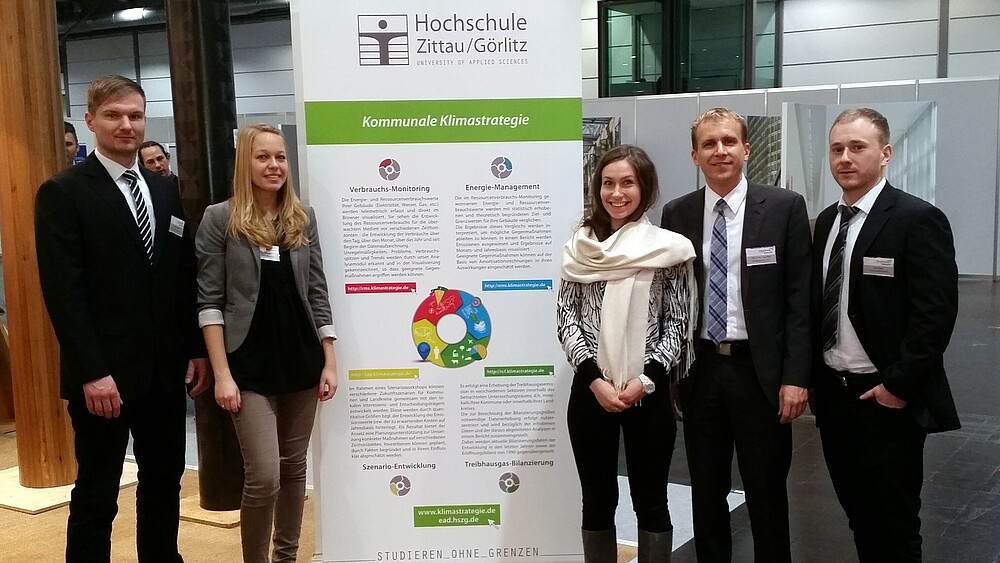
the EAD Group
A central element of this is an accounting methodology for measuring GHG emissions in various sectors such as energy, transportation, industry, agriculture, and waste management. The inventory process also takes into account statistical data from various sources and can thus be flexibly adapted to the needs of the respective municipality, city, or county.
The methodology was developed—with a focus on scientific accuracy and the need for practical applicability given the available data—primarily by Markus Will from the
faculty of Mathematics and Natural Sciences
Faculty of Electrical Engineering and Computer Science at the
In addition, various future scenarios for municipalities and counties can be developed and refined within the framework of scenario workshops. Such scenarios are specified and made comparable through quantitative metrics regarding the trend in emission levels and expected annual costs, in order to ensure the most reliable possible planning of climate protection measures and their implementation with predictable outcomes.
Prior to implementing the solutions described, it is possible to support data collection within the study area through monitoring solutions as well as systematic energy and resource management in municipal buildings. Continuous monitoring of resource consumption is an important first step toward understanding current consumption patterns and identifying opportunities for emissions reductions. Automated analysis components can evaluate relevant information, identify problems such as consumption spikes, recognize trends, and then visualize them.
Faculty of Electrical Engineering and Computer Science'
Computer Science Department
02826 Görlitz
Brückenstraße 1
Building G II,
Room A108
First floor
First floor
+49 3581 792-5354