
Making the University Future-Proof
In the rector election held on November 8, Prof. Dr.-Ing. Alexander Kratzsch was reelected Rector of Zittau/Görlitz University of Applied Sciences by the Extended Senate.
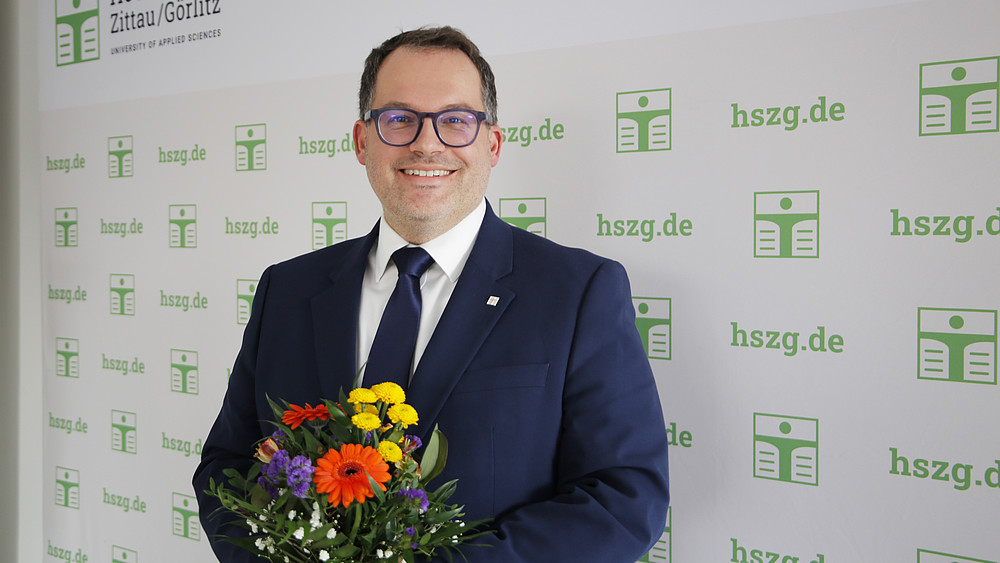
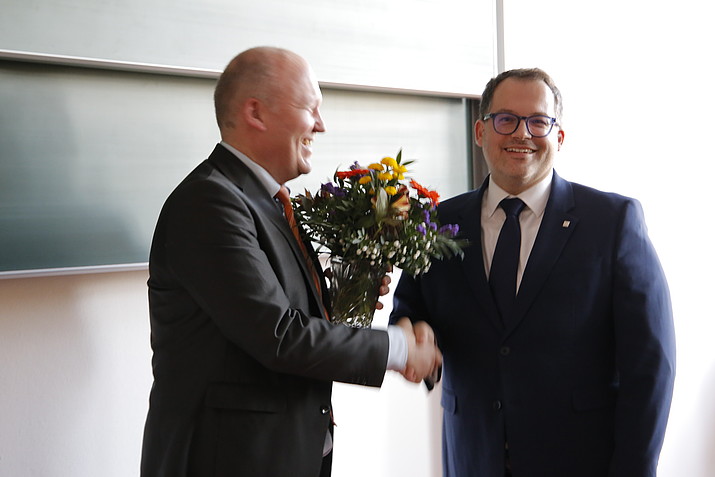
Prof. Dr.-Ing. Alexander Kratzsch was re-elected Rector by the Extended Senate of Zittau/Görlitz University of Applied Sciences on November 8, 2024. The election was based on the nomination submitted by the selection committee. The selection committee was chaired by the Chair of the University Council, Prof. Dr.-Ing. Welf-Guntram Drossel. Alexander Kratzsch will lead the Zittau/Görlitz University of Applied Sciences (HSZG) for another five years, from March 1, 2025, through February 28, 2030.
“Minister of Science Sebastian Gemkow said after the election: ‘I extend my warmest congratulations to Professor Kratzsch on his reelection. I am confident that, with him at the helm, Zittau/Görlitz University of Applied Sciences—as a strong institution with excellent connections within the academic system—will continue to distinguish itself in the future. The HSZG plays a central role in the development of the scientific and economic region of Eastern Saxony. The groundwork for further positive development has been laid, thanks in part to Professor Kratzsch’s achievements to date. I would like to thank him very much for the work he has already done and wish him all the good luck in his future endeavors.”
”During his second term, he intends to build on existing initiatives and launch new projects to further advance the HSZG’s development as a “university of the future,” one that is focused on modern education and research and relies on regional and global partnerships.
I am very grateful to the members of our university’s Extended Senate for once again placing their trust in me. I feel a strong sense of connection to our Zittau/Görlitz University and this region, and I am eager to tackle current challenges in order to shape the HSZG in a sustainable and forward-looking manner.
”
A Look Back at the First Term
Upon assuming the role of Rector on March 1, 2020, Prof. Kratzsch faced unprecedented challenges, such as managing the consequences of the COVID-19 pandemic and the associated introduction of hybrid instruction at HSZG. Much of the experience gained during this time will be incorporated into the university’s future digitalization plans.
Under his leadership, the University Executive Board has been developing the “University-For-Future Process” (U4F). This is a participatory project that involves the entire university and its regional community in planning for the future. The process was initiated to strengthen the university and position it innovatively to meet the demands of structural change in Upper Lusatia. Key areas of focus include the design of a future-oriented campus, digital transformation, and concepts for lifelong learning. Students, faculty, and regional stakeholders work together in workshops and projects to develop new ideas and measures that are directly incorporated into the university’s strategic direction.
To consolidate the results achieved in the U4F process, Prof. Kratzsch served as chair of the “University Development 2030+” Strategy Commission of the Senate, which resulted in a strategy paper outlining a long-term vision and strategic priorities to prepare the university for the challenges of the coming years. It emphasizes sustainable development in various key areas, including digital transformation, International Affairs, research excellence, and the expansion of opportunities for knowledge transfer. These initiatives are intended to help strengthen the university as an attractive center for education and research, particularly in the fields of energy economics, resource management, and social engagement. In line with Saxony’s overall higher education development plan, the strategy paper integrates climate protection goals and sustainability measures aimed at achieving long-term climate neutrality.
Since June 2023, Prof. Kratzsch has served on the board of the Hi!Lusatia e. V. science network . The research network was founded as a regional alliance and aims to promote the scientific, economic, and social development of the Germany-Poland-Czech Republic tri-border region.
In addition, since December 2023, Prof. Kratzsch has served as vice-chairman of the board and spokesperson for Saxony’s universities of applied sciences at the Saxony State Rectors’ Conference (Landesrektorenkonferenz Sachsen e. V.) and simultaneously serves as the state spokesperson for Saxony’s universities of applied sciences at the German Rectors' Conference (Hochschulrektorenkonferenz e. V.), where he advocates for the interests of Saxony’s universities.
Emerging from the U4F process, the HSZG, under his leadership, pursues the central goal of promoting STEM education in the region through extracurricular programs, such as mobile learning centers and student academies. To this end, the Prorectorate for Education and International Affairs at the the Upper Lusatia Future Learning Center (ZukLOS) was developed under the leadership of the Office of the Vice Rector for Education and International Affairs. On October 2, 2024, the official inauguration of the ZukLOS “Mobile Learning Spaces” trailer took place to recruit students in the STEM fields. In the future, the new Sprinter van with a trailer will visit schools and other educational institutions as a decentralized program to inspire students on-site with a variety of on-board experiments, including those for STEM subjects.
Furthermore, under the leadership of Prof. Kratzsch as Rector from 2021 to June 2024, the Saxon Film Academy was successfully established. Since January 2023, Prof. Kratzsch has served as project director of the BMBF-funded ProKoop project, which aims to secure faculty positions through internal and external collaborations.
It is a matter close to my heart to bring my own ideas together with those of others, to link them, to initiate a joint development process and finally to realize them.
”Future Plans and Visions
Prof. Dr.-Ing. Alexander Kratzsch views the future development of Zittau/Görlitz University of Applied Sciences as a combination of his own ideas and joint initiatives. For him, it is crucial to bring innovative concepts together in order to shape sustainable development processes for the university and ensure their long-term success. “University Development 2030+” remains the guiding principle for his actions—a concept he will continue to pursue with the support of internal and external experts to ensure stability and security for the university. This is framed by the U4F process, which enables the inclusive participation of all university members and involves the active engagement of external partners.
In the spirit of a strong sense of community—“We are all the university”—Kratzsch plans to implement measures following the already successful introduction of the “Family-Friendly University” certification. The accompanying plan to establish an Office for Equal Opportunity and Families is intended to implement measures in the foreseeable future to improve work-life balance. In addition, the work of the already established Personnel Development Commission is to continue , thereby strengthening the retention and integration of new employees.
Furthermore, Kratzsch aims to further strengthen digitalization. To this end, a “Center for Digitalization” is to be created that will consolidate IT tasks and promote the university’s innovative capacity through agile processes. In the area of teaching, he plans to develop new degree programmes based on the university’s own large-scale projects and integrate them into the KIA concept (Cooperative Study with Integrated Training) to ensure a practice-oriented and research-intensive academic experience. New degree programmes—such as those in Civil Engineering, semiconductor technology, and secondary school teacher training combined with special needs education—are intended to further drive regional structural change and strengthen Upper Lusatia as a hub.
As part of the university’s “Third Mission,” he is focusing on intensifying International Affairs and networking with external partners. The “Oberlausitz: A Place for Future Learning” (ZukLOS) is an innovative project that sustainably promotes education in the region and, through mobile learning centers, specifically ensures a skilled workforce for the future.
About the Individual
Professor Kratzsch is from Freiberg in Saxony and completed his studies in electrical engineering/automation technology at the HSZG in 2003. In 2009, he earned his Ph.D. (Dr.-Ing.) from the TU Bergakademie Freiberg. In March 2011, he was appointed professor of measurement technology and process automation at the HSZG.
1st floor