
"The timetable must be clear!"
At the 6th IMS Breakfast Meeting on the new quality management standard, participants shared their initial experiences with its implementation.
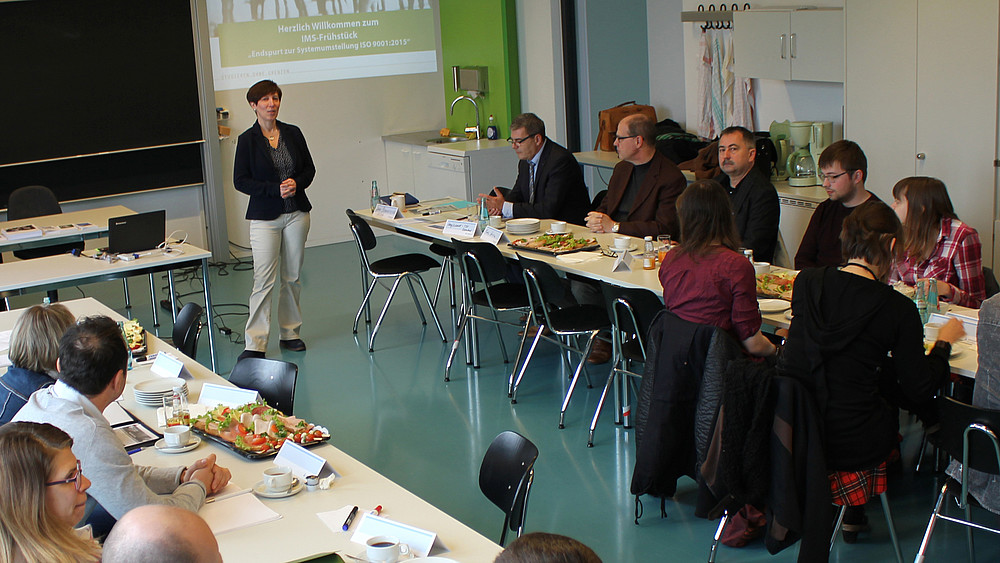
The clock is ticking—companies have 1.5 years left to adapt their quality management systems to meet the requirements of the revised ISO 9001:2015 standard. We’re halfway through the transition period, which began in September 2015 and lasts a total of 3 years.
After we provided information about the upcoming revision at the 2nd IMS Breakfast in June 2015, the topic was revisited at the 6th IMS Breakfast at the request of the companies. This is because both auditors and companies now have initial experience with implementing the new standard requirements. These requirements are quite demanding; companies must address issues such as environmental and stakeholder analysis, risk and opportunity assessment, and the management of quality-related knowledge.
Martin Sturm, acting professor of manufacturing technology, manufacturing metrology, and quality management, provided highly informed expert input on possible—and, above all, pragmatic—tools. Sabine Nolting, Quality Management Representative at the Fraunhofer Institute for Organic Electronics, Electron Beam, and Plasma Technology FEP in Dresden, provided a very clear and vivid insight into how the system transition was actually implemented in practice. The FEP was successfully recertified according to the new standard as early as November 2015 and was likely one of the very first organizations in Germany to do so.
The subsequent discussion with regional business representatives revealed that the need for knowledge and action remains high in many companies. On the one hand, the standard’s requirements are quite general, and the range of available methods is almost too diverse. On the other hand, many Quality management officers are initially left to their own devices when it comes to the system transition. It is therefore important to share experiences regarding best practices—how other companies have organized the transition process, involved their employees, and implemented the standard’s requirements.
In the spirit of a continuous improvement process, the companies agreed that meeting the demanding standard requirements is a long-term process that does not end with successful recertification, but for which the roadmap must be clear.
The IMS Breakfast is a series of colloquia that has been jointly organized since 2015 by TÜV Rheinland Akademie GmbH, Dresden, and the Chair of Integrated Management Systems to facilitate exchange among companies, students, and faculty.
Starting in August 2017, the colloquium series will be supplemented by an IMS training series launched by TÜV Rheinland Academy GmbH Dresden and the Chair of integrated management systems in collaboration with the ZWT.

First floor