
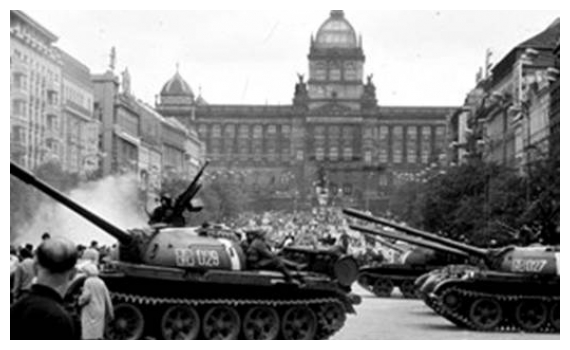
When, 50 years ago, on the night of August 21, 1968, two thousand tanks and half a million soldiers from the Soviet Union, Poland, Bulgaria, and Hungary marched into what was then Czechoslovakia, brutally crushing the Prague Spring, an Austrian photojournalist was immediately drawn into the events. His name: Franz Goës.
The young photojournalist was actually supposed to be reporting for a French newspaper on the reform efforts underway in the ČSSR since January 1968 under Alexander Dubček.
On October 31, 1967, Antonín Novotný, then head of state and party leader of the ČSSR, ordered a violent crackdown on student protests, thereby causing internal tensions within the Czechoslovak Communist Party (KPČ). Consequently, on January 4, 1968, Novotný was removed from office at the so-called January meeting of the Central Committee of the KPČ. He was succeeded by Alexander Dubček, who until then had been First Secretary of the Communist Party of Slovakia (KSS) and was now the reform-oriented leader of the ruling party.
In his reform efforts, Dubček advocated for “socialism with a human face” and sought cultural pluralism, in which fundamental rights—such as freedom of expression, freedom of the press, freedom of assembly, and the legalization of other parties—would be guaranteed. To this end, he lifted press censorship as early as February 1968. Further reform efforts were intended to grant enterprises greater freedoms and mark a departure from the centrally planned economy. The critical examination of the Communist Party’s past culminated in the “Manifesto of 2,000 Words,” published on June 27, 1968, in which intellectuals and artists rejected the Communist Party’s claim to power and spoke out in favor of continuing the reform policies.
The Soviet Union viewed all these events, which had been unfolding since January 1968, with extreme suspicion. It feared that the spirit of reform would spread to the other Eastern Bloc countries and ultimately threaten socialism. As early as March 21, 1968, initial talks were held between government representatives from Czechoslovakia and the Soviet Union, Hungary, Bulgaria, Poland, and the GDR. Further meetings, this time without Czechoslovakia’s participation, followed in May and June 1968. The states known as the “Warsaw Five” intensified pressure on the Czechoslovak leadership and, in the “Warsaw Letter” dated July 15, 1968—which later came to be known as the Brezhnev Doctrine—demanded an immediate and clear reversal of the reform process, threatening that they would no longer tolerate it. This set the stage for a military intervention.
When tanks rolled toward Prague and Bratislava on the morning of August 21, 1968, the Prague Spring stood no chance. Czechoslovak citizens still tried to defend their newly won freedom. But their resistance was brutally crushed by the invading forces of the Warsaw Pact. A few days later, Alexander Dubcek was forced to sign the “Moscow Protocol,” which repealed nearly all of the Prague Spring’s reforms and formalized the stationing of Soviet troops in Czechoslovakia.
The suppression of the Prague Spring cost about 150 people their lives.
The photo exhibition is provided by the Austrian Federal Ministry for Europe, Integration, and Foreign Affairs and the Rakouské kulturní fórum Prague and will be on display from November 9, 2018, through January 13, 2019, at the Zittau/Görlitz University of Applied Sciences, Görlitz Campus, Hermann-Heitkamp-Haus (GI) on the 3rd floor.
Contact:
Jürgen Möldner, Dipl.-Ing.(FH)
Faculty of Social Sciences
Multimedia Center (MMZ)
Tel.: 03581 374-4273
Email: j.moeldner@hszg.de