
Beer combines tradition and sustainability
The university beer brewed by biotechnologists tasted great at this year's Environment Day.
A Historical and Current Look at Beer
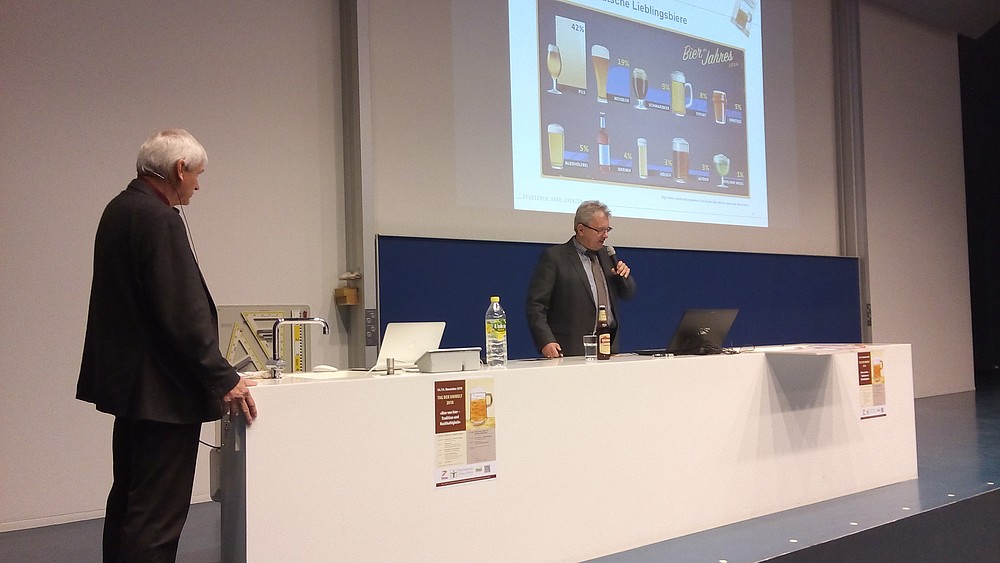
The large lecture hall filled up slowly at first, and then, at exactly 8 a.m., suddenly filled with no fewer than about 200 students from our university. That’s not exactly a given for many lectures at that time of day. But then again, this wasn’t just any lecture—it was the one held on November 14, 2018, for this year’s Environment Day, titled “Local Beer—Tradition and Sustainability.” And the topic did indeed draw many interested students out of bed—enough to even pay attention to two professors. Prof. Ender and Prof. Delakowitz then vividly and eloquently illustrated both historical and current aspects of beer. They explained the beer-making process, discussed ecological and sustainable aspects of beer production and distribution, and even touched on current trends regarding which beer varieties and beer-based mixed drinks are currently the most popular.
Germans’ favorite beer is unquestionably Pils or Pilsener, followed by wheat beer and dark beer. Every year, about 8 billion liters of beer are consumed in Germany, produced in approximately 5,000 different varieties by over 1,350 breweries. Beer lovers could therefore, in theory, drink or taste a different type of beer every day for 13.5 years! In a European comparison of annual per-capita beer consumption, however, Germany ranks second with about 101 liters, behind the Czech Republic, which consumes approximately 143 liters per person annually. Incidentally, the first Pils or Pilsner was brewed in the Czech Republic in 1842 and, as is typical, named after its city, Pilsen. However, recent archaeological excavations from 2017 prove that this was by no means the beginning of beer; during these excavations, researchers discovered an approximately 13,000-year-old alcohol production site near the Israeli city of Haifa. However, in this case—the earliest evidence of alcohol production to date—we must first consider the fermentation of grain and, thus, the basis of beer brewing. Beer production can thus be traced back to fermented grain used in breadmaking—and this likely happened by accident, because the bread dough was left out in the sun for too long.
Panel Discussion with Regional Breweries
At 2:30 p.m., the lecture hall filled up again, and the eagerly awaited representatives of the regional breweries took their places on the panel alongside the students, university staff, and citizens of Zittau who were already present. Following the opening of Environment Day by the university’s Vice President for Education and International Affairs, Prof. Dr. Christa Heidger, and by Zittau’s Mayor, Mr. Thomas Zenker, the professionally moderated discussion began with audience participation. There was consensus that the sustainability of beer and the brewing process is always linked to the traditions and regional roots of the breweries.
From an economic and social sustainability perspective, breweries are drivers of value creation, employers, training providers, and promoters of culture in our region. Traditional knowledge, brewing culture, and the art of brewing are passed down and preserved across generations.
Sustainability also plays a role for breweries in the Görlitz district when they are able to source their beer ingredients from Saxony—and thus from a relatively regional area. The fact that this, unfortunately, is not always possible is due to the hop and malt varieties required for specific beer types, which must then be purchased from elsewhere in Germany. Other sustainability efforts go hand in hand with the main distribution of beer to the new federal states and, when shipments do go to the Far East, with exports in cans. Depending on a brewery’s strategic focus, this can help reduce fuel consumption, energy use, and the environmental impact of transportation. In this country, it can generally be said that it is sustainable and environmentally friendly when beer is delivered to consumers in returnable bottles and kegs and the containers are returned to the breweries. This saves raw materials and energy that would otherwise be used to produce new containers and avoids waste, along with the costs associated with recycling and disposal.
A Beer to Wrap Things Up
To wrap up the day, everyone in attendance was able to quench the thirst for a beer—stirred up by the presentation and discussion—with small tastings that the brewery representatives had kindly brought along. The university beer—brewed specifically for this “Day of the Environment” by biotechnology faculty and students—was also sampled. After all, beer production is based on chemical and biological principles that had previously been demonstrated and taught in a very hands-on manner during a brewing seminar. And beer enjoyed in moderation and only on special occasions—like the university beer—has, after all, a convivial and social aspect to it and is said not to be unhealthy.
Zittau’s Underground World and Brewery Tour
There was even more to learn about beer, its history, and its production on the following evening, November 15, during a guided tour of the former Zittau beer cellars and the Görlitz Landskron Brewery. After all, both university towns look back on a long history of beer and have preserved their beer culture and tradition to this day. With that in mind, all that remains is to raise a glass in a toast and look forward to seeing everyone again at the next Environment Day.

2nd upper floor