
08. December 2016
10th TRAWOS November Conference
The Institute's conference focused on prospects for rural areas, outlined using the case of Upper Lusatia.
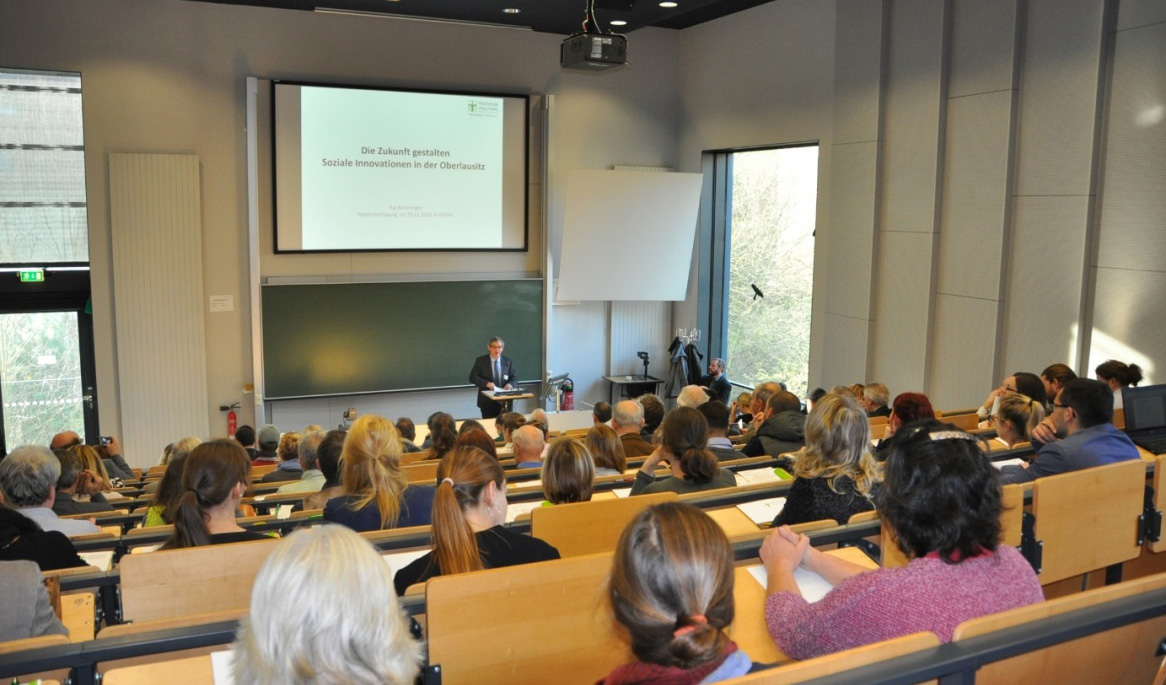
For the November 10 conference organized by the TRAWOS Institute for Transformation, Housing, and Social Spatial Development —founded in 2004—in cooperation with the Görlitz district and funded by the Saxon Demography Guidelines, more than 120 participants from the region, Saxony, and beyond gathered on November 25, 2016, at the University of Applied Sciences in Görlitz.
Together with speakers from Vienna, Berlin, Potsdam, Weißwasser, Erlau in Saxony, and the Upper Lusatia region, development prospects for rural regions in light of demographic, social, and economic transformation processes were discussed.
This discussion was based on findings—revealing quite ambivalent characteristics of rural areas in Upper Lusatia, their stakeholders, and their social practices—from two research projects led by the institute’s director, Prof. Dr. Raj Kollmorgen. While the project team of the SMWK-funded project used case studies to examine the conditions for the emergence of and regional governance relationships involving sociallyinnovative projects and initiatives in the region, the research team funded under the Demography Directive specifically examined the reasons for staying and the chances of remaining in the Görlitz district among young, qualified women. The morning’s presentations of findings were complemented by an “outside perspective” from the initiator of the research focus on transformation processes in the economy and society at the Zittau/Görlitz University of Applied Sciences and current president of the Potsdam University of Applied Sciences, Prof. Dr. Eckehard Binas.
In line with the goal of closely integrating academia and practice, the participants discussed issues with the guest speakers—who provided thought-provoking insights—in the tried-and-true format of four parallel workshop discussions following the lunch break, focusing on (1) conditions for innovation in rural regions and gender-specific approaches to addressing demographic change; (2) necessary infrastructure to attract newcomers and retain residents; (3) the innovation potential of an aging society in rural areas; and (4) specific modes of communication and network-building in rural areas.
The reports on the findings from the research projects, as well as a summary of the November conference, are expected to be published on the institute’s website in mid-January.
Ihre Ansprechpartnerin
Diplom in Business Administration (FH)
Katrin Treffkorn
Institute for Transformation, Housing and Social Spatial Development
02826 Görlitz
Parkstrasse 2
Building G VII,
Room 315
2nd upper floor
2nd upper floor
+49 3581 3744349
Your Contact Person