
News
Working Together for Science and Talent in the Neisse Euroregion.
ACC Coordination Meeting at HSZG: Together with its partner universities in Poland, the Czech Republic, and Germany, HSZG is shaping the Neisse Euroregion as a cross-border hub for science and innovation.
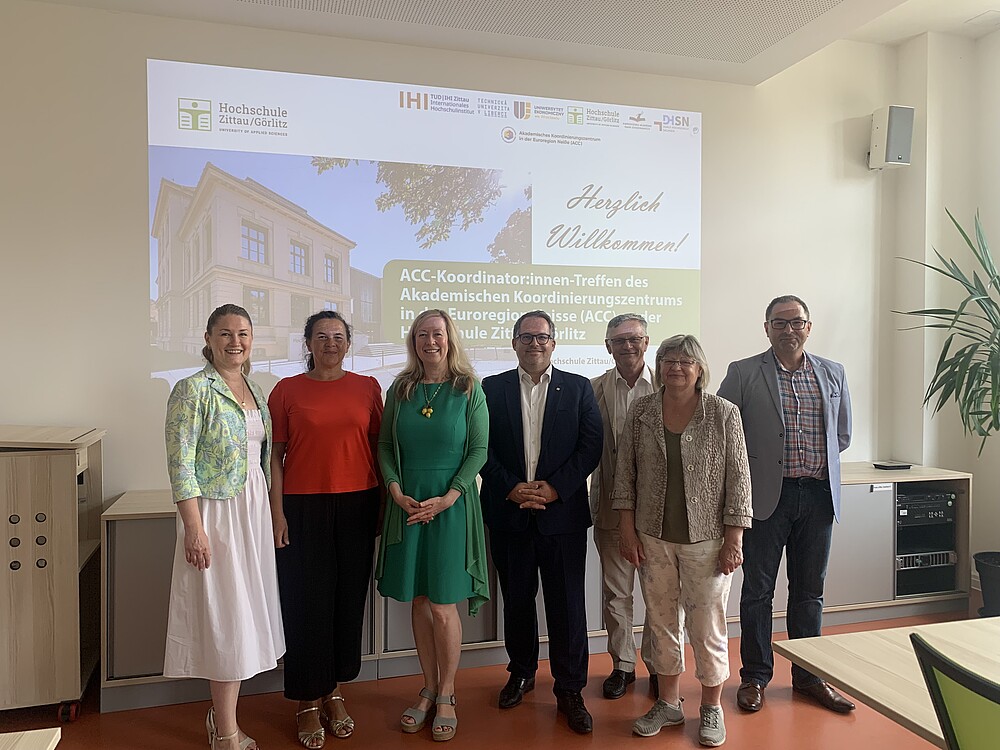
At the coordination meeting of the Academic Coordination Center in the Neisse Euroregion (ACC) on June 23, 2026, Zittau/Görlitz University of Applied Sciences underscored its commitment to shaping a joint region of science and innovation in the tri-border area. Together with partner universities from Germany, Poland, and the Czech Republic, the Zittau/Görlitz University of Applied Sciences is working to deepen cross-border cooperation, foster talent, and sustainably strengthen the innovative capacity of the Neisse Euroregion.
The ACC coordinators gathered at the Zittau/Görlitz University of Applied Sciences for this purpose. Representatives included the Technical University of Liberec, the Wrocław University of Economics, Jelenia Góra Branch (Uniwersytet Ekonomiczny we Wrocławiu), the Zittau International University Institute of the Technical University of Dresden (IHI Zittau/TUD), the Karkonosze University of Applied Sciences (Karkonoska Akademia Nauk Stosowanych), and the Zittau/Görlitz University of Applied Sciences. The focus was on current developments in cross-border university cooperation, new perspectives for talent acquisition, International Affairs, and regional innovation, as well as the further development of the ACC Journal.
For many years, the Neisse Euroregion has been a vibrant space for academic, cultural, and personal exchange. The ACC provides an important platform for this purpose, connecting universities and research institutions from Liberec, Jelenia Góra, Bautzen, and Zittau/Görlitz, highlighting common themes, and supporting early-career researchers across national borders.
Here in the tri-border region, in particular, we see just how valuable stable partnerships between universities are. Academic collaboration across borders builds trust, strengthens the region, and opens up new opportunities for young people.
”A good example of successful cross-border scientific collaboration was the ACC’s Young Scientists Conference 2026, held in April 2026. The conference was a great success and saw the highest turnout of young scientists in years. Six early-career researchers from the Zittau/Görlitz University of Applied Sciences also presented their research projects. Maria Zimmermann, a graduate of the HSZG’s master’s program in management of social change, took second place among 24 participants.
The major challenges of our time can only be solved by working together. That is why it is so important for students, early-career scholars, and researchers to learn early on how to collaborate across national and disciplinary boundaries. The ACC brings together people, ideas, and expertise—thereby sustainably strengthening the innovative capacity of our entire Euroregion.
”During the meeting, the HSZG also presented its current activities in the areas of talent recruitment, International Affairs, and semiconductor strategy. The focus was on the so-called “Talent Journey,” ranging from early STEM promotion as part of the “Zukunftslernort Oberlausitz” project, through international study preparation, to specialized degree programs for students, including those related to the semiconductor industry. The HSZG’s activities in the semiconductor sector generated great interest among the participants and impressively demonstrated how the Zittau/Görlitz University of Applied Sciences can serve as a bridge between securing a skilled workforce, enhancing the region’s attractiveness, and fostering economic networking in the tri-border region.
Our region thrives on our collective approach to educational pathways—from school through college to research, knowledge transfer, and career entry. The ACC is a valuable network in this regard because it connects people, topics, and institutions from Poland, the Czech Republic, and Germany.
”Following the coordination meeting, the guests were given a tour of newly established extracurricular learning spaces on the Zittau campus. During a campus tour, they visited, among other things, the Green Classroom, the Makerspace, the wind/PV tree, and the HSZG’s DLR_School_Lab. These learning spaces exemplify how the university combines education, sustainability, STEM promotion, and regional networking.
The meeting made it clear that cooperation in the border triangle is more than just institutional exchange. It is an important contribution to strengthening a shared region of education, science, and innovation in the Neisse Euroregion.
Since 1991, the Academic Coordination Center in the Neisse Euroregion (ACC) has been supporting cross-border higher education, science, and research in the spirit of European cooperation. It connects partner universities in Germany, Poland, and the Czech Republic, promotes joint research and educational activities, and facilitates exchanges with other institutions both within and outside the Euroregion.
Through the ACC JOURNAL, international student symposia, specialized seminars, workshops, and competitions, the ACC creates platforms for academic exchange, intercultural exchange, multilingualism, and the mobility of students and faculty. The goal is to foster young talent, strengthen creative research approaches, and further develop the Neisse Euroregion as a shared space for science and education.

1st floor

First floor