
Lecture: Polyhedra in everyday life and science
Lecture as finissage to the exhibition "Art of Technical Drawing"
| Begin |
15. January 2025 -
15:00 |
| End | 15. January 2025 - 23:55 |
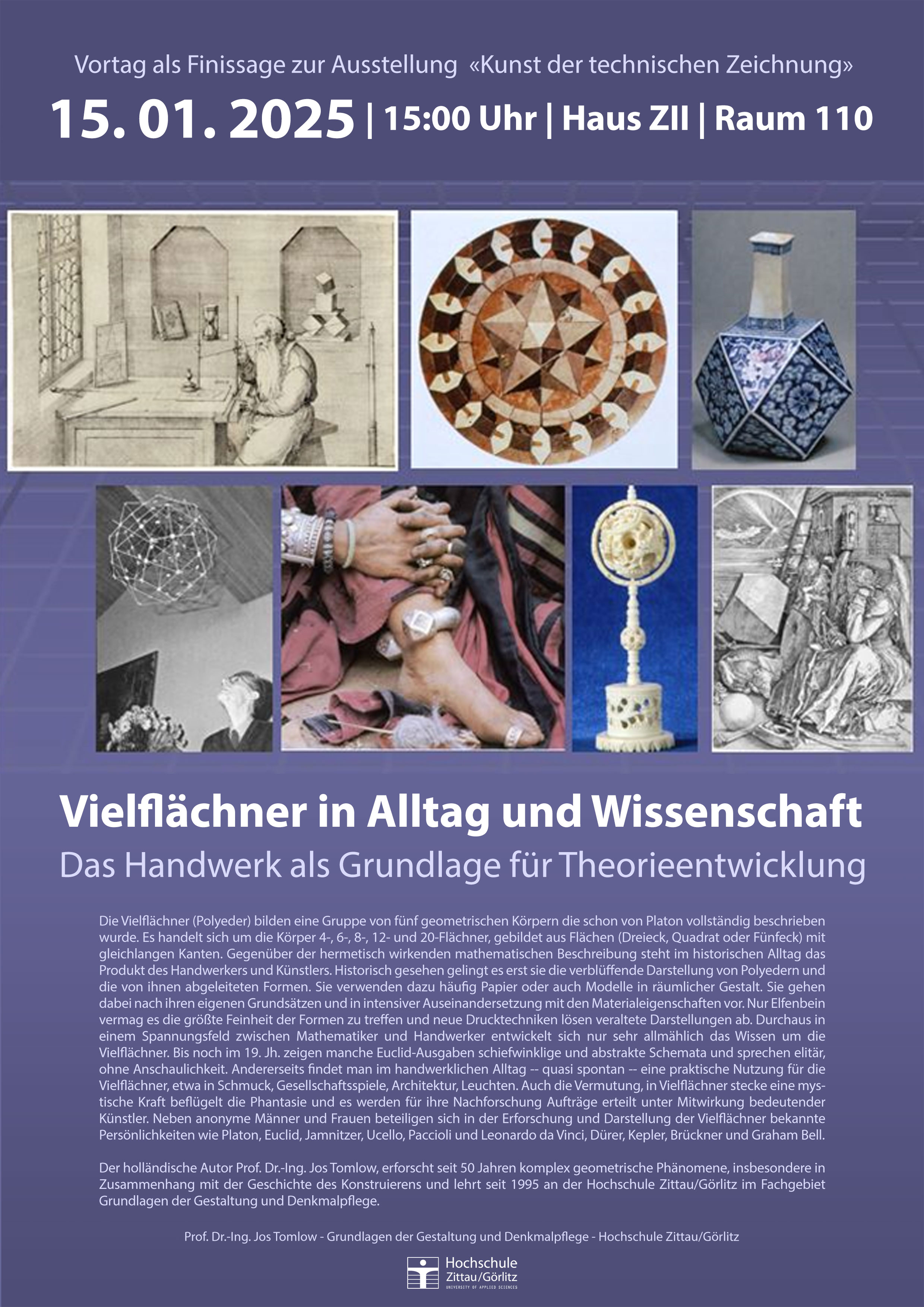
Polyhedra form a group of five geometric solids that were already fully described by Plato. These are the 4-, 6-, 8-, 12-, and 20-faced polyhedra, formed from faces (triangles, squares, or pentagons) with edges of equal length. In contrast to the seemingly impenetrable mathematical description, the products of craftsmen and artists are part of everyday historical life. Historically speaking, it is only through them that the astonishing representations of polyhedra and the forms derived from them come to life. To do so, they frequently used paper or three-dimensional models. In doing so, they followed their own principles and engaged intensively with the properties of the materials. Only ivory was capable of capturing the greatest subtlety of the forms, and new printing techniques replaced outdated representations. Straddling the divide between mathematicians and artisans, knowledge of polyhedra developed only very gradually. Even as late as the 19th century, some editions of Euclid featured skewed and abstract diagrams and employed elitist language lacking in clarity. On the other hand, in everyday craftsmanship—almost spontaneously—practical uses for polyhedra are found, for example in jewelry, board games, architecture, and lighting. The belief that polyhedra possess a mystical power also sparked the imagination, and commissions were awarded for their study with the participation of prominent artists. Alongside anonymous men and women, well-known figures such as Plato, Euclid, Jamnitzer, Ucello, Paccioli, Leonardo da Vinci, Dürer, Kepler, Brückner, and Graham Bell have contributed to the study and depiction of polyhedra.
The Dutch author Prof. Dr.-Ing. Jos Tomlow has been researching complex geometric phenomena for 50 years, particularly in connection with the history of construction, and has been teaching since 1995 at the University of Applied Sciences Zittau/Görlitz in the department of Fundamentals of Design and Historic Preservation.
First floor