

This program is a university degree program administered by the University of Leipzig; it can lead to a career as a civil servant and offers long-term job security. Start your career as a teacher and become part of an inclusive, diverse educational landscape.
At the start of the program, you’ll automatically begin the teacher training program for secondary schools. In Saxony, secondary schools cover grades 5 through 10. Shortly after starting the program, you’ll have the opportunity to expand your studies in a targeted manner: By adding a second subject—the “LEARNING” special needs education track—in the “2-in-1 degree programme,” you ’ll also earn the qualification to teach at special education schools. Special education schools are inclusive schools attended by children with special needs education requirements. If you choose this path, starting in the third semester, you’ll take specific classes / courses in inclusion and special education.
This expanded program opens up a wealth of opportunities for you to provide individualized support to students!

A collaboration between Zittau/Görlitz University of Applied Sciences and the University of Leipzig
About the degree programme
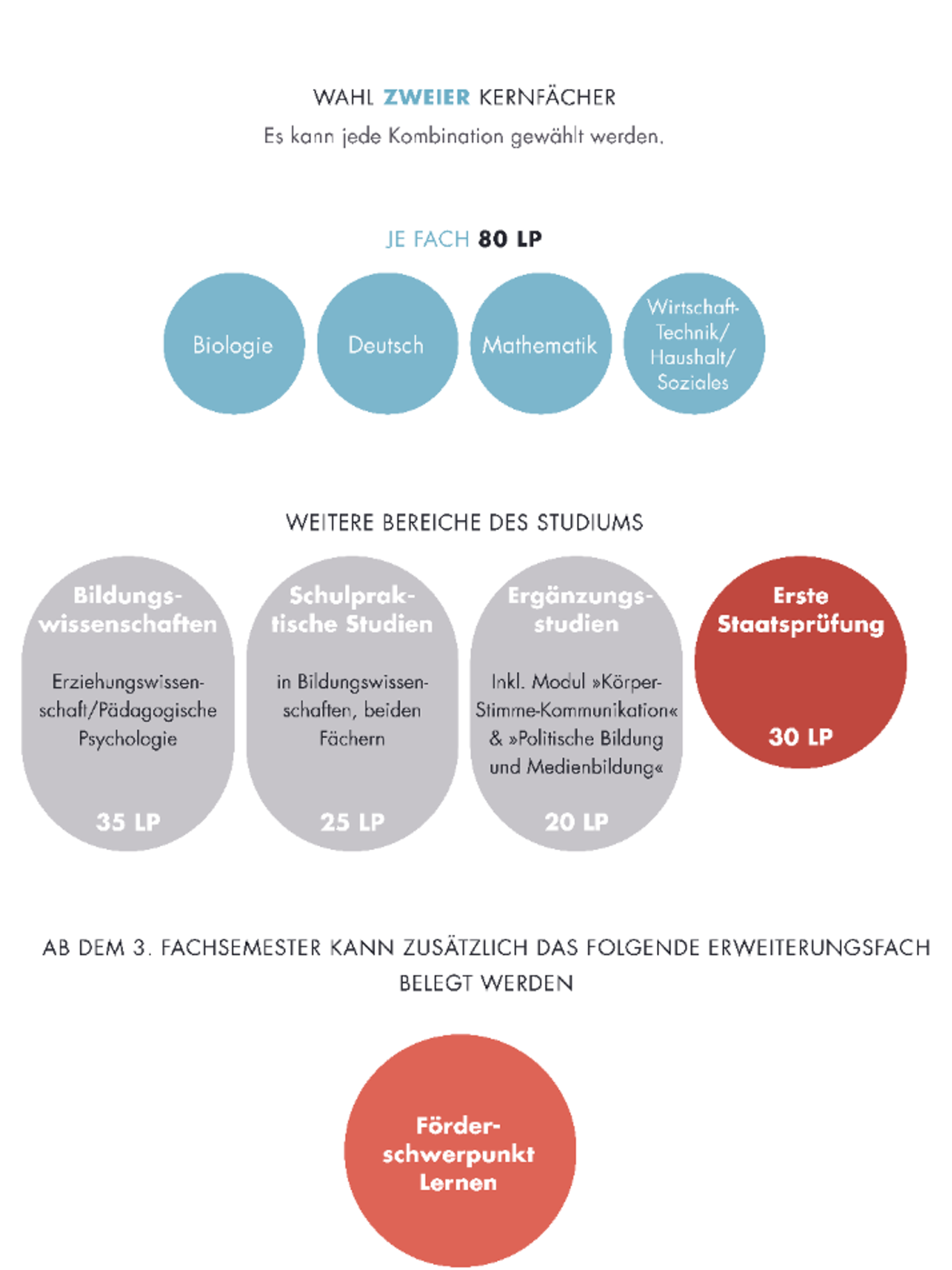
In the teacher education program, you’ll combine subject-specific and subject-didactic content in two chosen subjects—mathematics, German, biology, or WTH/S (economics, technology, home economics, and social studies)—with components in educational science, special education, and practical school experience. Of particular note are the components of the highly sought-after “LERNEN” special education track, which will help you provide individualized support to children and adolescents with special learning needs.
Don’t hesitate to choose science subjects like math or biology in addition to German and WTH/S! The program also focuses on teaching methodology and on how to make these subjects understandable and accessible to all students in an inclusive classroom setting.
You’ll gain practical experience in schools through extensive fieldwork, which offers valuable insights into everyday professional life and optimally prepares you for your teaching career. (Further information: Becoming a Teacher in Saxony)
You’ll complete your degree with the First State Examination, which will ensure you’re fully prepared for the preparatory service (formerly known as the teaching internship) and your subsequent teaching career.
Study details
The most important facts at a glance:
| faculty | Social Sciences |
| Location | Görlitz and Zittau |
| Degree | First State Examination |
| standard period of study | 9 semesters (secondary school teaching only) or 10 semesters (2-in-1 program: 2 subjects plus a specialization in special education) |
| ECTS credits | 270 (if the “LEARNING” special focus is selected: an additional 50 credits) |
| Language of Instruction | German |
| Enrolment for the | Winter semester |
| Admission restrictions | No admission restrictions (no NC) |
| admission requirement | General higher education entrance qualification (Abitur) or a vocational qualification that allows you to submit an application for a degree program at a university; phoniatric evaluation (= medical assessment of the voice, language, and speech) |
| Mandatory pre-program internship | for enrollment in the WTH/S (Economics, Technology, Home Economics/Social Studies) track: a relevant industrial placement of at least two weeks; For enrollment in the special needs education track with a focus on LEARNING: a four-week social internship at a children’s, youth, or social services facility |
Course content
Career opportunities
Professional areas where you can get started
High school teacher
After completing your teacher training program in Saxony, you’ll move on to the preparatory service (formerly known as the teaching internship). Here, you’ll deepen your knowledge through practical school experience—as the next step on your path to becoming a teacher. And after that? You’ll begin your career as a teacher at a high school, where you’ll guide children and teenagers through a crucial stage of their development. You’ll impart knowledge, nurture individual strengths, and support social learning processes. Your day-to-day work is diverse: From engaging lessons to organizing group projects, the job offers many opportunities to work creatively and responsibly. If you enjoy working with young people and are interested in educational challenges, you’ll find a fulfilling and secure career here.
Teacher at a special education school
Working as a teacher at a special education school opens up a diverse and responsible field of work that goes beyond traditional teaching. The focus here is not only on imparting subject-specific knowledge, but above all on providing individualized support and guidance to young people with different learning and life circumstances. With pedagogical sensitivity, creative solutions, and interdisciplinary collaboration, you’ll design educational pathways that extend far beyond standardized curricula.
You will find even more opportunities with us in other related degree programs.
Here's what our students have to say about the Secondary School Teacher Training program with special needs education
- All Important Academic Documents
- Information from the University of Leipzig on the joint degree program
- Website of the Faculty of Social Sciences (the faculty responsible for the degree programme)
Newsletter registration
FAQ
General Information About Studying and the Application Process
What is the difference between the two versions of the teacher training program?
In the teacher training program’s “Secondary School Teaching” track, you will study two subjects over the course of 9 semesters, along with educational sciences—including components on inclusive teaching—and complete at least five school internships. In the “Teacher Training at Upper Secondary Schools with Special Needs Education” track, a third subject is added starting in the third semester: the special needs education focus on learning, which includes an additional internship; as a result, your program is extended by one semester to a total of 10 semesters to earn this additional, highly sought-after qualification.
Course content and choice of subjects
Which subjects can I choose?
Choose from:
- Mathematics
- Biology
- German
- WTH/S (Economics, Technology, Home Economics/Social Studies)
You choose two of these—any combination is possible. Starting in the 3rd semester, you can take the supplementary subject “Special Education: Learning.”
Admission requirements and internships
Can I study with a vocational baccalaureate?
The teacher education program is a university degree program. You need a general higher education entrance qualification or a subject-linked university entrance qualification.
Admission with a vocational high school diploma is possible only in justified exceptional cases. Such cases are reviewed on a case-by-case basis.
Where can I have the phoniatric assessment/voice test done and how much does it cost?
You can find all information about the phoniatric assessment here:
https://www.zls.uni-leipzig.de/studium-beratung/ergaenzungsstudien/koerper-stimme-kommunikation-ksk/sprecherziehung/phoniatrisches-gutachten
(phoniatric assessment = medical assessment of voice, speech and language)
Do I need an internship for the special needs education elective?
Yes. For the “Special Education: Learning” track, you’ll need to complete a four-week social internship (e.g., at a children’s, youth, or social services facility).
The supplementary track doesn’t start until the 3rd semester, so you have time until then to gain those 4 weeks of practical experience.
Does the four-week internship have to be completed in one continuous period to meet the admission requirements for the “Learning” funding priority?
No. It can be divided into two parts and can be completed at different locations and in different institutions.
What internship do I need to complete as an admission requirement for WTH/S? Can a FSJ (Voluntary Social Year) also receive recognition for this requirement?
Unfortunately, a Voluntary Social Year (FSJ) does not receive recognition as an internship.
To enroll in the WTH/S course, you must provide proof of a two-week internship in a WTH/S-related field. This internship must have been completed after you obtained your university entrance qualification. Possible fields include, for example: woodworking and metalworking, construction, technology/electronics, horticulture and agriculture, the food service industry, or another skilled-trade or technical field related to WTH/S.
In addition, you must provide proof of a further mandatory internship lasting at least two months in a WTH/S-associated field in order to register for the First State Examination (which takes place in the 9th or 10th semester).
How long ago can an internship have taken place if it is an admission requirement?
Maximum 2 years before the start of studies.
How do I submit an application?
Your contact persons

1st floor

First floor
Starting now, we're also offering our Student Advisory Service via WhatsApp. Just send us a message at: +49 173 2086748
You might also be interested in the following degree programmes:
- Bachelor’s in Special Needs Education/Inclusion Studies
- Bachelor’s in Childhood Education
- Bachelor’s in Social Work
Still not sure? If you have any questions, please contact our Student Advisory Service. We’re here to help you choose the right program.
Our promise to you
Studying in the wild east?
Studying with us is different. Above all, it's better. Why? We have a family atmosphere. There are small study groups and the lecturers are always there for you. There is a close connection to practice in all degree courses. And finding affordable accommodation is no problem here.
There are many other reasons, such as university sports or the student representatives, clubs and societies. Campus life in Zittau and Görlitz, the wild east, is unique.