
14. August 2018
From firework festivals and fairytale castles
In mid-June, students of "Business and Languages" went on an excursion to Brno in the Czech Republic.
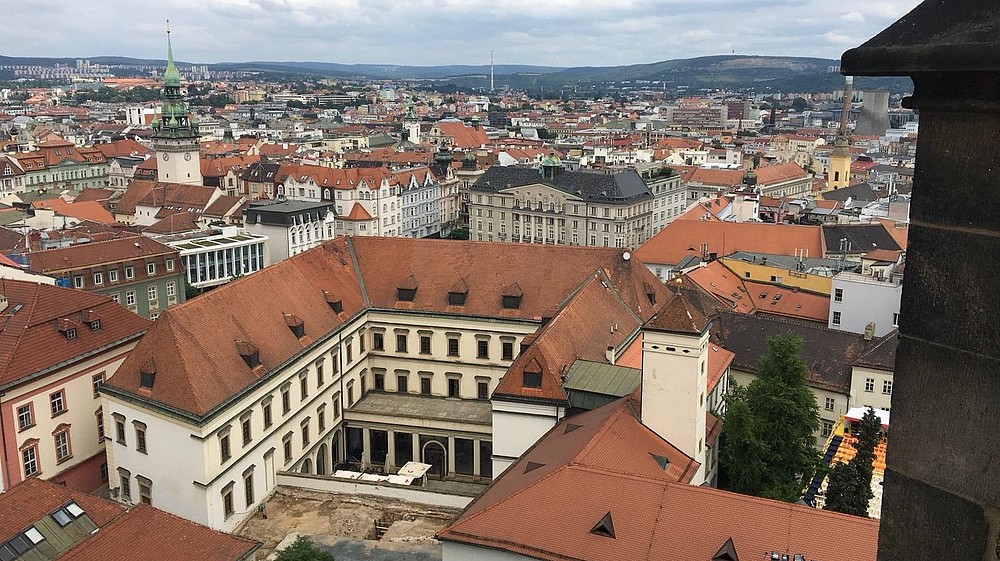
What’s the good way to learn a new language? Clearly, by talking to native speakers—and, ideally, in the target country itself. For students specializing in Czech in the “Economics and Languages” degree programme, this opportunity is available as part of an approximately one-week field trip, which traditionally takes them to either the Czech capital, Prague, or the Moravian city of Brno (German: Brünn). A group of eight people traveled to Brno from June 13 to 17. With a population of just over 400,000, the second-largest city in the Czech Republic boasts a rich cultural scene, a vibrant student life, and beautiful surrounding countryside, so the class’s decision to choose Brno was made quickly.
During their stay in the university city, the group’s cultural experience was enriched by the RE:PUBLIKA Festival, which—marking the 100th anniversary of the founding of Czechoslovakia—offered a month-long series of concerts, exhibitions, and events. So, on the very evening of our arrival, we were able to marvel at the French participants’ entry in the international fireworks competition, which took place at the nearby reservoir.
Over the following days, we naturally explored the city and its way of life in detail. With a focus on the myths and legends surrounding certain buildings, our stops included well-known landmarks such as the Old Town Hall and the Baroque Spielberg Fortress, as well as downtown squares like Krautmarkt and Freedom Square. This is how we learned a great deal about the city’s significant role in history as the capital of Moravia, as well as about its architectural and cultural heyday during the Habsburg monarchy. Most of the time, we had breakfast and lunch together and—as is customary—ordered in Czech, of course. This meant that especially those who weren’t quite as comfortable with the language had to step out of their comfort zone. However, thanks to the skills acquired through their studies and the empathy of some waiters and salespeople, even these situations were handled with confidence.
The students also had plenty of freedom to do their own thing. Some of us attended concerts in the Old Town, others visited the “Dva světy” (Eng. “Two Worlds”) exhibition by Alfons Mucha, and still others went to film screenings as part of the RE:PUBLIKA Festival.
Our group’s farthest day trip took us to Lednice, a good 50 kilometers south of Brno. Our destination was the neo-Gothic castle there, which—along with other parks and castles—has been listed as the Lednice-Valtice Cultural Landscape on the UNESCO World Heritage List since 1996. During guided tours of the first two floors, we were able to see how the princely Liechtenstein family lived and worked. The walk through the accompanying botanical garden, with its beautiful pond complex, rounded out the excursion and made it a wonderful experience. Our stay in Brno ended just as it had begun—with a long and impressive fireworks display, this time over Spielberg Castle right in the heart of the city.
The event also marked the conclusion of the RE:PUBLIKA Festival. Thus, on Sunday, we set off on our journey home literally “enlightened.” Field trips of this kind are a great practical component of a degree program focused largely on business, linguistics, and translation studies, because getting to know the country and its people provides a huge motivational boost for improving language skills. After all, it immediately provides the opportunity to put your first sentences into direct use. The entire class found the trip inspiring and a great success. Our special thanks go to Ms. Mgr. Potůčková, who took care of the impeccable organization of the trip in advance and also supported the students with advice and assistance during their stay.
Text: Max Melzer, Anne Christin Heidrich, Christine Herold
02826 Görlitz
Görlitz, Brückenstraße 1
Building G ll,
Room A0.14
Basement
Basement
+49 3581 374-4278