
Online teaching in the "Communication networks" module
Building up application-ready knowledge of communication networks online - how does that work? A summary at the end of the "Corona semester".

According to the class description, the class is designed to equip students with the skills to plan, set up, and connect small communication networks to other networks, as well as to operate them and troubleshoot and resolve any errors that arise.
Prof. Dietmar Scharf teaches these skills using the configuration of network devices from a leading global network equipment manufacturer. On the one hand, these devices are found in the vast majority of companies. On the other hand, countless documents, forum posts, and videos on the topics covered can be found online, which facilitates supplementary independent study.
Does this also work in online teaching?
The lecture was conducted online at the times scheduled in the timetabling system, supplemented by exercises that students could complete on their own terms—choosing the timing, scope, and pace—using the “Packet Tracer” simulation software. The main purpose of these exercises using the simulation software is to model the dynamic behavior of a network, including all its faults, via simulation—rather than in a laboratory course.
In addition to general online support from the instructor—such as answering questions and grading submitted solutions—several small-group tutorials were held. These online sessions were led by the lab engineer, Mr. Egmont Schreiter. The focus was on topics that were of particular concern to the students.
That’s the theory, but what do the students have to say about it? Did they ultimately acquire the desired skills?
We spoke with Emily Unverricht ( automation and mechatronics degree programme) and Dominik Samtleben ( electrical power systems degree programme) about this. Both are pursuing their degrees through the KIA (sandwich-style) degree course. With support from their companies, they have already earned their first vocational certification as electronics technicians and have just completed the “Communication Networks” module in their sixth semester.
-
How did you maintain the exchange with your fellow students? What recommendations do you have for younger students in this regard?
Emily Unverricht: Even before the COVID-19 crisis, a large part of our communication took place on social media. For example, we have a WhatsApp group with all the students in our year at the faculty, which was created during the first semester. I’d recommend that to new first-semester students as well. Virtual meetings can also be held using video conferencing software.
Dominik Samtleben: The professors emailed us the schedules for the courses, so we always had a good overview of our daily schedule. Most of our other communication with the professors also took place via email. Since the professors usually responded quickly, this wasn’t a problem. For urgent matters, you could also reach the professors by phone. If you encounter any problems, you can also contact the Faculty Student Committee for Electrical Engineering, which is always there to help students and offer advice. Communication with fellow students is also very important during this time, for example, to ensure you don’t miss assignment deadlines. For this, it’s a good idea to have a quick meetup in the student canteen or form a study group in a virtual classroom.
-
How did you give structure to your day-to-day studies and what drives you?
Emily Unverricht: The main thing that gives structure to my daily routine is the online lectures. I get up according to the lecture schedule and attend the lectures. I organize the rest of my time using a to-do list. It includes all my tasks and the times by which they need to be completed. Other than that, my day isn’t particularly structured. I tackle tasks when I have the time and inclination. However, I make sure to address everything as soon as possible so that a mountain of work doesn’t pile up. Since I’m someone who prefers to work alone, this semester has worked out well for me. I’ve been very productive in a relaxed way.
For lunch on weekdays, I go to the student canteen. Despite the limited selection, there’s almost always something I like. I prepare the other meals at home, either by myself or with my roommates.
Dominik Samtleben: There haven’t been any major changes to my daily routine, since all lectures took place as planned. Ultimately, I can say it’s been a good experience; with online lectures, it’s easier to manage some tasks than during an in-person semester. Even though it’s not always easy to be glued to the screen for several hours. However, an online lecture is particularly advantageous when working with simulation software. Plus, you can meet up with your classmates online, and in my experience, these meetings are much more productive than in-person sessions.
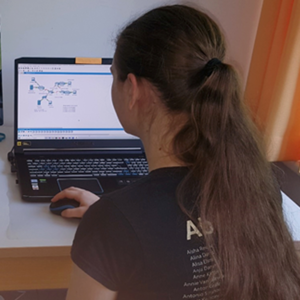
I was very productive in a relaxed way. Emily Unverricht
”-
During the in-person laboratory course, some of the assignments were completed using actual equipment. Did you also acquire the necessary knowledge through the simulation?
Emily Unverricht: I found the simulations very instructive. They allowed us to apply the theoretical material from the lecture immediately afterward in a practical setting, which helped us deepen our understanding. The simulation exercises could also be retained as optional practice for future in-person semesters. Nevertheless, I would have liked to have had a lab practicum to learn about hardware-specific features. In the laboratory course, the focus should then be on setting up the physical network rather than on programming it. Although this topic was discussed in the online seminar with Mr. Schreiter, I believe you learn better when you do things yourself.
Dominik Samtleben: Well, the lab sessions were indeed canceled, but we did have the online seminar where the components and connector types were introduced and demonstrated to us. Otherwise, there’s hardly any difference between conducting the experiments in the lab or simulating them on my computer. We always carried out the simulations as a group. To do this, we met in an available virtual classroom, and if someone ran into complications, we shared our screens and worked together to troubleshoot the errors. -
What did you particularly like about the class / course?
Emily Unverricht: I would like to take this opportunity to say that the "Communication Networks" class / course is one of the best-implemented online courses I have been able to attend this semester. I would particularly like to emphasize the opportunities for in-depth study through the control questions and the simulations with PacketTracer, as well as the opportunity to participate in Cisco NetAcad courses.
Dominik Samtleben: The simulation task with Packet Tracer and the control questions that are part of the lecture should be mentioned positively. The entire module is very good for online teaching and is also very student-friendly.

In the end, I can draw a good conclusion, some tasks can be better organized in an online lecture than in a face-to-face semester. Dominik Samtleben
”
1st floor