
A green future with bacteria
A biotechnologist between research and teaching: Prof. Dr. rer. nat. Jörg Kretzschmar in conversation.
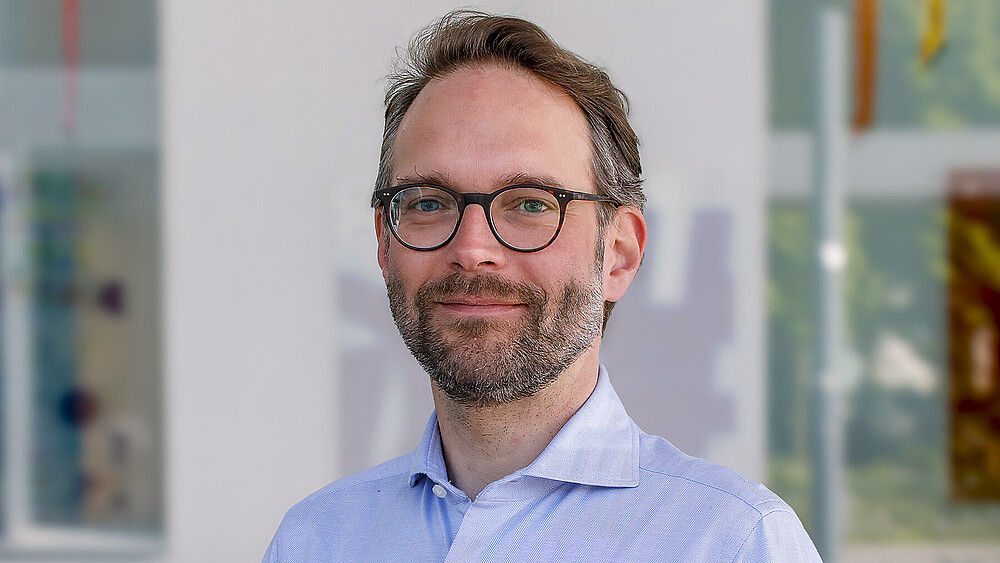
Prof. Dr. rer. nat. Jörg Kretzschmar has been working at HSZG since fall 2023 in the Department of Environmental Bioprocess Engineering within the Faculty of Natural and Environmental Sciences. In this interview, he introduces himself and talks about his passion for his field of research.
Prof. Kretzschmar, what key milestones have shaped your career so far?
I studied molecular biotechnology (B.Sc.) and environmental protection and regional planning (Diplom) at TU Dresden. After successfully completing both degree programmes, I had the opportunity to work as a research assistant in various departments at the DBFZ (German Biomass Research Center) in Leipzig for a total of 15 years. I spent most of that time in the “Biochemical Conversion” division, where I focused primarily on optimizing the biogas process from both biochemical and process engineering perspectives.
During this time, I established, among other things, a close collaboration with the Electrobiotechnology research group at the Helmholtz Center for Environmental Research in Leipzig. There, with the support of the Kurt Schwabe Institute for Measurement and Sensor Technology in Meinsberg and the Chair of Physical Chemistry, Measurement, and Sensor Technology at TU Dresden, I was also able to complete a large portion of my PhD thesis in the field of microbial electrochemistry. Specifically, I focused on the characterization of electroactive biofilms, which can be used as receptors for acetic acid biosensors in the biogas process. After completing my doctorate at TU Dresden, I was entrusted with leading a research group at the DBFZ and later became deputy division head.
What inspired you to pursue a career in science?
I made that decision during my first degree program. That’s when I quickly became fascinated by the use of microbial processes in technical applications.
What brought you to Upper Lusatia and to the Zittau/Görlitz University of Applied Sciences?
The opportunity to give back some of my knowledge to students as a professor at a university and to further my own education through teaching and applied research. And, of course, the region’s landscape and its proximity to the Czech Republic and Poland.
What are your main areas of focus at the HSZG?
I teach the fundamentals of process engineering, bioprocess engineering, and bioprocess technology in the degree programmes in Molecular Biotechnology, Pharmaceutical Biotechnology, and Ecology and Environmental Protection. I also give lectures and lead internships on environmental engineering and, in the future, environmental bioprocess engineering, among other topics, in the Green Engineering and Environmental Sciences degree programmes. In addition, I am working to carry out research projects and establish a new environmental bioprocess engineering lab.
Which research areas are particularly close to your heart, and why?
The development of environmental biotechnology processes that can contribute to a future bioeconomy is particularly important to me. The biogas process—and the subprocesses that take place within it—are an excellent example of how residual materials, waste, or renewable raw materials can be used for sustainable energy supply or the production of chemicals.
In particular, I am fascinated by microbial electrochemical technologies, as these involve, among other things, the use of bacteria that generate electricity as part of their metabolism, or the use of electrochemistry to convert residues or bacterial metabolites into high-value chemicals. Microbial electrochemistry can be used to develop a range of novel technologies and processes that are in line with the fundamental principles of green chemistry. Unfortunately, there are no concrete industrial-scale applications yet, but microbial fuel cells, electrolytic cells, and biosensors have already been demonstrated on a technical scale. I hope to make a small contribution in this area through my research in the future.
How do you structure your teaching to inspire students’ enthusiasm for your field?
I structure my teaching to be as active and descriptive as possible. It’s important to me that students can visualize what I’m trying to convey. That’s why I try to incorporate as many practical examples as possible into my teaching.
What advice would you give to students aspiring to a career in research (in your field)?
Let yourself be inspired and (sometimes) follow your gut. It’s important to be “passionate” about a subject or topic. Beyond that, of course, the more you’ve internalized the scientific fundamentals, the better. I myself have invested a great deal of time in repeatedly reviewing the fundamentals, and I still do that to some extent today.
What are your good survival tips for exam season? What tricks do you have up your sleeve to help students ace their exams?
The basics, of course, are regular attendance at lectures, seminars, and internships. Here, I think it’s especially important to get involved, ask questions, and challenge what you’re taught. Beyond that, I recommend getting enough sleep.
Which books are you absolutely determined to read this year?
Unfortunately, just textbooks… I don’t read very much in my free time (unfortunately).
Do you have any hobbies or interests that perhaps not everyone knows about?
I’m very interested in music and movies; I’m particularly drawn to the science fiction genre. In my free time, I play in a band.
What’s your favorite spot on campus or in the surrounding area?
I haven’t found it yet, unfortunately. But I really enjoy hiking in the Zittau Mountains when time allows.
The interview was conducted by the Office of University development and communication, University of Applied Sciences Human Resources Division.
First floor