
Securing the electrical grids of the future!
In this interview, Prof. Dr.-Ing. Cezary Dzienis talks about his field of appointment and how he has been approaching teaching at the HSZG since January 2022.
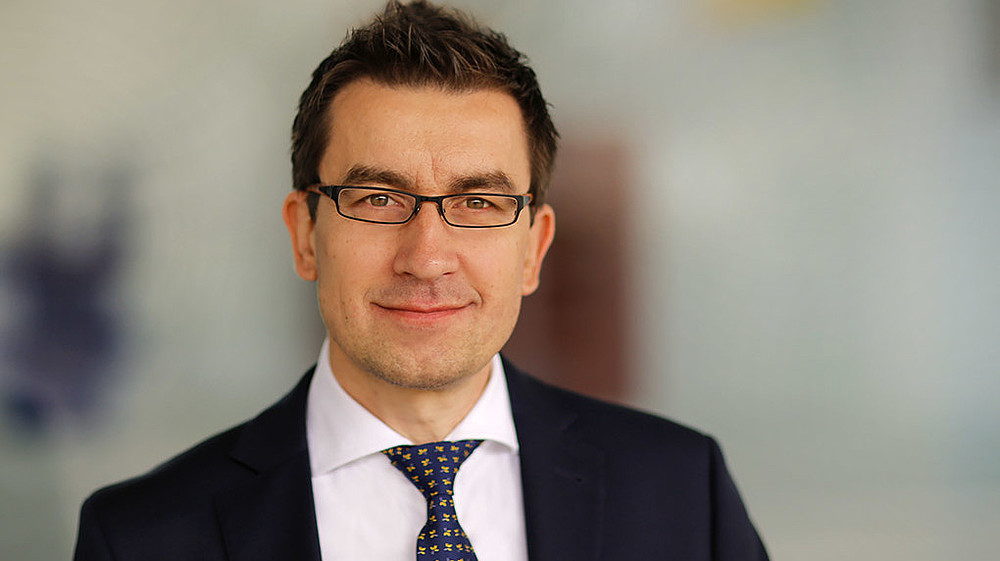
Prof. Dr.-Ing. Cezary Dzienis has been a professor of Grid Protection Technology/Smart Grid Management at the Faculty of Electrical Engineering and Computer Science at Zittau/Görlitz University of Applied Sciences since January 1, 2022. In an interview with the Public Relations Office, the Polish-born professor explains why new ideas for grid protection and grid management are needed, how he first came into contact with Zittau/Görlitz University of Applied Sciences, and what he recommends to prospective students.
Prof. Dzienis, grid protection technology and smart grid management are the focal points of your field of expertise. What makes this field so appealing to you?
The decentralization of the energy supply, along with the rightly intensified integration of renewable energy sources into the grid—which, however, still exhibit a volatile nature—is also changing the operational behavior of electrical grids. It is virtually impossible to control the generation, transmission, and distribution of electrical energy in a deterministic manner according to old rules. In order to operate electrical grids safely and reliably in the future, new ideas regarding grid protection and grid management must be developed and proven in practical application. Since, in my view, we are still a long way from this goal, one feels—at least that’s how I feel—like a pioneer in this field and sees a great opportunity to make an important contribution to society through various research activities.
How do you structure your teaching? Are there any current research areas in which you are involved?
Developing a teaching program in my field that is both appropriate and engaging for all stakeholders is challenging; for me, it means wanting—and needing—to successfully overcome certain challenges as quickly as possible. Translating theory into practical application in a way that’s easy to understand—which, in engineering disciplines, is generally achieved through lab experiments and computational exercises—proves to be somewhat more complicated in this case. The reason for this is the great complexity of the subject, which links many fields that are not necessarily related to one another. At this point, I have decided to demonstrate practice-oriented experiments in conjunction with the theory as early as the lecture level, thereby making students better prepared for the laboratory experiments. This is made possible by using a so-called “digital twin”—a PC-based simulation program that fully replicates the behavior of the hardware. We have already acquired specialized software for the field of protection and control engineering that enables the complete simulation of multiple protection devices. We are the only university in Germany that will use this specific software in teaching. In addition, we are good at preparing for a potential pandemic by ensuring that we can continue to offer laboratory experiments online. Furthermore, with the support of our industry partners, we were able to establish a state-of-the-art laboratory for protection and control engineering. Here, students can familiarize themselves with the latest technology.
With regard to research areas, I was already working on the application of traveling waves in the field of protection engineering and fault location at my former employer. I believe that this technology can be successfully applied, particularly in the power grids of the future, where conventional protection principles fail. Since protection technology is a highly sensitive field, the technology in question must be researched in great detail.
Where are you from, and why did you decide to take a professorship in Zittau?
I was born in Poland and come from the northeastern part of the country—an area also known as “the green lung of Poland.” Even while I was studying in Poland, I developed a strong ambition and determination to pursue a career in academia, with the goal of eventually becoming a professor. Thanks to the Europe-wide Socrates-Erasmus program, I was able to spend a semester at a German university and participate in various research activities there as a student assistant. The contacts I made at that time later led to my hiring as a research assistant. I documented the research results in my doctoral dissertation, which I successfully defended in 2007. In addition, I was involved in various industry-funded projects. This is how my connection to the Siemens AG Power Protection Division in Berlin began, where I gained industry experience as a developer and later as a Senior Key Expert in the field of grid protection. Many of my colleagues—from whom I have learned so much and whom I consider to be key contributors to this department—studied or earned their doctorates in Zittau. That was essentially my first connection to Zittau. Since I never gave up on my desire to do more research, the job posting from Zittau/Görlitz University of Applied Sciences for the Department of Grid Protection and Intelligent Grid Management sparked great interest in me. The university’s good reputation, the exciting research field of the position, my desire for a career change, and the location—all of these factors fit together perfectly. There was simply no other decision I could have made.
Where did you earn your degree, and what was your thesis topic?
I completed my studies at the Warsaw University of Technology. My final dissertation focused on ensuring the stability of the electrical power supply from the grid while accounting for volatile loads. By utilizing an energy storage system, I demonstrated how to meet fluctuating loads from the grid without compromising grid parameters. I was able to prove that, in this context, it is possible to utilize not only modern power supply technology but also control methods based on artificial intelligence. After completing my studies, I received an offer to pursue a Ph.D. at Otto von Guericke University Magdeburg, which I accepted. My dissertation focused on modeling nonlinearities in energy systems.
What advice would you give to young prospective students when choosing a degree program? Did anyone inspire you back then?
Each of us has a certain aptitude for performing specific professional activities with particular ease and finding professional fulfillment in the process. Even during high school, it’s important to recognize our talents and steer our development precisely in that direction. I recommend that all prospective students participate, even in their early high school years, in any events organized by universities and colleges that are dedicated to helping students identify their interests, and that they analyze these offerings in depth. When choosing a field of study, one shouldn’t necessarily rely on current degree programmes that are considered “trendy” or highly touted, but rather think long-term and consider what the job market will look like over the next 5 to 10 years—in other words, focus primarily on the forecasts. Today, I can say with certainty that we have a significant shortage of skilled workers in the broad field of electrical power systems, and this situation is not expected to improve in the coming years.
Do you have a particular philosophy when working with your students?
Since I started at Zittau/Görlitz University of Applied Sciences at the end of the 2021 winter semester, I haven’t had much direct contact with the students yet. Currently, I’m advising a few students who are writing their final dissertations. Both in my classes / courses and as part of research activities, I like to focus on collaborative work with the students. Explaining research questions together, and—especially—tackling persistent problems as a team, working together to identify and solve them. Maybe even once in a while after work, over a delicious, cold beer…—that’s when you sometimes come up with exciting, refreshing ideas…
Have you had a chance to explore the surrounding area yet? Are you more of a lake person or a mountain person?
I don’t have any clear preferences when it comes to scenery. I enjoy hiking, jogging, and biking. The Zittau area offers excellent opportunities for these activities. I’ve already had the chance to explore the Zittau Mountains a bit more closely with my family. We particularly liked the monastery on the mountain in Oybin. We’ve already planned more excursions, and we’re sure to have a lot of fun and enjoy our time together. Zittau’s unique location in the border triangle region also offers a wide variety of recreational opportunities, which we’ll definitely take advantage of in the near future.
The interview was conducted by Cornelia Rothe, M.A.
1st floor