
Augmented reality meets the semiconductor industry
HSZG research group SCO-TTi is working on a digitally enhanced maintenance workstation.
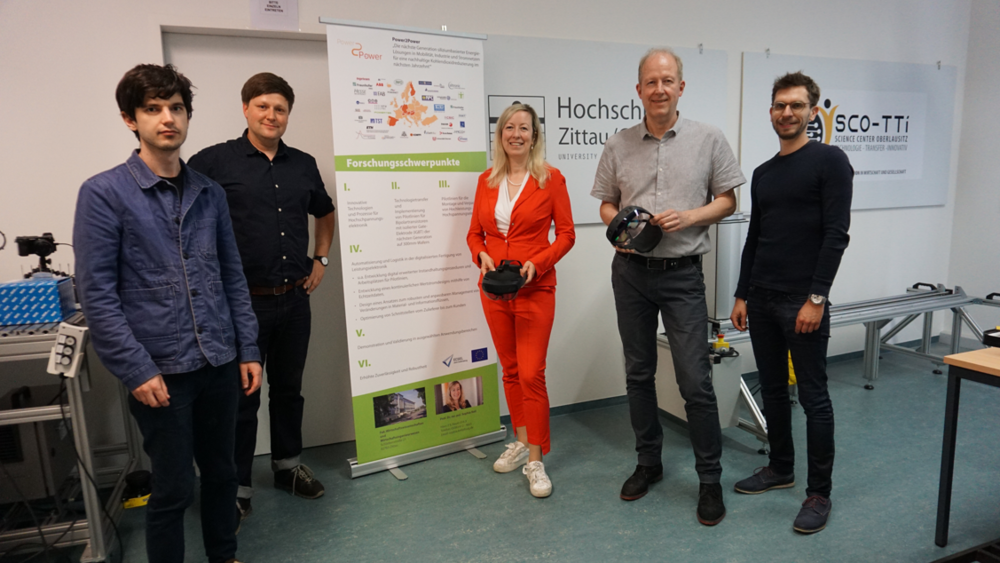
As part of the major European research project Power2Power , the research group SCO-TTi is collaborating with Infineon Technologies AG in Warstein on a digitally enhanced maintenance workstation.
To this end, HSZG first developed an implementation concept for industrial AR (augmented reality) and presented it at the IEEE ETFA 2021 conference. Based on this, an initial workshop on requirements analysis and process mapping took place at Infineon in Warstein in November 2021. A specific AR application was defined for performing maintenance on a semiconductor processing line. In collaboration with a software vendor specializing in AR, an application was then programmed using an agile approach—one that is intuitive for maintenance technicians, reduces cognitive knowledge work, and enables hands-free operation.
To test the application, the HSZG created a model maintenance workstation based on the original, which was used in the SCM Lab to initially run the specially developed test scenarios.
This laid the groundwork for holding a second workshop on the topic of “AR-supported workstations” from June 20 to 21, June 2022, a second workshop on the topic of “AR-Supported Maintenance Workstation” could be held both in person at the SCO-TTi SCM Lab at the Faculty of Business Administration and Engineering Management and virtually.
The goal of this workshop was to conduct intensive, user-specific testing and evaluation of the AR application designed and developed as part of the project using the Microsoft HoloLens 2, in order to determine the next steps for the final acceptance and approval of the entire system.
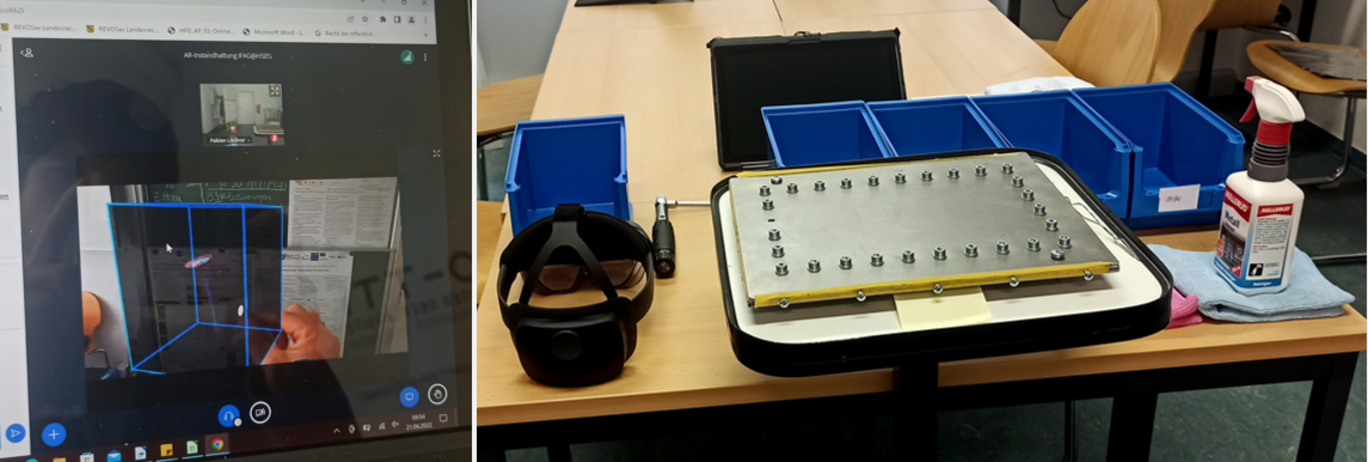
The partners from Warstein were able to test the application independently using the AR glasses and the maintenance model, as well as remotely monitor the stream in real time from the user’s perspective.
The application allows maintenance steps to be overlaid and additional information, such as illustrations, to be displayed directly on the tool. This provides cognitive support for both inexperienced and experienced employees during the complex maintenance of a machine tool used in semiconductor production. In addition, AR technology allows experts to see through the employee’s eyes and guide them.
We would also like to extend a special thank you to the staff of the university machine shop for their unstinting support in creating the tool.
For the next steps, we are looking for participants for further experiments with AR glasses and maintenance on our tool model and our machinery. If you are interested, please contact Mr. Kazimierz Przybysz and/or Mr. Fabian Lindner.




The Work underlying this publication was supported by the project Power2Power. It is funded by the ECSEL Joint Undertaking (JU) under Grant Agreement No. 826417. The JU is supported by the EU program for research and innovation Horizon 2020. The project is co-funded by the consortium partners and national grants from Austria, Germany, including the Free States of Saxony and Thuringia, Belgium, Italy, Spain, Romania, Finland, Hungary, the Netherlands, Slovakia, and Switzerland. Parts of the work have also been funded by the German Federal Ministry of Education and Research (BMBF) under the grant number 03WIR2704. The responsibility for the content of this publication lies with the authors and does not necessarily reflect the opinion of the JU or the BMBF.