
Message details
2026 Nobel Prize in Physics: Neutrinos in Ice
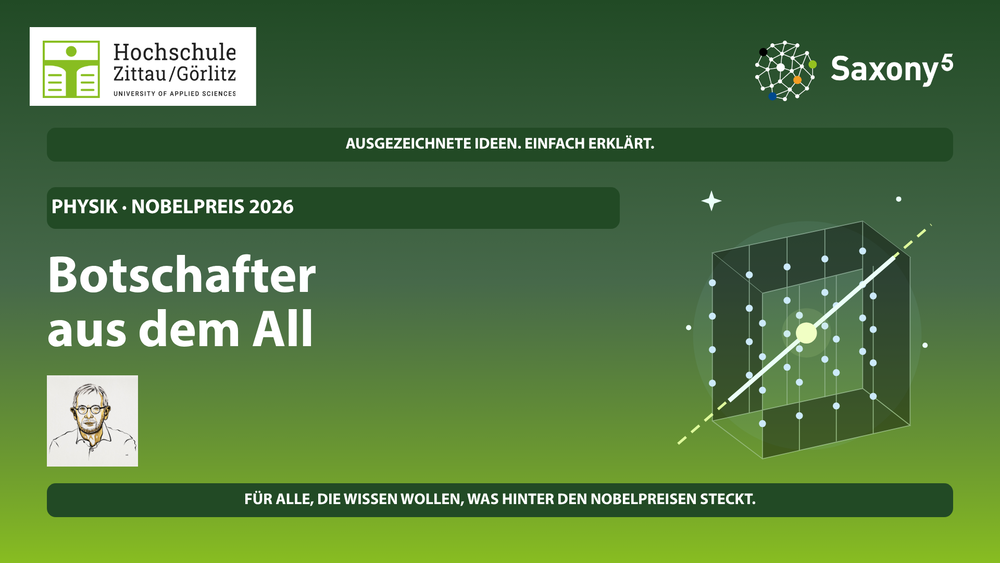
How does a cubic kilometer of ice become a telescope? Pavlo Plotko from the German Center for Astrophysics explains how the IceCube detector at the South Pole detects neutrinos from space and what they reveal about the universe. The lecture will be held in English.
| Begin |
13. January 2027 -
18:00 |
| End | 13. January 2027 - 19:15 |
| City | Building Z IV, Large Lecture Hall (Room 0.01), Theodor-Körner-Allee 8, 02763 Zittau |
Neutrinos in Ice: Observing the Universe Through Antarctic Ice
Every second, trillions of neutrinos fly through our bodies without leaving a trace. These nearly massless particles interact very little with matter. This makes them difficult to detect, but at the same time turns them into valuable messengers from regions of the universe from which no light reaches us.
For his pivotal contributions to the IceCube Neutrino Observatory and the discovery of high-energy neutrinos from space, Francis Halzen was awarded the Nobel Prize in Physics in 2026. IceCube uses one cubic kilometer of Antarctic ice at the South Pole as a detector. In 2013, the team announced the first detection of high-energy neutrinos from space. Later, it found information that some of these neutrinos originate from active galaxies with black holes at their centers.
What can you expect from the lecture?
Pavlo Plotko will demonstrate how ice becomes a telescope and what neutrinos reveal about the most extreme places in the cosmos. The lecture is part of the series “Excellent Ideas. Simply Explained.” organized by the Faculty of Natural and Environmental Sciences at the University of Applied Sciences Zittau/Görlitz. It is open to the public, will be held in English, and requires no prior knowledge.
About the Speaker
Pavlo Plotko is an astroparticle physicist at the German Center for Astrophysics (DZA) in Görlitz. There, he conducts research and coordinates international scientific collaborations. For his doctoral research at DESY in Zeuthen, he studied ultra-high-energy cosmic rays and high-energy neutrinos and modeled their sources. At the DZA, he is establishing research partnerships with universities and institutes in Central and Eastern Europe.
Neutrinos in the Ice: Observing the Universe Through Antarctic Ice
Every second, trillions of neutrinos pass through our bodies without leaving a trace. These nearly massless particles rarely interact with matter. That makes them hard to detect, but also valuable messengers from places light cannot escape. Francis Halzen received the 2026 Nobel Prize in Physics for his decisive contributions to the IceCube Neutrino Observatory and the discovery of high-energy neutrinos from space. In 2013, IceCube reported the first detection of high-energy neutrinos of cosmic origin. Subsequent observations found evidence linking some of them to active galaxies with black holes at their centers. Pavlo Plotko explains how a cubic kilometer of Antarctic ice became a telescope and what these neutrinos reveal about the most extreme places in the universe.
Pavlo Plotko is an astroparticle physicist at the German Center for Astrophysics (DZA) in Görlitz, where he works as a researcher and coordinator for international scientific affairs. During his doctoral research at DESY in Zeuthen, he studied ultra-high-energy cosmic rays and high-energy neutrinos and modeled their sources. At DZA, he builds research partnerships with universities and institutes in Central and Eastern Europe.
The talk will be in English. Admission is free. Registration is appreciated.
Registration and Participation
Admission is free. Registration helps us with planning. You are also welcome to attend without prior registration.

2nd upper floor
2nd upper floor