
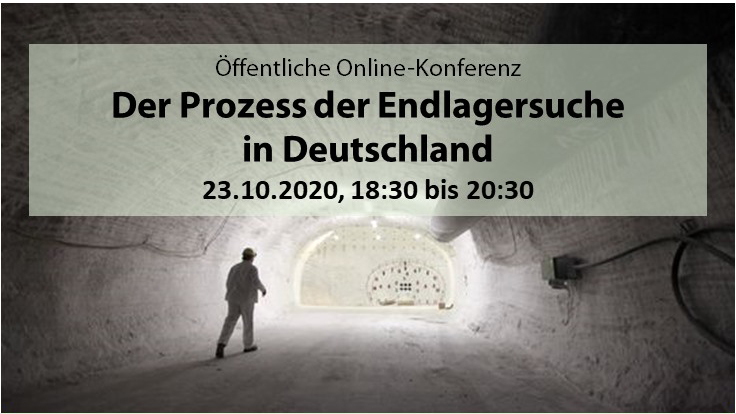
The repository search process in Germany
Online event
| Begin |
23. October 2020 -
18:30 |
| End | 23. October 2020 - 20:45 |
The Federal Company for Radioactive Waste Disposal (BGE) recently determined that 90 regions in Germany appear to be geologically suitable. This marks an important milestone in the multi-stage site selection process, which is intended to be open-ended, unbiased, and transparent.
The public is to be involved in all key phases to ensure that the mistakes made with Gorleben are not repeated.
The issue of final disposal is highly emotionally charged and is the subject of heated debate. Shortly after the publication of the BGE’s interim report, political voices quickly warned that certain regions—which are already heavily affected by the phase-out of lignite and structural change—had come under scrutiny.
The site selection process involves difficult decisions, and a fair compromise must be found. Whether this can be successful and whether protests and blockades can be avoided also depends on how the site selection process is structured. It will only gain acceptance if participation takes place on an equal footing, the necessary information is presented in an understandable way, and the uncertainties inherent in purely scientific analysis are transparently addressed. Thus, the final repository site selection process serves as a model for a new governance model designed to contribute, on a fact-based basis, to non-authoritarian consensus-building in the appropriate handling of other major societal issues (climate change, genetic technology, vaccinations, etc.).
We want to start a conversation about this issue. In the format of an online conference featuring a panel discussion, scientists, activists, and politicians will first have the opportunity to speak. The audience will also have the chance to ask the experts questions.
Scheduled agenda:
6:30 p.m.
Start and introduction: Final disposal as a “wicked problem,” Markus Will, HSZG
6:45 p.m.
Presentation: Final Disposal of High-Level Radioactive Waste in Germany—History and Current Status, Prof. Dr. rer. nat. Bernd Delakowitz, HSZG
7:00
Presentation: Condition Monitoring of Transport and Storage Containers (e.g., CASTOR) in Interim Storage, Sebastian Reinicke, IPM/HSZG
7:15
Presentation: Never Give Up – Insights into the History of the Abandonment of the Final Repository Site in Gorleben, Kerstin Rudek, anti-nuclear activist, political scientist
7:30 p.m.
Presentation: No Storage Is Not a Solution Either—Why Progress So Often Comes from the “In-Between.” An Intervention, Prof. Eckehard Binas, TRAWOS/HSZG
7:45 p.m.
Panel discussion with the speakers and representatives from politics, followed by a Q&A session with the audience
Dr. Stephan Meyer, CDU, Member of the Saxon State Parliament Dr. Jana Krauß, Alliance ’90/The Greens
8:30 p.m.
End
If you are interested, you can register here: eveeno.com/954044062
2nd upper floor