
2026 Nobel Prize in Medicine: How Light Makes the Brain Studyable
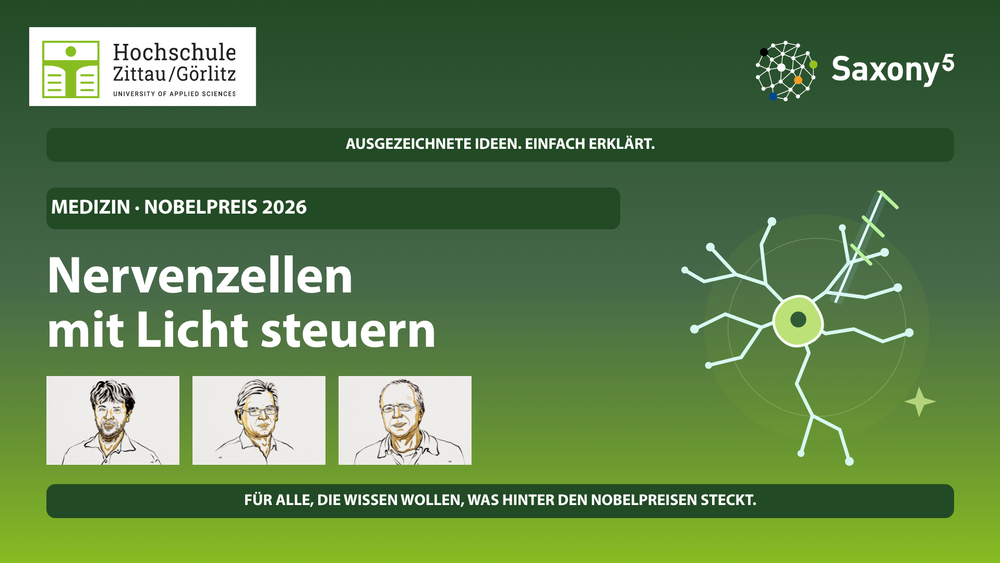
Can nerve cells be controlled with light? Dr. Elisabeth Maluck explains how optogenetics works and what possibilities it opens up for medical research. The public lecture on the 2026 Nobel Prize in Medicine is accessible even to those without prior knowledge of the subject.
| Begin |
25. November 2026 -
18:00 |
| End | 25. November 2026 - 19:15 |
| City | Building IV, Large Lecture Hall (Room 0.01), Theodor-Körner-Allee 8, 02763 Zittau |
Controlling the Brain with Light—How Does It Work?
How do memories, emotions, and decisions form in our brains? And how can we determine which neurons play a crucial role in these processes?
The 2026 Nobel Prize in Medicine honors a scientific discovery that enables researchers to specifically influence the activity of individual nerve cells using light. This is made possible by a field known as optogenetics. It involves the use of light-sensitive proteins that were originally discovered in microorganisms such as algae. These proteins make it possible to turn specific nerve cells on or off using light pulses and to study their function in greater detail.
What initially sounds like science fiction has fundamentally transformed modern brain research. The method helps us better understand how the brain processes information, stores memories, or controls behavior. At the same time, it opens up new avenues of research into neurological and mental disorders, such as Parkinson’s disease, epilepsy, or depression.
What can you expect from the lecture?
Dr. Elisabeth Maluck, a biochemist with a Ph.D. in neurobiology, explains the scientific background of this award-winning discovery. In an accessible way and without complicated jargon, she’ll demonstrate how optogenetics works and what possibilities it opens up for medical research. Drawing on her own research, she’ll share insights into how nerve cells can be selectively activated and deactivated using light.
The lecture is part of the event series “Outstanding Ideas. Simply Explained,” which makes the 2026 Nobel Prizes and the research behind them accessible to anyone interested.
No prior knowledge is required. Afterward, there will be an opportunity to ask questions and engage in conversation with one another.
About the Speaker
Dr. Elisabeth Maluck earned her Bachelor’s and master’s degrees in biochemistry with a focus on plant science. She completed her Ph.D. in neurobiology, studying sleep mechanisms in nematodes. In her research, she used optogenetics to selectively activate and deactivate nerve cells during and outside of sleep phases and to investigate the effects on the nervous system and behavior.
Today, she works in Quality management at a medical technology company in Görlitz. She supports the development and market approval of new blood tests for determining immune status by planning, evaluating, and documenting the necessary tests. She hopes to share her curiosity about biological processes and her enthusiasm for the natural sciences with a broad audience.
Registration and Participation
The event is open to the public and is aimed at anyone curious about current scientific discoveries.
We would appreciate your registration so we can better plan the event. Of course, you are also welcome to attend without prior registration.
Contact Person

2nd upper floor
2nd upper floor