
Date
HSZG at the Europe Festival
At the "Europafest" on April 27, Zittau/Görlitz University of Applied Sciences will be participating with various booths on interesting topics related to trinational cooperation.
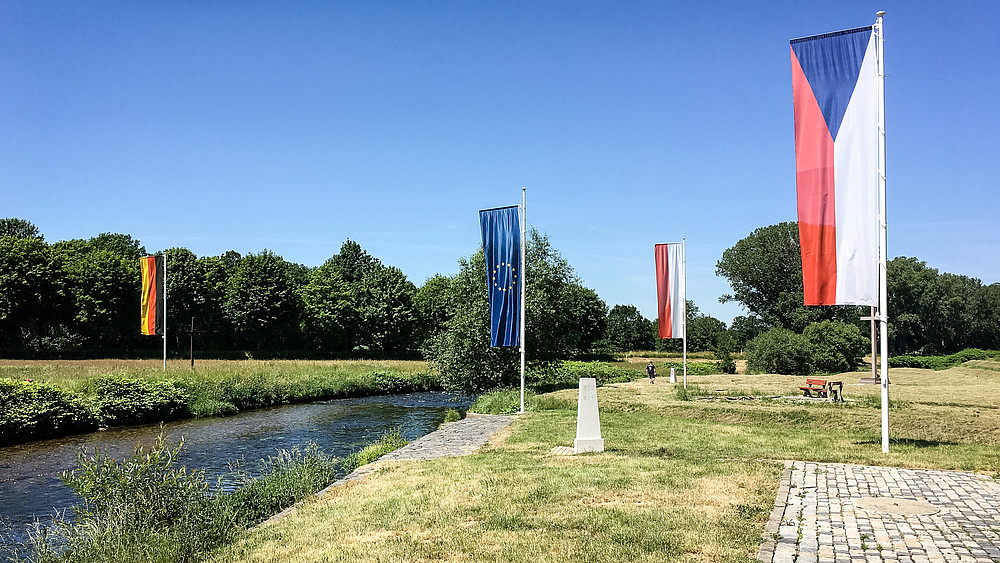
On April 27, we’ll be celebrating among friends: on Europe Day at the tripoint. There, we’ll work together to build more bridges between Germany, Poland, and the Czech Republic. Since the Czech Republic and Poland joined the European Union 20 years ago, cross-border projects have been flourishing in the region, including here at Zittau/Görlitz University of Applied Sciences.
Come visit us and our many other partners at the booths, and enjoy “Children’s Europe” with your family, as well as the cultural program on the festival stage.
More info: https://zittau.de/europafest
- ZIRKON - Zittau Institute for Process Development, Circular Economy, Surface Technology, and Natural Products Research
The ZIRKON Institute at the Zittau/Görlitz University of Applied Sciences presents itself with a variety of interesting topics related to sustainability in the tri-border region.
Waste Management and Recycling: A Cross-Border Issue! That’s why our staff members are reporting on this topic in the tradition of the “Zittau-Liberec Circular Economy and Landfill Workshop.” The history dates back to 2005, when it was founded by Prof. Dr.-Ing. Jürgen Schönherr of Zittau/Görlitz University of Applied Sciences in collaboration with Doc. Ing. Jan Šembera, Ph.D., of the Technical University of Liberec. The primary motivation for the workshop was to compare technologies and legal regulations in the fields of waste management and recycling on both sides of the border. Where do we stand today on these issues, and what is the focus of research today compared to 20 years ago?
Soils —Discover the water filters at our feet—presentation of a small demonstration facility that was opened in 2007 as a large-scale pilot plant in Bautzen/Nadelwitz as part of a Czech-German collaboration.
Silicone elastomers —what materials, which are found in every bathroom, still need to be researched? We believe: quite a lot! We are investigating the suitability of these materials as high-voltage insulators and focusing on the mechanisms of damage. We work in an international setting and regularly host visitors from the Technical University of Liberec.
- IPM – Institute for Process Engineering, Process Automation, and Measurement Technology
Our Zittau Power Plant Laboratory is home to cutting-edge research that benefits the region and beyond. A team from our Institute for Process Engineering, Process Automation, and Measurement Technology (IPM) takes visitors on a virtual tour of the laboratory using VR headsets and is available to answer questions. The construction of the Zittau Power Plant Laboratory is one of the largest research investments since the founding of Zittau/Görlitz University of Applied Sciences in 1992 and was made possible with support from the European Regional Development Fund.
- Lausitz Alliance – Life and Technology (L&T)
Life and Technology (L&T) is about discovering the diverse facets of cross-border cooperation in the heart of Europe—all within the context of innovation and technology transfer as well as a changing society. Leonie Liemich, Birgit Benesch-Jenkner, Renke Scholz, and Raffael Hermann invite you, our visitors, to join them in engaging in exciting discussions and projects centered on energy efficiency, energy security, and sustainability—and to share your own perspectives. Through graphic recording posters, we’ll present the key arguments regarding energy efficiency and energy security in the tri-border region. Our dedicated students in the “management of social change” master’s degree programme will present their work from the research internship on the topic of “National Borders.” We are particularly proud of our German-Polish project “A Green Future for the Border Region,” which has just gotten underway. Learn how sustainability and energy play a key role in our cross-border cooperation and what prospects are opening up for a green future.
But that’s not all! We’d also like to hear from you and cordially invite you to participate in our survey on German-Czech-Polish perspectives on sustainability. Your opinion is important to us and helps us develop forward-looking solutions for our region together.
- GAT—Institute for Health, Ageing, Technology
The GAT’s AAL Lab will be a guest at the Europafest. The latest assistive technologies will be presented to the general public. The “LivingLab” creates the conditions for transferring research findings into the everyday lives of older adults, their families, housing companies, care providers, health organizations, policymakers, and tradespeople. In an apartment in Görlitz located in the KommWohnen-Frauenburgkarree complex, various assistive technology systems are available that are designed to make everyday life easier for seniors and improve their quality of life. Everyone is welcome to try them out on-site to assess whether they would actually provide relief in their own homes.
The ability of informal and professional caregivers to provide good care depends on their well-being and resilience. The WELL CARE project, based in part at the GAT Institute of the HSZG, is guided by the latest EU care strategy. WELL CARE focuses on identifying, evaluating, and promoting evidence-based measures to support the resilience and mental health of informal caregivers and long-term care providers.
The project will run for four years (2024–2027) and is being carried out in Sweden, the Netherlands, Germany, Italy, and Slovenia, in collaboration with partners at the EU level and a U.S. researcher. WELL CARE is a Europe-wide research project funded by the European Union’s “Horizon Europe” research and innovation program
- Energy security here in the border triangle? Discuss it with a professor!
The outcomes of the Kyoto (1997) and Paris (2016) climate conferences have led to national and international commitments and climate protection programs. These, in turn, have resulted in targets for reducing greenhouse gas emissions. The energy transition is an important and necessary component of the German and European climate protection programs. The phase-out of conventional fossil-fuel power plants is also affecting the Saxon Lausitz coal region. The transition to renewable energy offers opportunities for research and development of new technologies and for attracting industrial partners. Professor Uwe Schmidt from the Faculty of Electrical Engineering and Computer Science will be available at the booth to answer questions.
In addition, our university athletics program will be represented on site. Prospective students will have the chance to schedule a spontaneous consultation.
2nd floor
2027/2028
Academic Year Schedule 2027/2028 (D)
Academic Calendar (EN)
2026/2027
Academic Year Schedule 2026/2027 (D)
Academic Calendar (EN)
2025/2026
Academic Year Schedule 2025/2026 (German)
Academic Year Schedule 2025/2026 (English)
Past Academic Year Schedules
Academic Year Schedule 2024/2025