
"Like one big family"
Alumni Interview with Valentin Reinhardt from the KIA degree programme in “automation and mechatronics.”
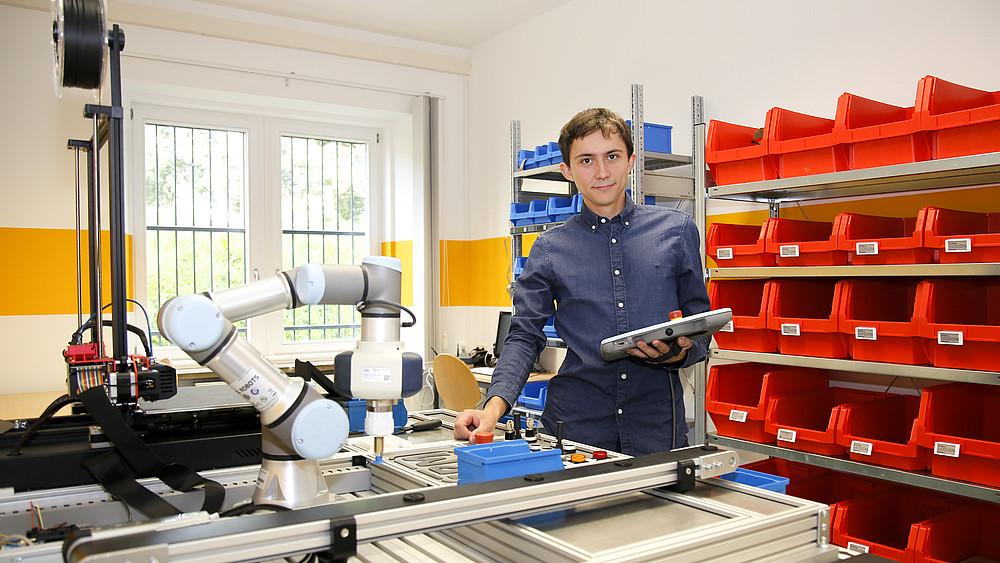
Valentin Reinhardt studied on the KIA (sandwich-style) degree course in automation and mechatronics at our university and graduated with his Diplom this year. In this interview, he talks not only about his studies at HSZG but also about his experiences as a volunteer in the flood-affected area.
This year, you completed your studies in the KIA degree programme “automation and mechatronics” with your Diplom thesis. What led you to choose this degree programme in Zittau?
I was looking for a program where I could gain practical experience. That’s why I quickly came across the Zittau/Görlitz University of Applied Sciences, because I could study there as part of an integrated apprenticeship program. I then submitted applications to many companies in Leipzig and that’s how I found the trade business where I completed my apprenticeship as an electrician. The company agreed to let me pursue my apprenticeship as part of a KIA (sandwich-style) degree course. That’s how I ended up in Zittau.
You wrote your Diplom thesis on the topic “Design and Implementation of a Human-Robot Application in Manufacturing.” What exactly did you focus on in that project?
I built a system that connects a 3D printer to a human operator. The 3D printer prints a component that can be automatically retrieved by a robot, while the human acts solely as a quality control operator at a station. After inspection, the human places the component into another holder and positions it. The robot then automatically retrieves the components and places them on the conveyor belt. So, essentially, it’s a logistics application.
Did pandemic conditions make it more difficult to work on your Diplom?
Actually, my work wasn’t restricted at all, because I was allowed to use a lab at the Institute for Process Engineering, Process Automation, and Measurement Technology (IPM). I didn’t experience any significant restrictions there. I was usually alone or with one other person in the lab; social distancing guidelines were followed, and I had plenty of space and was able to do everything I needed to. Communication with my advisors also worked very well. Whenever I had a question, I could simply stop by their office in person, send an email, or give them a quick call. Everyone was easy to reach.
During the time you were working on your Diplom thesis, however, you didn’t just focus on your topic—you were even in the flood-affected area as part of your work with the volunteer fire department. How did you provide support on-site, and how did you manage to do that alongside your thesis work?
I had already done such good preparatory work on my Diplom thesis that a week of deployment didn’t set me back. That’s why I drove to Rech in the Ahr Valley. As firefighters, our first task there was to set up the general command center; the German Armed Forces and the THW were already on site. The entire town had been swept away—you rarely see a field of rubble like that. We helped pump out the basements, remove the mud from them, and clean the streets. We also had to be very careful, because most basements contained heating oil tanks, and the mud was contaminated as a result. There was no water, and electricity was provided only by emergency generators—that’s where the real work was being done. Buildings had been swept away and streets destroyed—a huge sinkhole had even formed right in the middle of town. My current job keeps me completely occupied and I’m often on site for installations; otherwise, I would have loved to go back there to help.
You’ll soon be working for an engineering firm in Leipzig. What tasks can you expect there?
Right now, I’m still working as an electrician on installation projects. At my new engineering firm, I’ll be responsible for industrial plant design. I’ll be developing the electrical plans and even the control systems. I’ll know more details once I start in October.
You received a good Diplom from Zittau. How will you remember your time at HSZG?
There are big differences between a university and a university of applied sciences. At HSZG, I wasn’t just a number—here, the person behind the number matters, and I could talk to anyone. It feels like one big family. If you have problems, you can get help anywhere without having to go out of your way to find it. Also, rent in Zittau is quite affordable, so it’s even worth getting your own apartment. Zittau and the surrounding area have a lot to offer. I enjoyed hiking and exploring everything—it’s very close to Poland and the Czech Republic. Last year, for example, I went on a weekend trip to the Giant Mountains with some fellow students. The HSZG offers a complete package of a family-like atmosphere, a helpful community, and a great setting.
The interview was conducted by Hanna Maiwald of the Office of University development and communication.
Upper floor