
Far more than pure description
Prof. Dr. Nadine Jukschat has been Professor of Applied Sociology at the HSZG since July. She introduces herself in this interview.
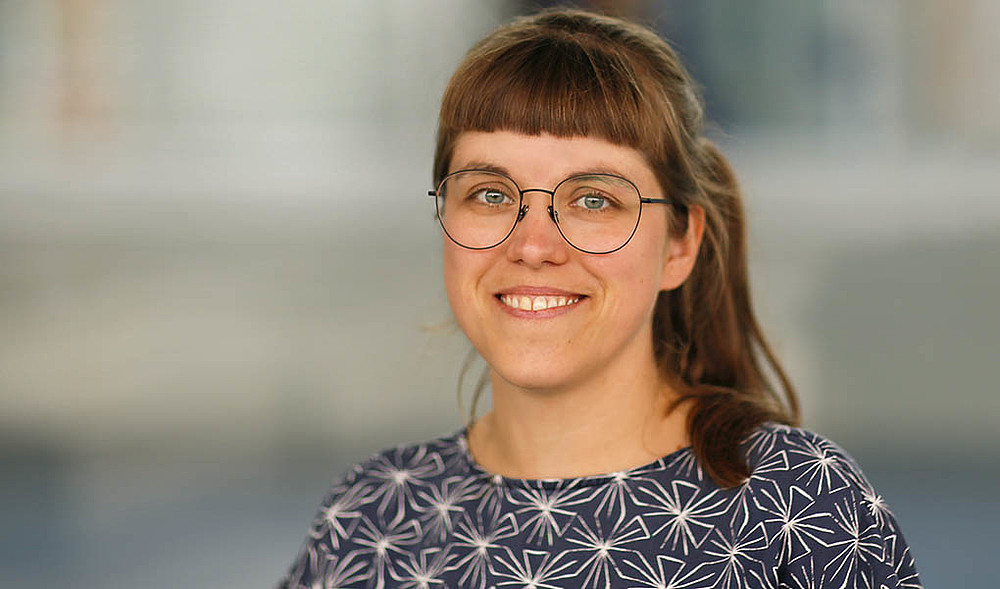
Criminology, radicalization, and the promotion of democracy in the correctional system. Prof. Dr. phil. Nadine Jukschat’s research and areas of interest are wide-ranging. Since July 1, 2021, she has served as a professor of applied sociology in the Faculty of Social Sciences. In this interview, the Zittau native outlines her academic career to date as well as her areas of teaching and research. The expert in empirical social research methods also describes what qualitative research means to her and what she hopes for her hometown.
Prof. Jukschat, a warm welcome to Zittau/Görlitz University of Applied Sciences and to our beautiful three-country region. Or should we say: Welcome back?
Thank you very much! Yes, indeed, I have deep ties to Upper Lusatia, both personally and through my family. I grew up in Zittau and the Zittau Mountains, and my parents and in-laws live here in the region. As a teenager, however, I found many things here too confining, so after graduating from high school, I went to Australia for just under a year. After that, I studied in Leipzig, where I discovered (cultural) sociological thought and qualitative-reconstructive social research at the Institute for Cultural Studies there. I’ve always been interested in topics related to social problems, deviance, and social control. So it’s probably no coincidence that, after completing my studies, I ended up at the Criminological Research Institute of Lower Saxony (KFN). After eight years at the KFN in Hanover, I moved to the German Youth Institute (DJI) in Halle, where I most recently focused extensively on radicalization and social polarization, as well as the potential of education and Social Work to strengthen democratic coexistence. And now I’m very much looking forward to this new professional role in my old hometown. Especially since I’ve noticed that a lot has been in flux here in recent years. And with structural change, major—and undoubtedly challenging—social transformations are on the horizon, which need to be shaped and accompanied by scientific research. Perhaps I can contribute a little to that.
Since July, you have been working at the Faculty of Social Sciences as a professor of applied sociology. How did you find your first few weeks this summer?
I was welcomed and accepted very warmly and cordially by my colleagues. Of course, the campus is very quiet due to the pandemic, and on top of that, my start coincided with the break between semesters. But that gives me the opportunity to settle in at my own pace and thoroughly prepare my teaching for the winter semester.
What are your main areas of focus in teaching and research?
As part of my work at the DJI, I most recently provided academic support for (social) educational model projects focused on prevention and deradicalization in the correctional system and probation services. In this context, I’ve also spent a great deal of time examining the conditions of professional practice in Social Work. In doing so, the importance of reflexivity has been made very clear to me time and again. I am convinced that sociological thinking in general—and the interpretive approach of the qualitative-reconstructive research paradigm in particular—is helpful for (aspiring) Social Work practitioners, education, or other social and political organizations—are helpful when it comes to systematically stepping back from everyday practice, as well as for the analytical examination of social processes, mechanisms, and interrelationships in their respective fields of practice. In my teaching, I therefore aim to focus on working with students to apply sociological thinking and methodological competence in ways that are fruitful for their respective fields of practice.
With regard to research, I intend to build on my previous work on political socialization, (de-)radicalization, and the promotion of democracy, and to focus on questions of political participation arising in Lausitz in connection with the impending regional structural transformation. My hope is that teaching and research can be fruitfully combined in this process.
The upcoming winter semester is scheduled to take place entirely in person again, pandemic permitting. What are your expectations for collaborating with your students on campus?
First of all, I’m simply curious about the students, their ideas, and their topics! I’m looking forward to getting to know them—and in-person instruction naturally offers good conditions for that. Let’s hope it will be possible.
Criminology, radicalization, and the promotion of democracy in the correctional system on the one hand, and video game addiction and ethnographic practice-based research on the other. The range of your academic work to date sounds exciting and diverse. Where does your interest in these topics come from?
Essentially, my research topics are linked by a fundamental interest in how society creates social problems and how it addresses them. For a long time, I conducted biographical research—for example, examining the conditions under which deviant behavior emerges and becomes entrenched. In my PhD thesis, I focused on addictive video game use, and later I studied individuals from other countries who were incarcerated in Germany for residential burglaries. In recent years, as part of my research on the phenomenon of radicalization and radicalization prevention, my focus has shifted more strongly: toward the societal and discursive construction of categories of social problems, the consequences of these framings for the affected groups, and the professional (social) pedagogical approaches to addressing these problems.
In one of your academic lectures, you explore the question: How does one move from a research idea to theory formation in qualitative research projects? As an expert in empirical social research methods, have you found a quick answer?
I’m afraid I have to disappoint you there. There can be no quick and easy path. Qualitative research requires a certain capacity for perseverance, because it is hard work and often involves an intense, iterative struggle with the data. Often, however, it is precisely the detours and supposed disruptions that ultimately foster insight. After all, the very principle of qualitative research is that it is open and sensitive to the internal logic of the field being studied—always ready to revise one’s own assumptions in light of empirical reality. If we also associate qualitative research with the aspiration to contribute to theory-building—rather than merely providing nice stories or pure description—it requires the courage to detach oneself from the concrete data and take the leap into abstraction and generalization. The good news is: conducting qualitative-reconstructive research is also incredibly fun! And you should just go for it, because the best way to learn qualitative research methods is by practicing them—ideally in research workshops and through exchanges with more experienced colleagues.
What insight from your academic career so far would you have liked to have had at the very beginning of your training, and would you now pass it on to your students?
At the Institute for Cultural Studies at the University of Leipzig, I was very fortunate to be shaped by an academic environment that, while always demanding a great deal from students in their engagement with the subject matter, also had a great deal of faith in their abilities. I only realized later that this kind of enabling approach is not something to be taken for granted. I would like to provide students here with the same experience of being encouraged in their own ideas and their implementation, and of being able to engage in constructive debate.
What did you miss most about your home country?
Every time I visited home, I was reminded once again just how beautiful it is here. The varied landscape, the swimming lakes, the mountains with their impressive rock formations… And of course, it’s wonderful to be closer to my family again—especially for my children, who now get to see their grandparents much more often than before.
And what do you hope for your hometown?
My hope is that the region can overcome the trauma of the post-reunification transformation process—which was biographically difficult for many—focus on the positive developments of recent years, and view the upcoming structural change as an opportunity. After all, we’re not only facing an enormous process of economic transformation, but also a social one that’s no less challenging. I very much hope that we’ll succeed in shaping this process in a participatory way, counteracting polarization and divisions, and strengthening democratic, solidarity-based cooperation at the local level.
The interview was conducted by Cornelia Rothe, M.A.
2nd upper floor