Utilizing regional potential together
At the digital simul+ forum titled “Greenhouse Gas-Neutral Circular Economy in Lausitz,” the results of the CircEcon requirements concept for hybrid material systems were presented.
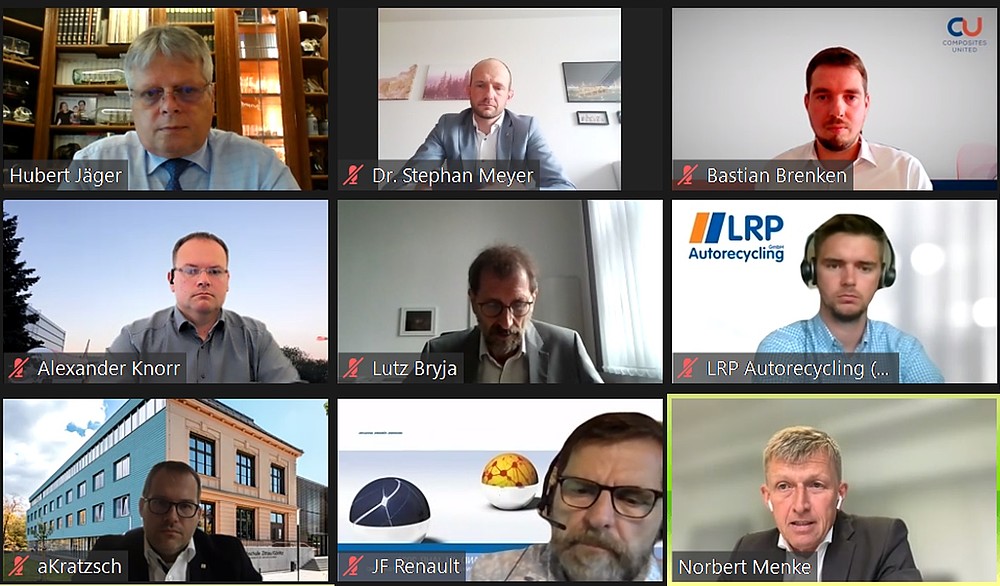
On July 21, 2021, the digital simul+ forum “Greenhouse Gas-Neutral Circular Economy in Lausitz” took place with over 90 participants to present the key findings of the CircEcon requirements concept for hybrid material systems. Under the umbrella of the Saxony Lightweight Construction Alliance (LAS), the three technical universities in Chemnitz, Dresden, and Freiberg, as well as the Zittau/Görlitz University of Applied Sciences (HSZG), intend to design, build, and operate a research campus—unique in Europe (CircEcon: Green Circular Economy) in Lausitz—a project that is unique in Europe—and to operate it as an interdisciplinary research institution. Currently, a needs assessment funded by the simul+ Future Initiative is being developed to estimate the potential and conduct a technical-economic evaluation of particularly relevant priority topics, which will form the cornerstones of the decentralized CircEcon research campus.
Only through the synergy between the circular economy and the energy transition can future ecological and economic problems be solved. The CircEcon project takes a holistic approach to this—starting with circular design, through maximum resource efficiency in production, all the way to maximum waste recovery. CircEcon provides sustainable recycling concepts for the increasing use of fiber-reinforced plastic composites (FRP) in the energy technology, aviation, and rail transportation sectors and establishes a hub for technology transfer from universities to industry. At the same time, CircEcon opens up unique opportunities for skilled workers from the lignite mining regions. With its planned implementation on a pre-industrial scale, CircEcon also creates the conditions for attracting companies of all sizes focused on reuse, remanufacturing, recycling, and waste treatment of hybrid materials.
CircEcon is a state initiative in cooperation with the three Saxon technical universities together with the HSZG with a clear reference to the core regions of structural change and, with planned locations in Hoyerswerda, Weißwasser, Rothenburg and Görlitz, pursues a decentralized approach for the greatest possible exploitation of the regionally available potential for the circular economy of hybrid composite materials with metals, polymers, renewable raw materials, fibres made of glass or carbon and other fillers.
Following opening remarks by Minister of State Thomas Schmidt (Saxon State Ministry for Regional Development (SMR)) and Sebastian Gemkow (Saxon State Ministry of Science, Culture, and Tourism), a keynote presentation by Dr. Jean-Francois Renault (Coordinator of the Center of Excellence for Circular Economy at Projektträger Jülich), and a presentation of the project by Prof. Lothar Kroll (LAS Chairman of the Board, Director of the Institute for Lightweight Structural Design at Chemnitz University of Technology), the project participants initiated a panel discussion moderated by Prof. Hubert Jäger (LAS Chairman of the Board, Director of the Institute for Lightweight Construction and Plastics Technology at Dresden University of Technology). During the discussion, representatives from companies, research institutions, trade associations, government agencies, and political circles explored the potential of the circular economy in Lausitz.
The dialogue session, moderated by Dr. Marzena Schöne (Head of the simul+ Future Initiative, SMR), was organized by LAS in collaboration with SMR and supported by Composites United, the Saxony Economic Development Agency, and the Cleantech Initiative East Germany. Dr. Schöne welcomed the guests with a quote from Victor Hugo: “Nothing in the world is as powerful as an idea whose time has come.” Prof. Holger Lieberwirth (co-opted board member of the Saxony Lightweight Construction Alliance and director of the Institute for Processing Machinery and Recycling Systems Technology at the TU Bergakademie Freiberg) was able to draw a positive conclusion at the end of the eventand once again highlighted the core message of Prof. Alexander Kratzsch (panelist, Rector of the HSZG), namely that the sustainable strengthening and revitalization of the Upper Lusatia region can only succeed if all stakeholders continue to work together so successfully.
Source: Press release from the Lightweight Construction Alliance of Saxony e.V.
Office
Julia Bachmann
c/o TU Bergakademie Freiberg
Prüferstraße 1a, 09599 Freiberg
Phone +49 3731 39-2341 I E-mail: kontakt(at)leichtbauallianz-sachsen.de
1st floor