
Curtain up for innovation
The SCO-TTi research team presents research papers and plans for the new year.
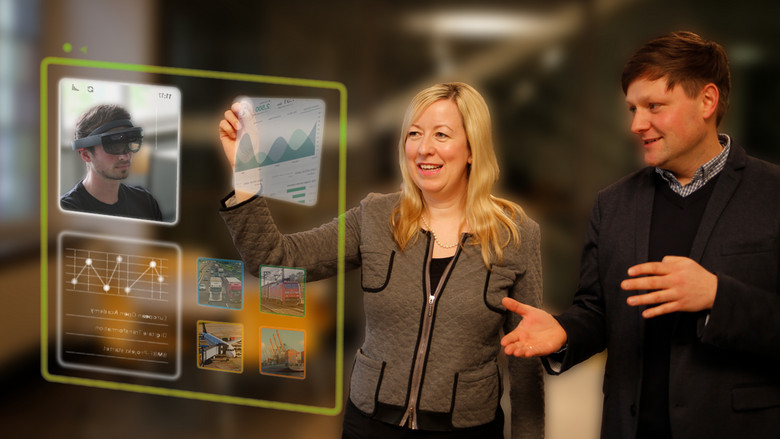
The SCO-TTi research group at HSZG, led by Professor Sophia Keil, looks back on a successful year and presents its scientific findings and plans for the new year.
Since 2018, the SCO-TTi research group (Science Center Oberlausitz – Innovative Technology Transfer) has been engaged in various research and development projects in the field of Industry 4.M(ensch). The focus is particularly on shaping the human-centered work of the future in production and logistics. This includes, for example, worker assistance systems such as augmented and virtual reality, human-machine and human-computer interactions, as well as educational technologies and on-the-job training.
The vision of SCO-TTi is to create knowledge and develop skills to enable people-centered work and value creation in the three-country region and the world.
”The group consists of researchers from the departments of Business Administration—specifically, Production Management and Logistics, as well as Business Informatics—and other staff members from the Faculty of Business Administration and Engineering Management and the Institute for Process Engineering, Process Automation, and Measurement Technology (IPM).
In recent years, the team has secured and completed research projects at the EU, national, and regional levels. Among the successfully completed EU projects are, for example,
- Integrated Development 4.0 (iDev40): Together with 39 partners from six countries, the project investigated, among other things, the complex interrelationships between technologies, the people who use them, and the organizational, economic, and ecological context in which they are embedded, as well as
- Power2Power (P2P): The goal of the project was to research and develop innovative power semiconductors with increased power density and energy efficiency. A total of 43 partners from eight countries collaborated on the project.
Two artificial intelligence projects are currently underway: the EU project “Artificial Intelligence in Manufacturing leading to Sustainability and Industry 5.0” (AIMS5.0) and “PerspektiveArbeit Lausitz” (PAL).
- AIMS5.0 aims to strengthen European digital sovereignty through comprehensively sustainable production. The project and its well-balanced consortium of 53 ambitious academic and industrial partners intend to boost the economy through the application, expansion, and implementation of AI-enabled hardware and software components and systems across the entire industrial value chain.
- PAL brings together the expertise of interdisciplinary teams in work research and engineering from five universities, as well as 27 companies and associations from Saxony and Brandenburg. Their shared goal is to make work in the Lausitz region more efficient, attractive, and healthier through data-driven assistance systems.
At the national level, SCO-TTi is part of the Lausitz – Life & Technology alliance. Within this framework, the project to design and test the “European Open Academy” (EurOpA) continuing education academy in the Upper Lusatia Innovation Region was successfully carried out. The project to research information-based assistance systems for human-centered and learning-friendly production design in the Lausitz of tomorrow (Factory4 Future) is currently being implemented.
- EurOpA aimed to enhance the global competitiveness of the Upper Lusatia region by designing and testing a continuing education academy tailored to the needs of large corporations and SMEs, in order to train employees in areas such as the use of digital technologies and the design of digital business processes.
- Factory4Future is investigating the use of digital assistance systems in production. The goal is to develop technologies tailored to the individual needs of employees in order to, among other things, reduce training times and costs and increase the adaptability, resilience, and competitiveness of companies in the Lausitz of tomorrow.
At the Saxon state level, the Virtual Reality for Operations Management (VR4OM) project was successfully completed.
- VR4OM aimed to design and test a new, innovative learning environment for students at the Zittau/Görlitz University of Applied Sciences. To this end, 360° photos and videos were captured at regional industrial companies and enhanced with e-learning and gamification elements. The application can be experienced via mobile devices, desktop PCs, and virtual reality headsets.
As part of this project, the SCO-TTi team, in collaboration with regional industry partners, was able to create a novel, digital, and interactive learning environment.
In the coming weeks, SCO-TTi will provide further updates on the following topics to give you a closer look at the work carried out over the past year:
- Continuation of successful European research in semiconductor manufacturing
- Continuation of research on assistive technologies for regional SMEs
- Successful completion of a research paper on innovative and accessible e-learning
- New research project on designing AI for the workplace of tomorrow
In addition, two doctoral projects are currently underway at SCO-TTi. One focuses on the behavioral economic effects of visualizations on management decisions (Fabian Lindner), and the other on the design of teaching and learning scenarios using augmented reality (Daniel Winkler).
SCO-TTi offers training on research topics in the context of lifelong learning in order to efficiently deploy the potential of skilled workers in companies and accelerate the integration of new employees.
By using smart glasses, SCO-TTi enables expert knowledge to be preserved and made accessible, thus promoting documentation and knowledge transfer in companies.
SCO-TTi supports the reduction of training times through individual and target group-specific training measures such as the display of texts in the native language or through pictorial visualizations, thus also facilitating access to the labour market for people with special needs.
With the help of AI research, SCO-TTi supports companies in enabling their employees to make faster and better decisions in routine situations.
SCO-TTi digitizes the production environments of various companies, enabling students to have immersive learning experiences through the use of virtual and augmented reality, take virtual field trips regardless of time and place, and gain a more tangible understanding of what it’s like to work in a company.
The university makes the technologies of the future workplace personally tangible and “hands-on” for students, helping them develop an understanding of what constitutes a good workplace and how the use of new technologies impacts business objectives and costs.
Through an interdisciplinary, project-based, and problem-oriented approach to teaching, students become familiar with various technologies while addressing issues of sustainability and ethics.
SCO-TTi regularly offers students the opportunity to work as assistants and to write project papers and final dissertations on current topics in production and logistics management.

First floor