
From Leipzig via Rostock to Upper Lusatia
The new Professor of Cell Biology Prof. Dr. rer. nat. Elisa Wirthgen in conversation.
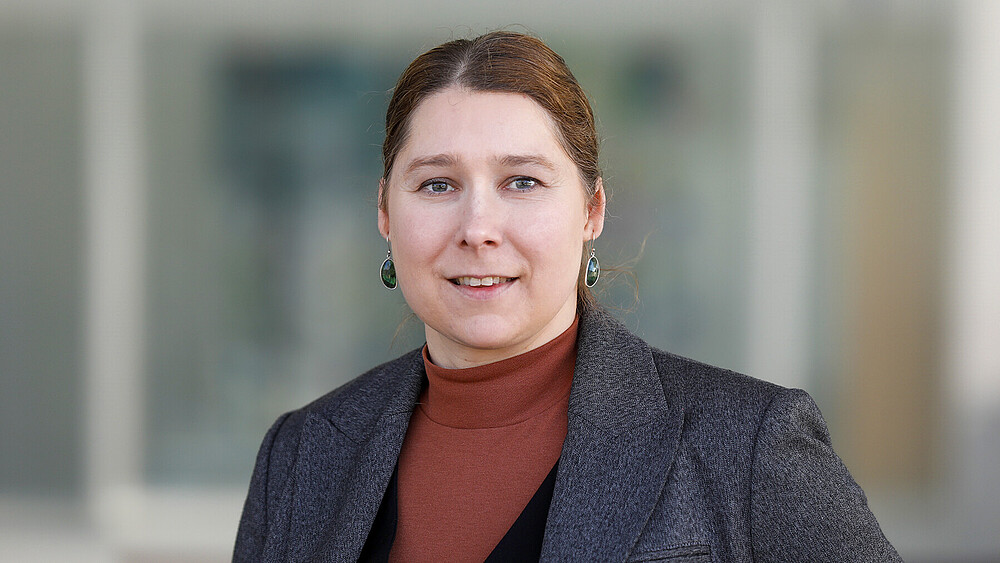
Since February 1, 2025 , Prof. Dr. rer. nat. Elisa Wirthgen has been teaching in the Department of Cell Biology at the Faculty of Natural and Environmental Sciences. In this interview, she talks about her journey to Upper Lusatia, her fascination with immunology, and her unique teaching approach. She also offers advice for navigating a stressful exam period.
Professor Wirthgen, would you please start by briefly introducing yourself?
My name is Prof. Dr. rer. nat. Elisa Wirthgen. Since February 1, 2025, I have been a professor of cell biology in the Faculty of Natural and Environmental Sciences. I was born in Leipzig.
What has your career path been like so far? What milestones have shaped your career?
In 2006, I earned my Diplom in biology with a focus on genetics, immunology, and molecular medicine at the University of Leipzig. In 2012, I received my Ph.D. in animal physiology from the University of Rostock.
I then received an EXIST scholarship until 2015 and founded the company “Ligandis,” which was also supported by the MV scholarship. This was followed by several years as a postdoctoral researcher at the Leibniz Institute for Farm Animal Biology (FBN) in Dummerstorf, where I conducted research on metabolic, endocrinological, and immunological biomarkers in humans and animals.
From 2018 to 2021, I worked at the University Medical Center Rostock as a postdoctoral researcher and laboratory director of the Mucosal Immunity research group. My research there focused on mucosal immunity and cellular immunotherapy in the context of chronic inflammatory bowel diseases. Starting in 2021, I took over as acting head of the same research group and also coordinated the classes and exams in pediatrics for medical students.
What inspired you to pursue a career in science?
Exploring the complexity of life on various levels has fascinated me ever since my doctoral studies. Science constantly challenges me in new ways and allows me to critically examine hypotheses. I’m inspired by the opportunity to combine curiosity with purpose—not simply assuming how something might be, but being able to substantiate it with facts.
What ultimately brought you to Upper Lusatia?
Actually, I first came to Upper Lusatia to take up the professorship in cell biology here. Before that, I had lived near Rostock since 2008 and, prior to that, in the Leipzig area. The city of Zittau, the countryside, and the people immediately appealed to me—and I also felt right at home at the HSZG from the start.
What exactly do you do here, and what is your area of focus?
I teach immunology, genetics, and molecular and cell biology, with a special focus on hands-on work in the molecular and cell biology lab.
Are there any research areas that are particularly close to your heart?
I’m interested in inflammatory mechanisms in general and, in particular, in the development of chronic inflammatory diseases. These affect an increasing number of people at all stages of life and have an enormous impact on their lives as well as on health economics. My goal is to better understand the underlying mechanisms so that I can potentially contribute to prevention, diagnosis, or treatment.
How do you structure your teaching to inspire students?
I combine current textbook knowledge with the latest scientific findings and, whenever possible, draw connections to topics relevant to everyday life. Immunology, in particular, is closely related to topics such as nutrition, stress, and the development of diseases like allergies or cancer. Here, students have the opportunity to learn to what extent their own habits or environmental factors influence our health, as well as where we can exert influence and where we cannot. I also try to foster media literacy by incorporating current topics from public debates or trends on social media into my teaching. I use digital tools to assess learning objectives or gather feedback. I very much hope to convey my own enthusiasm for the complexity of biological processes to my students.
What advice would you give to students aspiring to a career in science?
There’s no one-size-fits-all advice. Follow your own path. It won’t always be easy, and it will rarely be predictable. Be open to opportunities, and don’t let setbacks discourage you. Having a clear goal can help you stay focused.
Do you have any survival tips for exam season?
Too much stress arises from starting to study too late. This is a good experience for me, as I know it well. It’s important to accept that fact first, rather than continuing to get frustrated about it. Study groups have helped me a lot, as long as there’s good chemistry among the participants. In general, I recommend working through the material consistently throughout the semester, attending lectures regularly, and engaging with the instructors. Even so, exam periods will always be challenging.
And finally, a few personal insights: Which book are you absolutely determined to read this year?
“Meditations” by Marcus Aurelius.
What three things absolutely must be in your office?
At least one plant, something personal, and pictures of my family.
Is there a life motto that guides you?
“Life is change—and often things turn out differently than expected.”
Thank you very much for the interesting conversation, and continued success at HSZG.
The interview was conducted by the Office of University development and communication, University of Applied Sciences Human Resources Division.
First floor
First floor