
Visions for the coal regions
HSZG students present ideas for structural change to Saxony's government.
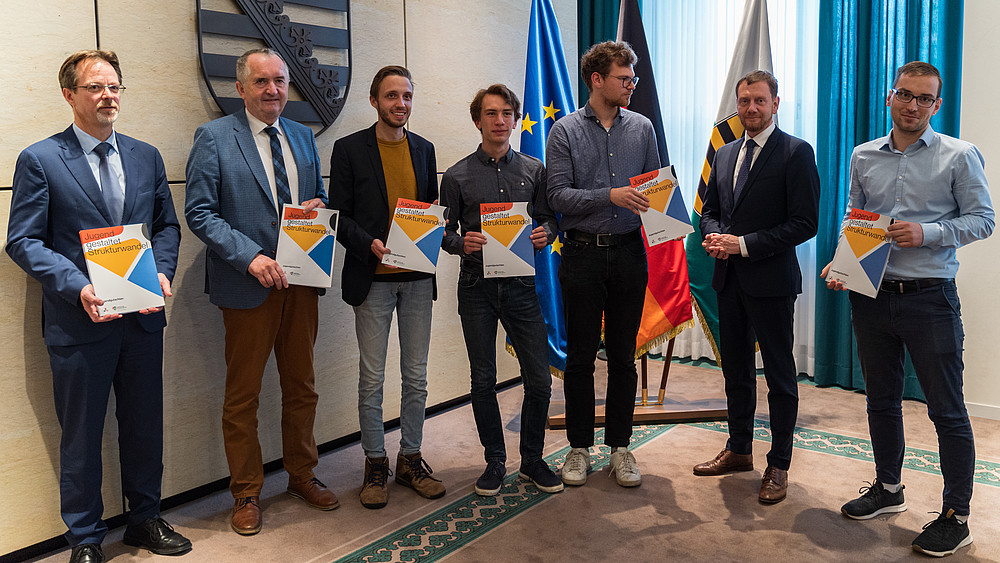
Successful structural change requires young people with ideas and visions for their home regions. HSZG students Timon Conrad and Marcus Wöckel are both among them. Together with other young people from coal-mining regions in the east and west, they have come together to develop ideas for structural change. These include proposals such as establishing mobile medical clinics in rural areas, building tiny-house communities on former open-pit mining sites, or—in Timon Conrad’s case—transforming the university campus into a “testing ground for the energy transition.”
The best ideas were incorporated into a “youth report” titled “Youth Shapes Structural Change.” On October 18, the students met at the Saxon State Chancellery to present their report to Saxony’s Minister-President Michael Kretschmer.
Timon Conrad, a student of energy and environmental engineering, also had the opportunity to draw attention to his project proposal. His suggestion is that universities and colleges in coal-mining regions should become climate-neutral and, in doing so, involve researchers and, above all, students. For example, if they were to plan and calculate the costs of a photovoltaic system that would then actually be built on campus, this would, in the 23-year-old’s view, provide far greater motivation than any theoretical lecture.
Now, the first step toward implementation has been taken: Saxony’s Minister for Regional Development, Thomas Schmidt, as well as the officer for Structural Development in the Lausitz and the Leipzig Region, Jörg Huntemann, showed great interest and offered the group another meeting for a more detailed discussion of the youth report.
The public relations department conducted an interview with Timon Conrad on the topic of the “youth report”:
Who came up with the idea for this “youth report”?
The ideas emerged during a “Planathon” in November 2021 with other young people from the three coal-mining regions. The event was organized by Leuphana University as part of the federal government’s youth strategy.
What made you decide to participate in the Planathon?
Lausitz is a region very close to my heart—it’s where I was born and raised. I hope that in the future, young people will have the same—or even good—opportunities, whether in education, vocational training, leisure, or participation and decision-making. Especially when it comes to decision-making, I’d like to see it structurally embedded so that everyone can actively participate. That’s what I’m working toward.
How did you approach the project?
I went into the Planathon with a relatively open mind about the outcome. I’d already participated in other events, such as “Mission2038,” which focused more on smaller, individual projects that each participant could carry out on their own. The Planathon, however, was about a vision with more possibilities. That’s what really motivated me to participate.
How did the report ultimately come together?
The “Youth Report” was written by the Planathon’s youth editorial team over the course of several additional virtual meetings. During these sessions, the recommendations for action were developed and the ideas were refined. Many of the ideas listed in the appendix of the full version—which serve as the basis for the summary—came from the Planathon, which was also attended by Marcus Wöckel, who studies electrical power systems at HSZG. At the Planathon, approximately 50 young people from the three coal-mining regions across four German states came together. Marcus Wöckel represented the Central German coalfield, and I represented the Lausitz coalfield. Selected participants subsequently attended the handover of the report to the respective state governments—Marcus for Saxony-Anhalt and Saxony, and I only for Saxony. The handover of the report to the federal government is still pending.
Who can help bring your ideas and recommendations to life?
I discussed the “Youth Report” with Professors Dzienis, Kornhuber, and Schmidt at our university. Together with them, I am currently working on ideas that seem feasible for the HSZG, such as a climate-neutral campus. I’m engaged in a lively exchange with Lukas Müller from Görlitz, who is also participating in the HSZG’s University4Future process as an external advisor. Together with Annekathrin Kluttig and Florian Reß from the Climate Protection Management team, we’re exploring how our ideas can be integrated into the university’s climate protection strategy. I also find the project work done by Prof. Kunick and student Jonas Pfeiffer to be good. They are currently trying to make the Görlitz campus more “climate-neutral” in terms of heating. In general, anyone who’s interested can support us with their ideas and drive.
What was it like for you at the State Chancellery when it came time for the handover?
For me, it was nice to be able to talk with politicians. Above all, I’m pleased that there’s another meeting scheduled, so we could go through the ideas step by step rather than just handing over the report itself.
Click here for the visions for the coal regions: The youth report "Youth shapes structural change".
More information:
Timon Conrad
E-Mail: Timon.Conrad(at)stud.hszg.de