
Tackling real problems digitally
How Prof. Anna Prenzel designs digital solutions for the HSZG and gets students excited about computer science.
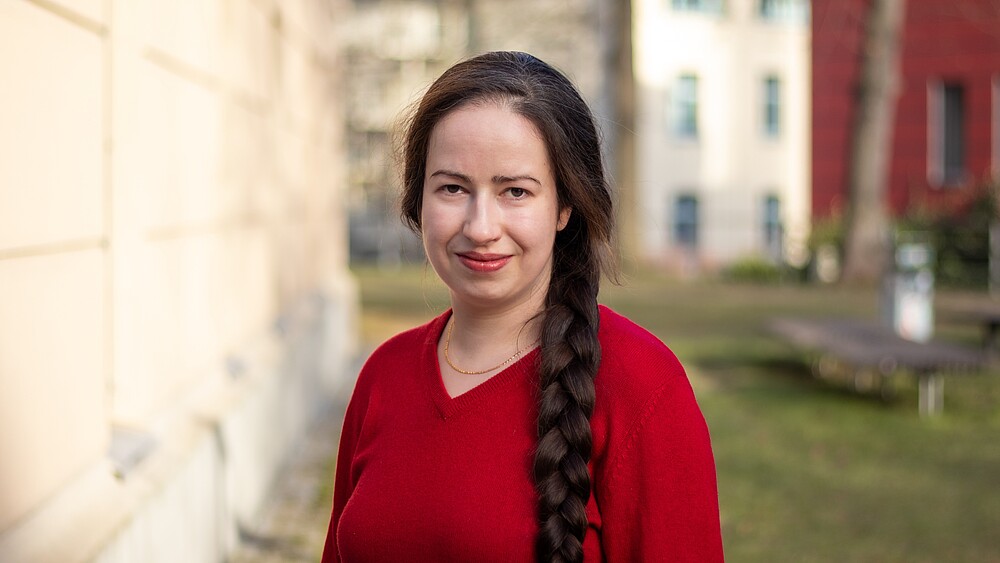
Prof. Dr.-Ing. Anna Prenzel is Professor of Applied Computer Science at the Faculty of Electrical Engineering and Computer Science. In this interview, the Görlitz native talks about her connection to the HSZG, her enthusiasm for knowledge transfer and the advantages of practice-oriented learning.
Prof. Anna Prenzel, today we’re introducing you as a professor, but you’ve been familiar with HSZG for quite some time now. How did that come about?
I began my studies at the Zittau/Görlitz University of Applied Sciences in 2006 and have been based here ever since. Today, I teach in the Faculty of Electrical Engineering and Computer Science in the field of Applied Computer Science. As a native of Görlitz, I’m especially happy to be continuing my professional career in my hometown.
Can you tell us a little more about the steps you took on your path to becoming a professor?
After earning my bachelor’s and master’s degrees in computer science here in Görlitz, I worked as a research assistant at the Faculty of Electrical Engineering and Computer Science until 2012. I then worked in the Image Processing Group at the Institute for Process Automation and Measurement Technology (IPM) until 2014. Starting in 2012, I began my doctoral studies at BTU Cottbus-Senftenberg and successfully completed them in 2018 with a PhD thesis on “Designing Human-Computer Interaction for Decision Support in Planning Systems.” From 2013 to 2024, I taught as a lecturer with a specified function at the Faculty of Electrical Engineering and Computer Science, where I advised students in Applied Computer Science and designed various classes / courses. In addition, I worked in the IT department of my father’s company, OPTIK-Labor Dr. Wolf-Dieter Prenzel.
What motivated you to pursue not only computer science but also research and teaching? Was there a specific moment or experience that shaped this decision?
During my studies, I discovered my passion for programming and algorithms, especially in combination with the design of interactive user interfaces. I was fascinated by how digital solutions can be used to efficiently tackle real-world problems. Nowadays, there are numerous tools—such as low-code platforms and AI-supported development processes—that make this even easier. When I began giving lectures, my enthusiasm for sharing knowledge grew. My goal is to equip students with the necessary tools and methods so they can independently develop innovative digital solutions and creatively solve practical problems.
You’ve never left Görlitz—what makes the region, and specifically Zittau/Görlitz University of Applied Sciences, so special to you?
Görlitz is my hometown, and I really enjoy living here. I love my city’s green spaces just as much as the historic Old Town and the lively downtown area. In my free time, you’ll occasionally find me in one of the cafés on or around Postplatz, or—when the weather is stormy—enjoying the waves at Lake Berzdorf. The HSZG also offers me the opportunity to conduct research and teach in my hometown—something I greatly appreciate.
What are your main responsibilities at HSZG? What are you currently focusing on the most?
I am the program director for the “Economics and Computer Science” degree programme and am also active as a member of the university’s Senate. My main priorities include the further development of the computer science department and teaching.
And what are your current research focuses? Are there any topics that are particularly close to your heart?
In the future, I’d like to focus more on didactic methods in computer science education and on digital innovation processes. I’m also interested in how universities can use innovative platforms to promote knowledge transfer both within and outside the university. Science communication is a central aspect here.
How do you structure your teaching to inspire your students?
I place great importance on students learning in a practice-oriented way and becoming creative on their own. In my courses, they should have the opportunity to develop a digital solution for a use case of their own choosing—one that actually works. Once they’ve overcome the initial hurdle, they can put their own ideas into practice—and that often sparks genuine enthusiasm.
What advice would you give to students interested in a research career in your field? What should they keep in mind?
It’s important to gain practical experience early on. I therefore recommend getting involved as a student or research assistant and participating in research projects. Attending conferences and academic events also helps you network and become more familiar with the research landscape.
Exam season can be very stressful for many students. Do you have any tips or strategies for getting through this phase in a good way?
Explore the library’s collection of literature! Independent literature review is one of the most important components of learning at a university. It’s very beneficial for learning and understanding if you examine different approaches to a topic in various books. Also, always look for books, articles, or other resources that suit your personal learning style.
Is there a place on campus or in the surrounding area that you particularly enjoy visiting to unwind or find inspiration?
My favorite place is definitely the computer labs, especially when students are in the zone and working intensely on their projects. It’s great to see how they make progress and develop solutions.
How do you manage to balance work, family, and free time?
It’s not always easy. But I’m very fortunate to be able to count on the support of my partner and my family. Without them, it would be much harder to juggle everything.
If we could take a look at your office, what would we always find there? Are there things you absolutely can’t do without?
“Coffee, coffee, coffee!” I say that with a wink, but in reality, it represents the energy and passion I put into my work. Coffee helps with that, of course!
And how do you unwind after a long day at work? Do you have a favorite TV show, or do you enjoy a good meal?
I’ve seen every episode of Star Trek and Stargate. Right now, I’m watching “Madam Secretary.” And without a doubt: I love pasta in all its forms.
The interview was conducted by the Office of University development and communication, University of Applied Sciences Human Resources Division.