
Focus on agriculture
Farmers and scientists discuss biodiversity
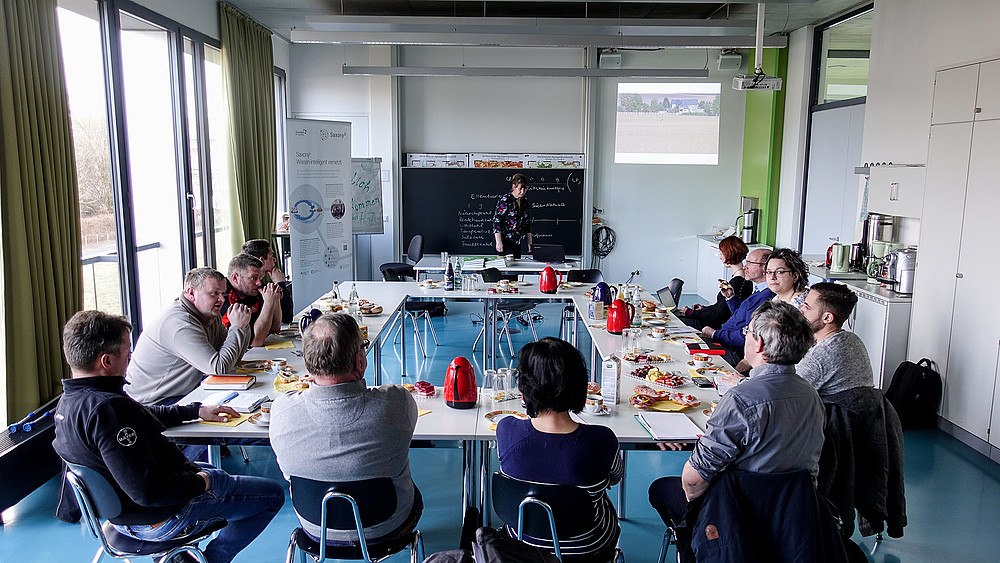
The topic of agriculture is currently very much in the spotlight in the media and on the streets. It also played a role at HSZG on February 11. Nine farmers were welcomed to the Faculty of Natural and Environmental Sciences for a presentation of research findings by Dipl. Ing. agr. Jana Dörnchen-Neumann and Dipl.-Ing. (FH) Samantha Kühnel. Last year, the two researchers set out to determine the level of plant diversity on Ecological Priority Areas designated under the GREENINGS program. Through the mediation of the Farmers’ Association, they gained the trust of the farming operations—on the condition “that the areas not be immediately declared a biotope just because a skylark is found there.”
The two researchers have now presented the results of their studies, which were conducted on a total of 36 selected plots across 10 farms in the Görlitz district. It was encouraging to see how many different measures the region’s conventionally managed farms are already implementing to increase biodiversity: field margins, erosion control strips, forest edges, riparian zones, flowering areas, fallow land, and late-mowed meadows… As a result, several plant species that are in decline or whose survival is threatened were found in the fields and meadows. From Jana Dörnchen-Neumann’s perspective, there is still much more that can be done; however, she was very pleased with the results.
At the same time, calls for greater biodiversity on agricultural land are currently a somewhat contentious issue. Farms must prioritize economic considerations above all else and are subject to numerous regulatory constraints that leave them little room for entrepreneurial maneuvering. For now, the researchers see their commitment as being solely to science and the conservation of biological diversity. It was all the more gratifying, then, that discussions took place in an open atmosphere, with each party respecting the other’s perspective. In addition to addressing problems—such as nutrient runoff from agricultural land or overly intensive grassland use—the discussion also covered potential solutions, such as making greater use of funding opportunities and better applying the tools of the GREENINGS initiative. The debate reflected the full spectrum of the current discussion surrounding agriculture: the Fertilizer Ordinance and nitrates in groundwater, the purchase of agricultural land as an investment, insect protection and pest control, low prices for agricultural products, and so on. The discussion also made it clear that it is not easy for local farmers to operate successfully from a Business Administration perspective under a wide variety of legal frameworks—such as EU subsidy law, nature conservation law, water law, and the Emission Control Ordinance—while simultaneously meeting all the requirements that various stakeholders place on them.
After a short lunch break, Andreas Jedzig spoke about his work as a C1 agricultural advisor and encouraged the farmers in attendance to take greater advantage of his free consulting services on nature conservation issues.
In the end, everyone agreed—there needs to be many more events like this where the various stakeholders can come together. And next time, perhaps not only farmers and researchers, but also representatives from politics, government agencies, administration, and associations. Because it became clear once again—talking to one another builds trust and mutual understanding.
The research and the event were funded by the SMWK and Saxony⁵.
Text: Martin Kunack

First floor
First floor