
Chalk for sense
Four culture and management students from the HSZG organized a social experiment on the topic of "Meaning and Happiness".
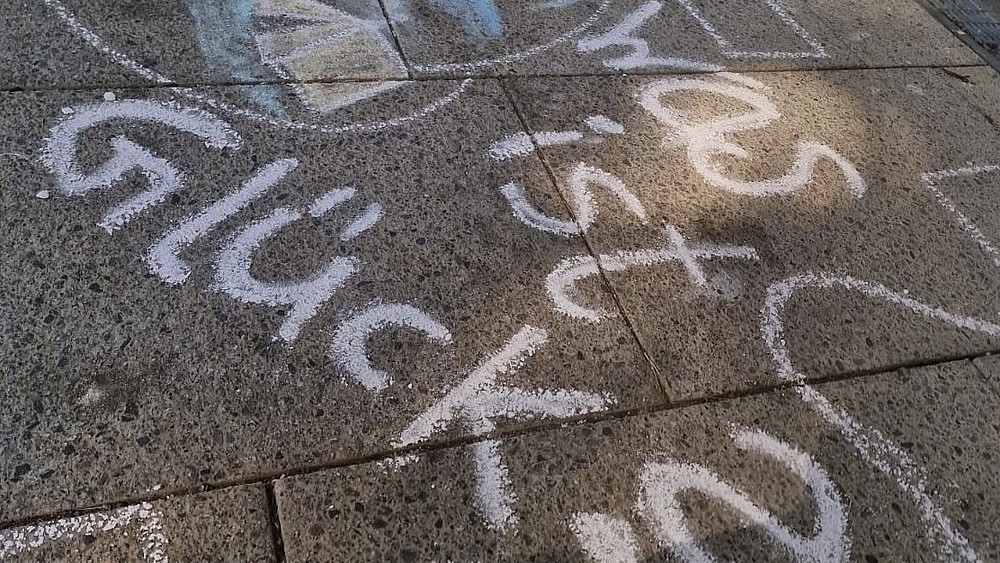
On the topic of “Meaning and Happiness,” four Culture and Management students from Zittau/Görlitz University of Applied Sciences organized an event led by Maik Hosang to analyze the perspectives of young adults and stimulate discussion.
The project was conceived as part of the “Philosophy of Culture and Aesthetics” module and carried out by John Ledzbor, Selina Henker, Sophie Starke, and Romy Wolf. Student Romy Wolf reports on the event:
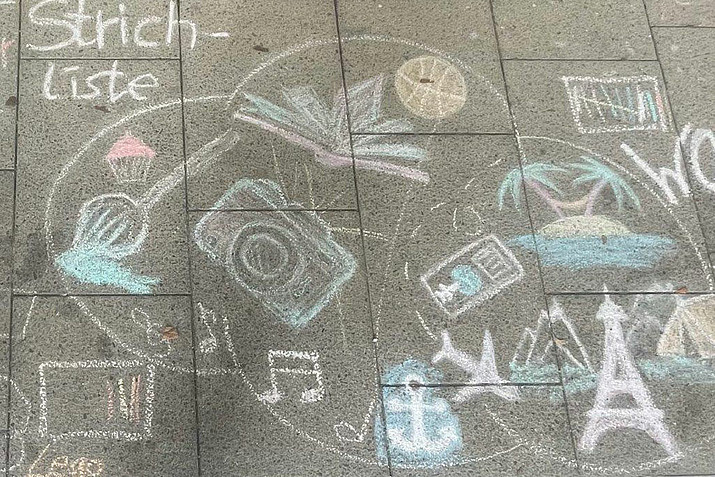
After finalizing the details, getting in touch with, and coordinating with the relevant officials at our university, we created a colorful design in a centrally located open space in front of the student canteen on our campus. We created a collage of chalk drawings. To do this, we gathered general themes related to “meaning and happiness in life” and depicted them on the ground in the form of symbolic drawings. Our categories—which participants could later identify with—were:
family, friendship, hobbies, vacations, the environment, career, wealth and success, social engagement, love, religion, and finally, freedom.
To encourage participation in our small social experiment, we reached out to students at our university as well as children at the nearby elementary school through posters that did not fully explain the purpose of our activity but simply asked in which of the drawings they would find happiness or meaning in their lives. To be able to assess later which symbols and categories were most important to our participants, we provided them with chalk so they could mark a check in the empty boxes provided for that purpose. Then it was time for us to observe.
Reactions
The first reactions from students soon became apparent. They ranged from “That’s cool and profound!” to “I’m too old for that” to “They drew everything with chalk … just like kids!” We had hoped for more positive reactions. But to our great delight, more and more passersby joined in, picked up the chalk, thought for a moment, and added their marks to the symbols that meant the most to them.
We were particularly thrilled by the responses to the question“What is the meaning of life, philosophically speaking!” and by the photos taken by participants. Since our university campus is open to the public and the student canteen is also used by people from outside the university, many passersby were able to get involved. A large group of children from the nearby elementary school eventually discovered our artistically designed floor space and literally pounced on the chalk. They quickly made their marks and eagerly added new little drawings.
Categories
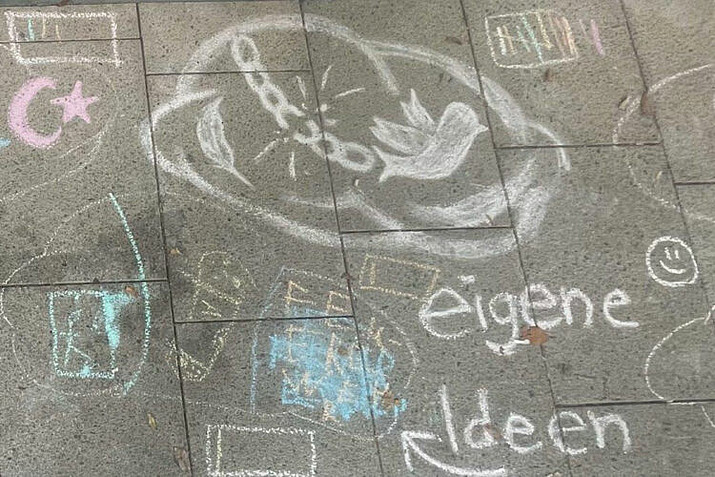
The career aspiration “firefighter” and the material leisure activities featuring “Lego” and “Nintendo” brought a smile to the faces of many passersby, but above all, the categories of friendship, family, and the environment—as viewed by the children—touched our hearts. In nearly every category, new little pictures emerged, bringing our entire creation to life. More and more categories also appeared, such as “imagination,” “food,” and a little platypus, which, fortunately, was also approved with just four strokes.
The Results
Our participants most frequently associated meaning and happiness in their lives with friendship (17 votes), freedom (16 votes), and food and the environment (15 votes each). Religion (3 votes), wealth (5 votes), imagination, and education (7 votes each) received the least support.
CONCLUSION What can we take away from this?
What struck us most was that the children approached our initiative with far less bias and greater freedom, answering questions with enthusiasm, reflected on the topic, and were eager to share their thoughts—unlike young adults, who, likely due to the spirit of the times, the ever-increasing fast pace of life, and the shifting of personal priorities influenced by external factors such as money and the pressure to perform, appeared less open and motivated.
However, we are certain that even those who did not want to participate at least paused for a moment to think about the topic and perhaps reflected on their own thoughts and goals—at least, that is what we sincerely hope.
Thanks to the eye-catching nature of our campaign, we certainly succeeded in drawing attention to the topic of “meaning and happiness”—something we would like to see more of in general. That’s why we’re coming away from this social experiment completely satisfied and believe that it was definitely worthwhile for us.
And in which categories would you have set your priorities?
The report on the social experiment was recently published in the national portal "Purpose - Das Magazin für Sinnhaftigkeit".
2nd upper floor