
"Not a must, but unstoppable!"
The guidelines for gender-sensitive language at the HSZG go online.
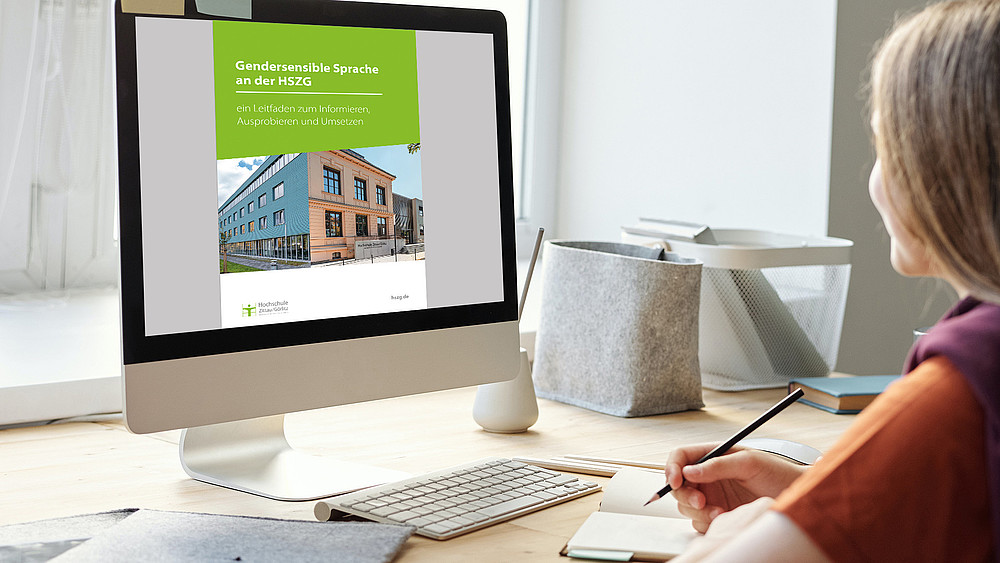
The university’s own gender-inclusive language guide was published on March 7 on the University Information Portal (HIP). It is the result of intensive discussions held by a working group consisting of four dedicated staff members from the HSZG:
- Prof. Dr. phil. Annette Muschner from the Faculty of Managerial and Cultural Studies,
- Dr.-Ing. Jana Reinhold, Equal Opportunities Officer at the HSZG, and
- Antje Pfitzner, M.A., from the Office of University development and communication, responsible for public relations, and
- Dr. rer. pol. Peggy Sommer from the Office of University development and communication, responsible for Quality management at the HSZG.
In the interview, they describe what the gender-inclusive language guide is all about, what key tips it offers for internal communication, and how the collaboration unfolded.
"The Gender Language Guide is not a linguistic publication. Rather, it is a clearly structured set of recommendations for anyone who would like to use gender, but doesn't know exactly what options they have," explains Prof. Muschner.
”The numerous discussions led to a practical compromise for the university. “On more than one occasion, my three co-authors brought me back down from my linguistic theory cloud to their everyday university life, ” the linguist says with a smile. She says that in many cases, there simply isn’t enough time in the day-to-day work routine. Quick and clear solutions are needed so that letters, applications, reports, and other documents can be sent out immediately.
With this in mind, the team settled on three priorities: 1. neutral phrasing, 2. the gender star, and 3. dual naming. At the end, for those in a real hurry, there’s even a glossary of gender-sensitive phrases that have already become established at our university. “After all, university-wide guidelines are practical for everyone who doesn’t want to keep stumbling over the same hurdles,” says Prof. Muschner.
Peggy Sommer couldn’t agree more: “From a Quality management perspective, the main goal was to establish a consistent language for internal communication processes—in other words, to set a standard.”
The four HSZG staff members found it personally enriching that they also learned a great deal from one another during the exciting development process. Antje Pfitzner feels the same way: “The great thing about working together was that we all brought our own perspectives and attitudes on the topic to the discussion sessions. We found common ground on many points and learned a lot from one another, so that in the end we created a product we all fully support.”
Equal opportunities officer Jana Reinhold is very happy and proud that the HSZG can now provide its members with a small internal ‘guide’ on gender-inclusive language: “Demand has risen in recent months, even though attitudes toward this topic still vary widely. I hope that with this guide, we can help break down barriers and skepticism and inspire a love for gender-inclusive language.” It is particularly important to her that the guide is understood and used by everyone as a resource.
After all, the question is also: Gender-sensitive language—is it really necessary? “No,” says Annette Muschner. “Gender-sensitive language isn’t mandatory. It’s always a very personal decision. Anyone who wants to continue using the generic masculine form obviously doesn’t need our guide.”
From a linguistic perspective as well, some unreadable and incomprehensible verbal monstrosities are naturally subject to criticism, the linguist notes, but the process can no longer be stopped.“Far too many gender-sensitive words and phrases have already become established in our language.”
This is also impressively demonstrated by the findings of corpus linguistics, which analyzes vast collections of texts from the press, radio, television, and the internet, as well as from government documents, academic literature, and fiction. “So we’re right in the thick of it, ” Annette Muschner is certain.
The team was particularly pleased that there was lively interest in the online conference “Gender-Sensitive Language—Is It Necessary?” offered in January. Around 80 participants accepted the invitation and took part in the discussion.
The gender guidelines are intended to reflect and support language development at the HSZG. New language habits and needs will continue to be incorporated in the future. Jana Reinhold supports this perspective and sums it up:“Developing the guide within our small, motivated team has shown just how challenging and enriching language design can be. That’s why the guide isn’t set in stone. We’ll continue to refine it and welcome any information and suggestions.”
Click here for the gender language guide!
Questions and suggestions are always welcome.
We look forward to your ideas!
Contact: gleichstellung(at)hszg.de

1st floor