
Its name means: "Full of light!"
Chiaki, from Japan, is doing a research internship at the IPM and has impressed everyone with her project and her culture.
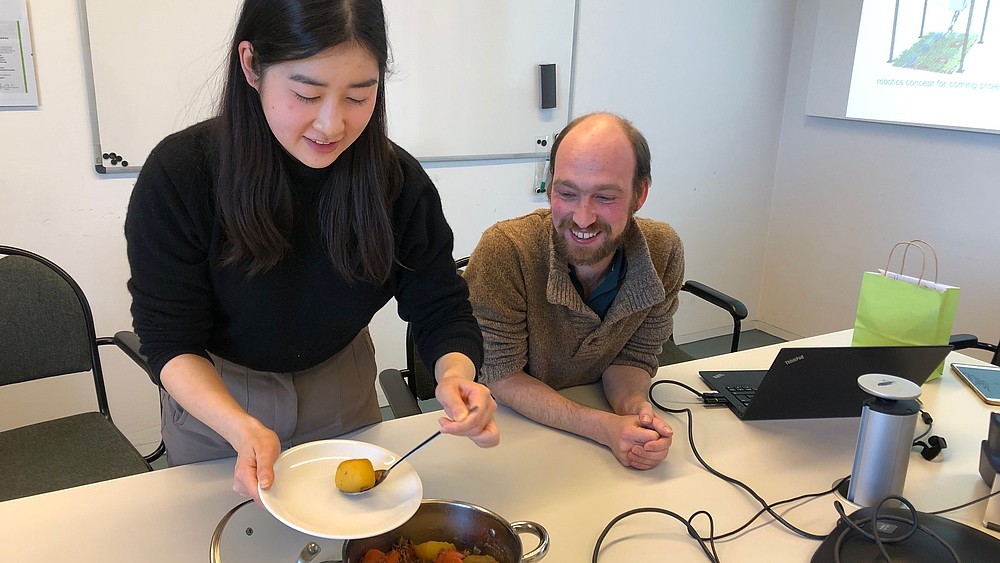
Chiaki Nishihara can’t stop smiling as she plates and serves the traditional Japanese stew, nikujaga. The 23-year-old student from Tokyo has just presented her internship report and can now fully showcase herself as an ambassador for her homeland and its culinary culture. Staff members from the Institute for Process Engineering, Process Automation, and Measurement Technology (IPM) and her advisor, Martin Herling, gratefully accept the offering.
Chiaki spent three months conducting research at the IPM. The overarching goal of the project is to use a robot to determine optimal conditions for plant growth. “Using parameters defined in advance—derived from analyses and calculations of collected data—the robot should be able to determine the good conditions for plant growth,” explains Martin Herling. “Simply put, if you want to grow carrots next to onions, the robot should already know in advance what soil conditions and what use of irrigation and fertilizer are necessary to achieve the best results in the end.”
Chiaki didn’t quite get that far during her three-month stay, the research assistant notes with a smile. There’s still a long way to go before reaching the final goal—the use of artificial intelligence in agriculture. But through her programming work and the collection of data sets on the growth of conventional wheat, Chiaki has made a valuable contribution to the research.
Using a camera, she filmed the plant in time-lapse over several days. She analyzed the resulting images to derive data models for plant growth, which ultimately form the basis for the work of an AI-controlled robot.
For Martin Herling, Chiaki is the first intern he has supervised as part of his research project. He is very satisfied with the collaboration and emphasizes that he deliberately gave Chiaki plenty of room to try things out for herself and incorporate her interests. "In the three months, we got as far as image analysis. The functions that were developed can now also be edited and expanded thanks to open source technology," he summarizes.
In addition to the presentation of their research results, there was also time for a brief introduction to Japanese writing.
"For example, my name is made up of the two characters for 'one thousand' and 'brightness'. So together they mean something like 'full of light'," explains the likeable student Chiaki Nishihara.
”This culture-loving Japanese woman made the most of her three-month internship in Germany, funded through the IAESTE program, reports Martin Herling. With side trips to Poland, Sweden, and Switzerland, she explored a large part of Europe in that short time. Her next stop will be seamlessly “across the pond.” In the U.S., the 23-year-old—who is actually studying immunology in her hometown of Tokyo—will continue her master’s program during a six-month stay. She’s taking the fond memories of her time in Zittau and German culture with her.
The Sächsische Zeitung published the article: "Japanese woman researches in Zittau" on 04.03.2022.
IAESTE stands for: International Association for the Exchange of Students for Technical Experience.
The program is about the placement and perception of work-related internships, preferably in the natural sciences and engineering. More than 90 countries around the world participate in the program.
Curious to find out more? Find out more here!
Text: Cornelia Rothe M.A.

2nd upper floor