
Hildebrand Prize for Egmont Schreiter
Once a winner of the Neiße Electrical Olympics himself, Egmont Schreiter is being honored for his many years of dedication to promoting young talent in the field of technology.
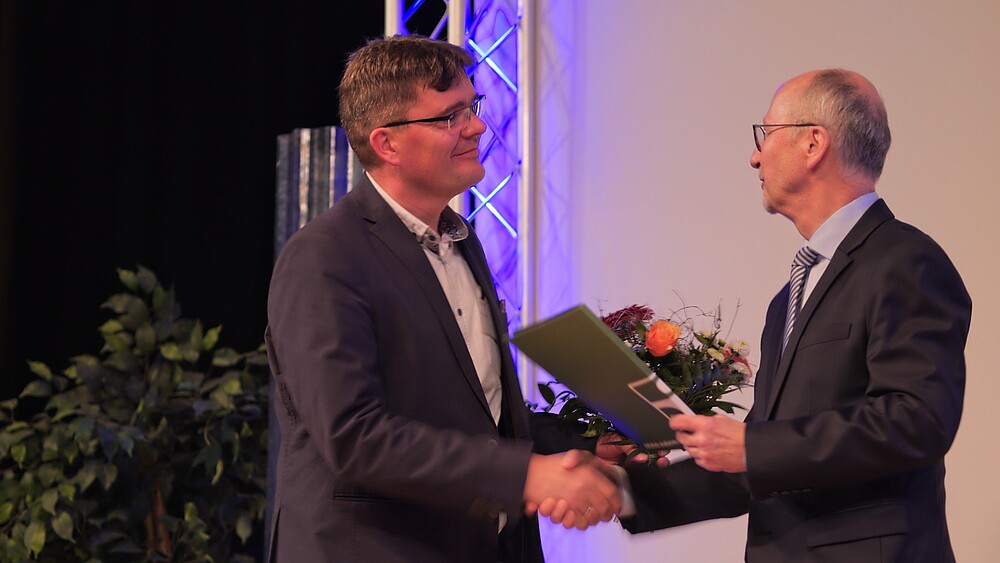
In 2000 , Egmont Schreiter, then a high school student , won the “Neisse-Elektro” Electrical Engineering Olympiad. Twenty-six years later, Schreiter—now a laboratory engineer in the Faculty of Electrical Engineering and Computer Science at Zittau/Görlitz University of Applied Sciences—received the Prof. Hans-Joachim-Hildebrand Prize. The University recognized his exceptional commitment to the technical education of young people. The award was presented on November 13, 2026, as part of the “75 Years of Electrical Engineering” celebration.
From Olympic Champion to Organizer
Egmont Schreiter still remembers his own participation in good detail. His teacher at the time had encouraged him to take part in the Olympiad. He was surprised even to himself that he ended up taking first place. As a prize, he received a computer that was so large he couldn’t transport it home on his moped. Above all, however, this success reinforced his career path.
He remained loyal to electrical engineering. After working as a development engineer in industry, Egmont Schreiter joined the HSZG in 2007. Since 2009, he has worked as a laboratory engineer and supervises hands-on classes / courses in various laboratories. In addition, he organizes programs for high school students, conducts laboratory tours, and provides insights into technical coursework.
He has also remained involved with the Olympiad. He has been actively involved in its organization since 2010 and has held overall organizational and technical responsibility since 2013. The competition brings together high school students from Germany, Poland, and the Czech Republic and was held for the 32nd time in 2026.
Discover Technology and Create It Yourself
What Egmont Schreiter particularly appreciates about his work are the small successes young people experience. For example, when students build a mobile robot during an internship, learn how motors and sensors work, and ultimately program it themselves.
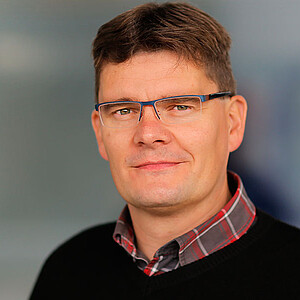
What makes me happiest is when students realize what they are capable of achieving on their own. When they start developing and trying out their own ideas, that’s the greatest success for me.
”His involvement extends beyond competitions and lab programs. As part of the “Zukunftslernort Oberlausitz” (ZukLOS) educational initiative and the Campus4U project, he played a key role in designing the makerspace, equipping the AirLab, and developing concepts for the Green Classroom and the Energy Trail. He also helped bring the wind-photovoltaic tree on campus to life.
These programs offer students the opportunity to explore technical concepts hands-on, bring their own ideas to life, and gain experience with science and technology.


An award with a long tradition
The Prof. Hans-Joachim-Hildebrand Prize is named after the founding rector of the former Zittau University of Engineering. Hans-Joachim Hildebrand initiated the establishment of the science prize in 1988. In addition to scientific achievements, he also placed great importance on training qualified young professionals. The foundation’s assets are managed by the Friends of Zittau/Görlitz University of Applied Sciences, which, together with the university, laid the groundwork for the award.
In his laudatory speech, Prof. Dr. Wolfgang Kästner from the Faculty of Electrical Engineering and Computer Science paid special tribute to the award recipient’s personal dedication:
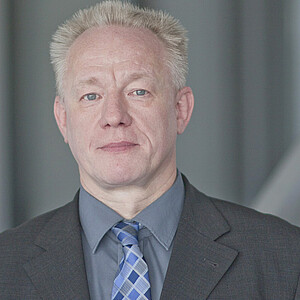
Such commitment cannot be mandated. It stems from personal conviction, a sense of responsibility, and passion.
”The ceremony took place in the presence of Hans-Joachim Hildebrand’s son. Rector Prof. Dr. Alexander Kratzsch, Vice President Prof. Dr. Sophia Keil, and Mario Linack, chair of the Friends of the University Association, also attended the ceremony.
Egmont Schreiter himself views the award as recognition of a collective achievement. He emphasizes that his work is only possible thanks to dedicated colleagues and the freedom he enjoys at the University. He is grateful for this environment and hopes to continue helping shape it in the future.
1st floor
1st floor