
Together for heat planning
HSZG discusses challenges and solutions in municipal heat planning with local authorities, energy suppliers, research and industry representatives.

On October 26, the hybrid information and discussion event “Municipal Heat Planning—Challenges and Solutions” took place at CELSIUZ, the transfer laboratory of Zittau/Görlitz University of Applied Sciences. The event marked the kickoff of a series of events that Zittau/Görlitz University of Applied Sciences is planning in collaboration with the Saxon Energy Agency – SAENA GmbH – to support municipalities in implementing the upcoming mandatory requirement for heating planning.
For the first time, stakeholders from all relevant sectors were to come together, address their specific questions, and engage in dialogue.
Prof. Matthias Kunick of Zittau/Görlitz University of Applied Sciences, as subproject manager for the “Energy” transfer field within the Saxony5 consortium, welcomed the nearly 60 representatives from municipalities, regional energy providers, planning firms, research institutions, and economic development agencies, and kicked off the event with an overview of the current state of heat supply and the objectives of the Heat Planning Act and the Building Energy Act.
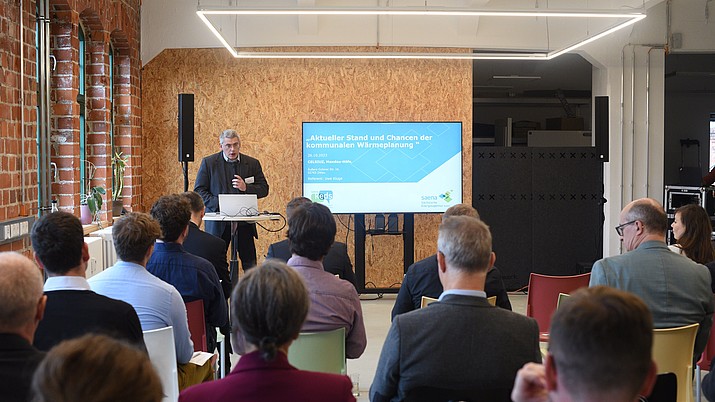
In the first keynote presentation , “Current Status and Opportunities for Municipal Heat Planning,” Mr. Uwe Kluge of SAENA (Saxon Energy Agency GmbH) emphasized the importance of a heat supply strategy that must provide planning certainty for both consumers and suppliers. He explained the requirements for municipal heat planning in detail and highlighted improvements that were incorporated into the final text of the law between the draft bills. He also described how the Heat Planning Act and the Building Energy Act, which will take effect on January 1, 2024, are intended to work together.
The second keynote presentation was delivered by Mr. Kai Kaufmann, Managing Director of Energie- und Wasserwerke Bautzen GmbH (EWB). In his presentation titled “Municipal Heat Planning and the Transformation Plan in Bautzen,” Mr. Kaufmann discussed the challenges of municipal heat planning from the perspective of a utility company. He made it clear that, given the changing legal framework, heat planning at his company is an ongoing process aimed at ensuring a secure, economical, and climate-friendly heat supply. Mr. Kaufmann presented the current state of heat supply in Bautzen and explained the available potential. He also provided information on outstanding issues regarding the financing of heat planning and its practical implementation.
The keynote presentations were followed by brief remarks from representatives of municipalities and energy utilities, who commented on the current status of municipal heat planning in their respective communities. In addition, research institutions such as Zittau/Görlitz University of Applied Sciences, the Fraunhofer Institute for Energy Infrastructures and Geothermal Energy (IEG, Zittau), and the Institute for Air Conditioning and Refrigeration Technology (ILK, Dresden) presented concrete support services and technical solutions.
The subsequent discussion and Q&A session was co-moderated by Prof. Matthias Kunick and Dr. Clemens Schneider from Fraunhofer IEG. Topics discussed included a potential mandatory connection to district heating networks, the scarcity of biogenic fuels and other renewable energy sources, the feasibility of retrofitting existing buildings, the costs of restructuring the heat supply, and the implications for residents.
The event concluded with a presentation by Mr. Armin Verch from SAENA, who provided information on “Funding and Services Offered by the Municipal Heat Planning Service Center.” He reiterated that municipalities can provide their residents with planning certainty through heat planning. He also provided information on funding opportunities and resources for municipal heat planning.
A survey conducted after the event showed that participants are very interested in continuing this format and that the exchange between representatives of municipalities, regional energy suppliers, planning firms, research institutions, and economic development agencies helps to identify solutions to the challenges of the heating transition.
A follow-up event is therefore planned for March 2024 in Zittau, which will once again be organized and hosted jointly by Zittau/Görlitz University of Applied Sciences and SAENA.
- Energy infrastructure for the climate-neutral supply of electricity and heat
- Thermal energy storage
- Use of surface waters for the provision of heating and cooling
- Possibilities of near-surface and deep geothermal energy for heating networks
- Utilization of industrial waste heat
- Utilization concepts and technical solutions for energy-intensive leisure facilities
Prof. Matthias Kunick (Department of Energy System Technology, sub-project manager of the "Energy" transfer field) with the main research areas:
- Regenerative heat supply: Heating networks & district solutions
- Building energy concepts
- Infrastructure expansion
Mareike Schneider (Transfer network project Saxony5, transfer field "Energy"):
- Transfer employee
- Supervisor of the "Energy" network
- Event management