
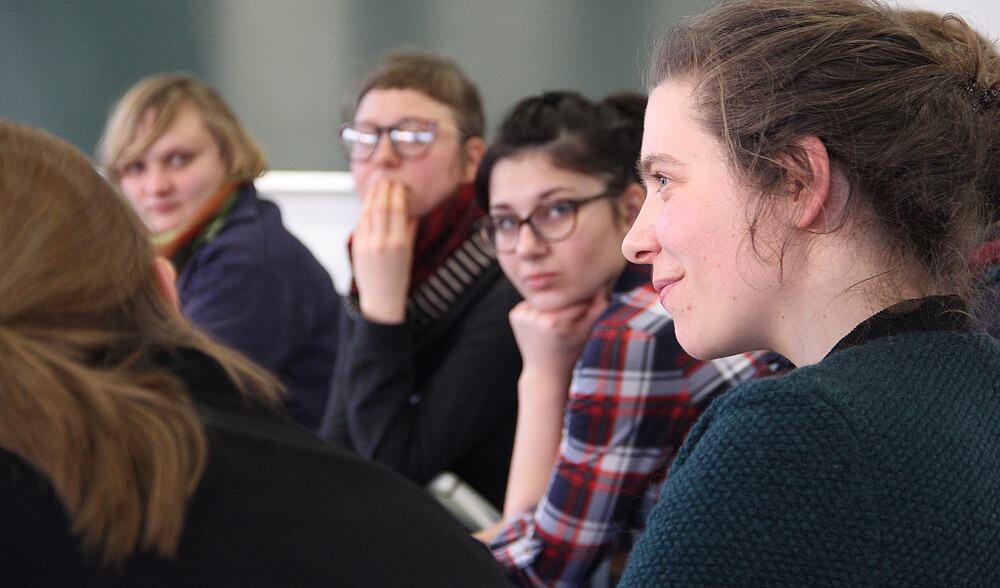
About 60 women and (a few) men attended the symposium “F for Strength – Women. Life. Upper Lusatia” at the university on January 26, 2018. The closing event for the research and practice project on the conditions for retaining and the development opportunities for qualified women in Upper Lusatia (more info here) brought together project participants, interested members of the public, and representatives from regional government, politics, and business in Görlitz.
In the morning, project coordinator Julia Gabler (TRAWOS Institute) and Ines Fabisch (Equal Opportunities Officer for the Görlitz district and project sponsor), together with staff members and participants, summarized the stages of the research and outreach efforts leading up to the project’s implementation. This was followed by the opening of the reflection session led by Professor Ulrike Gräßel (HSZG, F-S), titled “From Talking About Women to Talking With Women.”
Mr. Frank-Peter Wieth, Head of the Gender Equality Division at the Saxon State Ministry of Social Affairs and Consumer Protection, spoke about women and the difficult position his department faces in current political debates. Afterward, Heike Zettwitz, Head of the Economic Affairs Department at the Görlitz District Office, outlined possible development prospects for the region—providing ample material for the subsequent discussion and, above all, for the workshops that followed.
The afternoon of the symposium was entirely dedicated to women as creators and initiators and opened up opportunities to discover (surprisingly) female perspectives on the region. The clowning workshop led by Valentin Hacke (Kulturbrücken e.V.) offered the opportunity to unexpectedly shift perspectives, let loose, and simply follow the (clown’s) nose.
A second workshop with Regional Manager Ansgar Kaup (Richter + Kaup, Görlitz) and Sandy Marschke from the Görlitz Office for District Development explored women’s development perspectives in rural areas, yielding exciting results. “Welcome 2018” was the theme of the third workshop, in which the Queer Film Festival, the Women’s* Forum, and Ladies’ Night—alongside the Upper Lusatia Alliance for the Future, KoLABOR, and other regional initiatives—impressively showcased what it means to settle in and stay here.
At the end of the day, it seemed less like the conclusion of a project was being celebrated and more like the beginning of a new journey. Prof. Ulrike Gräßel’s concluding remarks pointed the way forward: “Make women visible, reach out to women, welcome women—in the city, in the countryside, and in the Görlitz district! We still have a lot of work to do.”
Following the symposium, the closing event of the three-year research and project cycle will take place on March 2, 2018. Together with Petra Köpping, Saxony’s State Minister for Equality and Integration; Bernd Lange, District Administrator of the Görlitz district; Friedrich Albrecht, Rector of the Zittau University of Applied Sciences/Görlitz, Prof. Dr. Friedrich Albrecht, and the Chair of the Saxon State Women’s Council, Susanne Köhler, the political impact of the project will be discussed and an outlook provided: How can the potential of women’s perspectives in the Görlitz district be supported and better realized?
Contact
Dr. Julia Gabler
TRAWOS Project Coordination
Phone: 03581 374-4345
Email: j.gabler(at)hszg.de