
"One university - one book"
The HSZG is one of ten universities receiving funding as part of the joint programmes “One University—One Book,” organized by the Stifterverband and the Klaus Tschira Foundation in cooperation with DIE ZEIT.
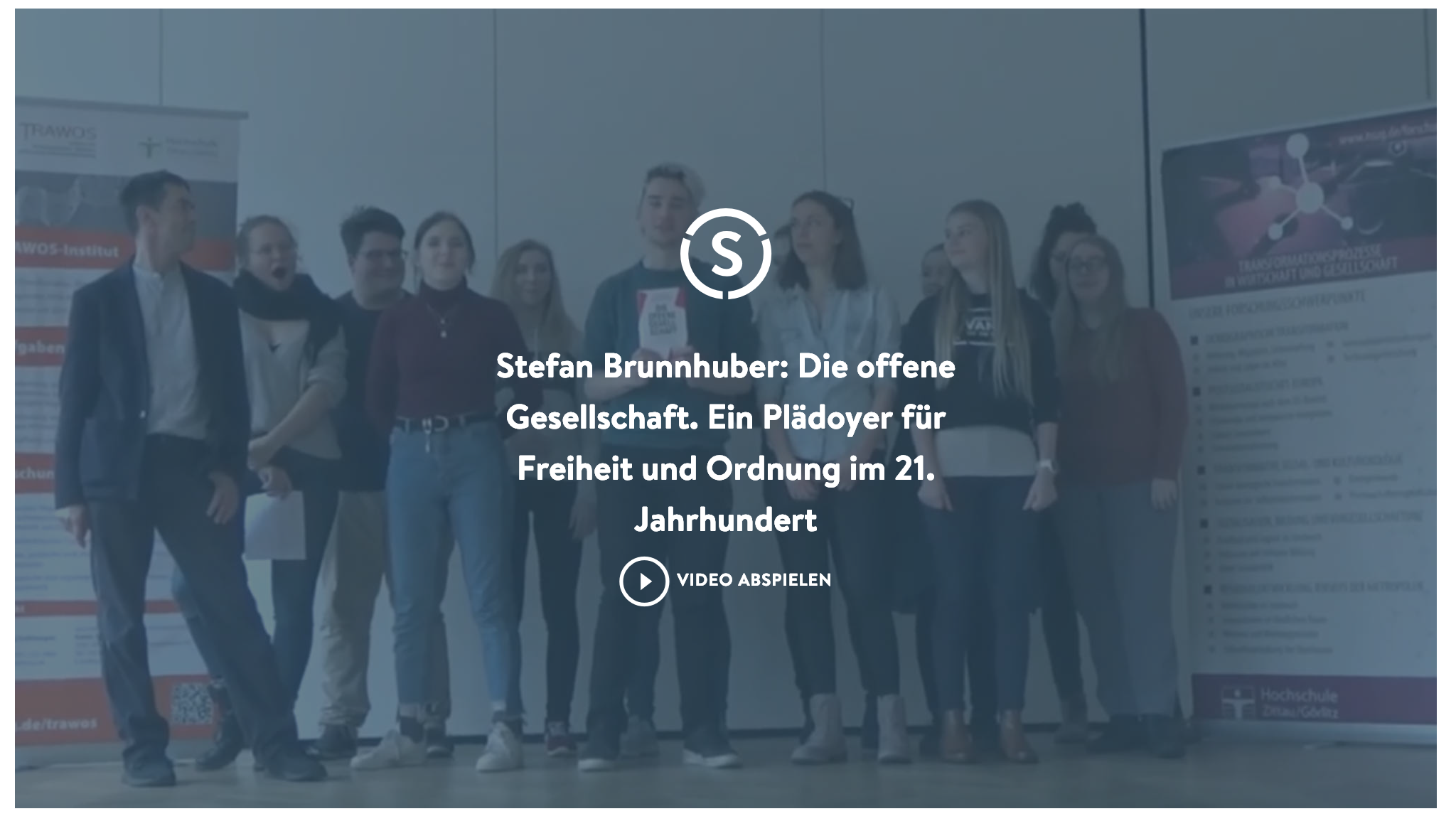
Zittau/Görlitz University of Applied Sciences is among the winners of the competition
The grant amount for each winning university is 10,000 euros for the implementation of the project. The funds are earmarked for the fulfillment of the tasks of Zittau/Görlitz University of Applied Sciences. They are intended to support the implementation of the award-winning project “The Creative Challenges of Open Societies at Their Peripheries: The Case of the Transformation Process in Lausitz” based on Stefan Brunnhuber’s book *The Open Society: A Plea for Freedom and Order in the 21st Century*. “We are very pleased that our university is among the winners of this competition,” said Rector Professor Alexander Kratzsch.
“What does an open society mean to you?”
Dr. phil. habil. Maik Hosang had participated in the competition with his students at the time with this project. What motivated them to do so? “We live in a time full of exciting and, at times, threatening challenges—the key terms being climate change, digitalization, globalization, etc. There are no ready-made solutions for all these issues of the future; rather, they must be sought and found together through open and interdisciplinary discourse. But this open discourse is not always easy, since even scientists tend to confine themselves to their own specialized fields. Thus, it is easy to celebrate the successes of new technologies, but difficult to simultaneously discuss their social and psychological effects. Moreover, since unresolved crises also trigger fears, quite a few people tend to regress or cling to premodern, non-open, and ideologically closed forms of thought. This also affects significant segments of the population in all modern European democracies—and especially in places where global challenges are further exacerbated by specific regional crises: for example, the structural transformation in Lausitz driven by the phase-out of coal.
Karl Popper addressed this central theme in his book *The Open Society and Its Enemies*. And Stefan Brunnhuber—Professor of Psychology and Transformation at Mittweida University of Applied Sciences—further developed these ideas for the present day in his book *The Open Society. A Plea for Freedom and Order in the 21st Century.” Building on this, faculty and students at the HSZG are organizing various discussions centered on this core competency. This will take place in four formats: an interdisciplinary lecture series, a conference with students, faculty, representatives of regional civil society, and experts from beyond the region, the integration of the topic into the curriculum of various degree programmes, and a short contest for students from various faculties on the topic: “Write down in three sentences or draw a picture: What does an open society mean to you?”
The Spirit of a University
With the “One University—One Book” competition, the organizers aim to strengthen dialogue and foster a sense of belonging among all university members, spark discussion through the selected book, and generate enthusiasm for a shared topic. It is up to the universities to decide whether, due to the current COVID-19 situation, they will postpone their planned activities to the next semester or launch them as early as the summer semester using creative virtual formats. “Especially in times when we cannot meet in person, engaging with a book together across the entire university offers a good opportunity to creatively counteract isolation,” says Volker Meyer-Guckel, Deputy Secretary General of the Stifterverband. “The spirit of a university is not only evident in lectures and seminars,” emphasizes Beate Spiegel, Executive Director of the Klaus Tschira Foundation. “It is also reflected in how good staff members from a wide variety of departments communicate with one another. ‘One University—One Book’ fosters this sense of community through discussion of a topic chosen by the university itself.”
The decisive factor in funding the projects was not the work itself, but the rationale for why it was selected and the plan for how communication about it would take place. Unconventional communication formats are intended to encourage engagement with a topic across all hierarchical boundaries, further develop the culture of communication at universities, and strengthen the connection between universities and society.
Detailed information on the winning projects can be found here.
2nd upper floor