
A novel for the 60th birthday
In this interview, Steffen Seifert from the University Language Centre talks about his fascination with languages and his self-fulfilled lifelong dream.
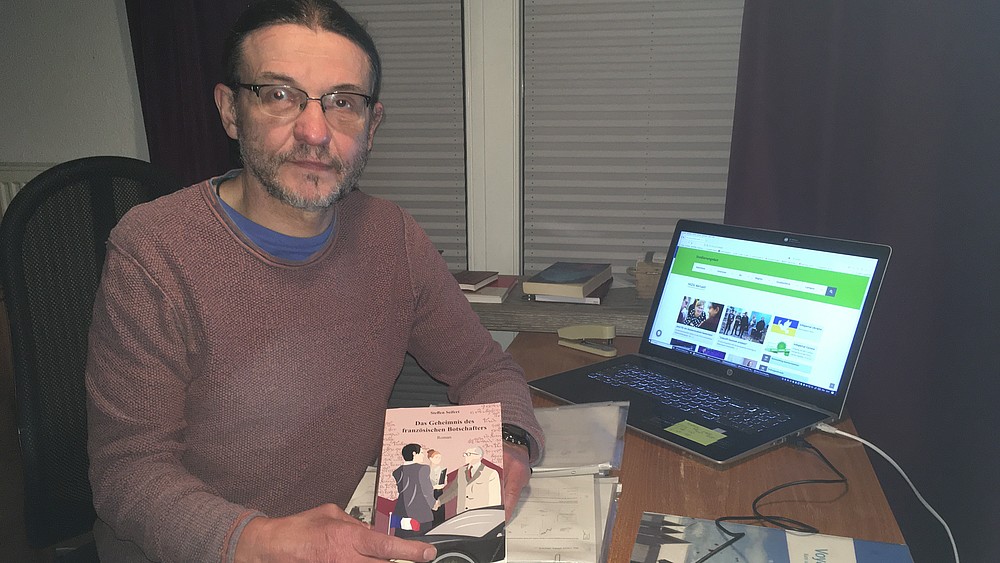
Steffen Seifert is a Diplom language mediator as well as a trained secondary school and vocational school teacher and has been working at the University Language Centre of the HSZG for five and a half years now. He teaches English, French and German as a foreign language for a wide range of degree courses during the semester. In this interview, he gives an insight into the wide range of languages on offer at the HSZG and reveals where his fascination for languages comes from and what lifelong dream he realized for his 60th birthday.
Mr. Seifert, you’ve been working at the University Language Centre since September 2017. What does a typical workday look like for you?
During the semester, it’s the typical daily routine for a teacher. In the mornings, I teach classes / courses in Görlitz or Zittau, usually in blocks of four semester-week hours. In the afternoons, depending on my schedule, I have additional classes / courses, followed by a thorough review of the material. For me, it’s important to analyze what was good in class and what perhaps didn’t quite work, as well as which points I should review more thoroughly with the students next time. Afterward, I update the materials in OPAL to give students the opportunity for independent study and review. Next, I send an email to the students with the self-study assignments. On days spent entirely in the office, I also work on the long-term revision or redesign of courses and try to incorporate new teaching materials and current topics into my planning.
What sets the Language Center at HSZG apart, and what does the current program look like?
Our Language Center is, so to speak, a service provider for the entire university. We offer courses for all fields of study in English, German as a Foreign Language, Italian, Spanish, French, as well as Polish, Czech, and Russian. As far as possible, we strive to ensure that the subject matter of the courses is tailored to the respective field of study. Our goal is to prepare our graduates for professional life in English and in one additional foreign language. In the high-responsibility positions that all our students aspire to, the ability to communicate fluently in foreign languages and within their respective fields is simply an absolute must.
What did you mean by “potentially” here?
We are, of course, pleased that mandatory language training is firmly established in many degree programmes. After all, this is the only way to ensure international cooperation and intercultural understanding. However, we would like to see mandatory language courses play a more prominent role even in those fields of study where this is not yet the case. After all, this is ultimately in the best interest of our graduates, who might otherwise have to spend additional time and money in their free time taking continuing education courses later on in order to fully meet the requirements of their respective employers.
Do you have a favorite subject that you teach?
Yes, I really enjoy teaching French. Since it is—at least in Germany—the second most commonly taught language after English, I would like to see French given a little more emphasis in order to achieve the communication skills in English and another language that I mentioned earlier. I’m thinking, for example, of students in Tourism Management or culture and management—but why not future computer scientists as well?
Have you always worked as a language teacher, and why does this subject fascinate you so much?
In my 35-year career, I’ve worked both as a translator and interpreter—including many years at Bombardier in Görlitz—and as a teacher at various types of schools. Yes, for me, languages have something alluring, fascinating—almost magical. After all, we need language for everything we do: identifying, analyzing, and solving problems; understanding our history and learning from it; understanding our place in this world; and, of course, arguing, discussing, and debating.
My professional career began in 1988 with a position in the interpreting department of the GDR’s Ministry of Foreign Affairs. It was there that I first found significant inspiration for my book. Of course, I didn’t realize that at the time. But I’d always known that I wanted to do something creative with language. And what could be more creative than a novel you’ve written yourself that tells a—hopefully exciting—story? When another idea came to me in 2016 during a guided tour of Görlitz—an idea whose background is deeply rooted in the city’s history—I knew for certain that I would finally fulfill a lifelong dream and write a novel. It was published last October.
What is your novel about, and how do you find the time to write alongside your job?
The plot of my book, *The Secret of the French Ambassador*, is what’s known as a “crossover.” It’s a combination of East German history, Görlitz history, scientific facts, and… a touch of mysticism. In my book, I explore a mystery of human history that still hasn’t been fully clarified in every detail. I don’t want to give away any more than that, because we want people to read the book…
Yes, and then there’s the time factor. For the most part, I used my weekends and numerous vacation days, rather than time after work. Of course, I benefited from the fact that the main phase of writing and revising took place during the COVID-19 years from 2020 to 2022. Throughout this process, I always kept my teaching at the university and my work on this book strictly separate. That did, however, require a fair amount of self-discipline.
Were you also inspired by the HSZG, your colleagues, or your students?
When I started working at the HSZG in the fall of 2017, the basic concept for the book was already in my head, so in a sense, the inspiration had already come. But it took nearly three more years before I had developed the narrative arc sufficiently in my mind and began writing in April 2020. Nevertheless, my work here at the university certainly influenced my novel project. In conversations with students, for example, I learned time and again that many of them really enjoy picking up a book and reading in their free time and don’t necessarily prefer video games. That encouraged me in my project. I also once had a lengthy conversation with students about the GDR’s past and could sense a clear interest in that era, which they, of course, do not know from personal experience. Among colleagues, too, we occasionally discuss the pre-reunification period.
I’d like to take this opportunity to thank Andreas Daniel Stock from the culture and management degree programme and other students who led a creative writing workshop on the Görlitz campus last December. There, I had the chance to briefly present my book to an audience for the first time and share my experiences with writing.
English, French, Italian or would you prefer Polish or Czech? You can find the range of courses offered by the University Language Centre of the HSZG and the relevant contact persons here.
First floor