A breath of fresh air
Lausitz research project provides a breath of fresh air for the use of renewable energies in urban areas

On February 1, 2023, the joint project “LausitzWind,” a collaboration between Zittau/Görlitz University of Applied Sciences (HSZG) and the Cunewald-based company Härtwig Mechanical Engineering GmbH & Co. KG, was launched at HSZG. The project focuses on developing a visually unobtrusive, sustainably manufactured, high-performance wind turbine for use in urban areas. For three years, the project will be funded as part of the WIR! initiative “Lausitz – Life & Technology” with funds from the Federal Ministry of Education and Research (BMBF).
The structural transformation in Lausitz is entirely driven by the phase-out of fossil fuels. It is clear, however, that energy needs must continue to be met even after 2038. In addition to generating energy from sunlight, wind energy currently represents one of the most promising alternatives. The well-known large-scale wind farms in rural and coastal areas already reliably supply electricity from renewable sources, but they are unsuitable for operation in urban areas. The reasons for this are manifold, ranging from high noise levels and shadow flicker to the space required. Vertically oriented wind turbines (VAWTs) offer an alternative for populated areas. However, these must be redesigned.
The decentralization of energy supply and the efficient use of local renewable energy sources are key prerequisites for achieving the goal of reducing energy dependence on fossil fuels while simultaneously ensuring energy security. The use of small wind turbines to supplement the energy needs of individual units, such as private households or small and medium-sized enterprises (SMEs), can offer a smart alternative in this regard. As part of the collaboration between Zittau/Görlitz University of Applied Sciences and Härtwig Maschinenbau GmbH & Co. KG in the “LausitzWind” joint project, such a wind turbine is being developed for use in populated areas, with a focus on cost-effective operation and minimal impact on the immediate surroundings.
”LausitzWind - vertical wind turbine rethought
Disadvantages of vertically operated turbines include, for example, the lack of self-start capability or the strongly fluctuating torque on the rotor axis. The LausitzWind project is therefore researching a new, intelligent system for effective adjustment of the rotor blades. Thanks to machine learning, the control system will also automatically ensure efficient alignment of the rotor blades. A general disadvantage of wind turbines is the noise they generate. Each turbine generates what is known as aerodynamic noise, which is comparable to the noise generated by an open car windshield. One component of the overall project is to design the rotor blades in such a way that the noise level is significantly reduced in contrast to comparable turbines.
Problems with the Ecological Footprint of Green Energy
It is clear that the use of renewable energy sources is leading us into an era of environmentally friendly electricity and heat generation. On the other hand, the production of the equipment required for this remains a problem from an environmental perspective.
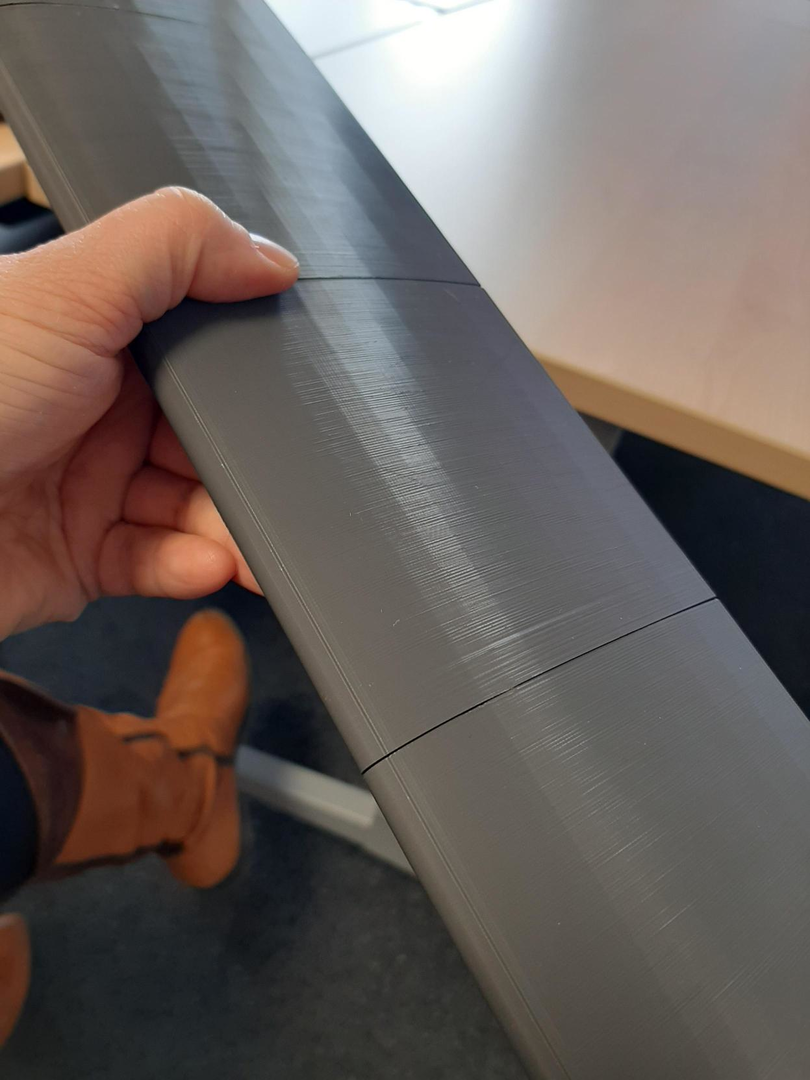
LausitzWind is addressing this issue by researching the use of natural fiber composites for the manufacture of rotor blades. The goal is to replace GRP and CFRP materials with environmentally friendly alternatives. This not only reduces the ecological footprint during manufacturing, but the possibility of recycling the turbine at the end of its service life also plays a major role in this project. For this part of the project, the partners are also collaborating with the LaNDER³ project at HSZG. In doing so, LausitzWind draws on a wealth of experience in the processing of natural fiber composites that has been built up over many years.
Objectives of LausitzWind
The goal of the LausitzWind project is to develop the turbine in accordance with the requirements outlined above and thereby establish new processes and technologies for local industry. For example, during the development phase, experience will be gained in lightweight construction using natural-fiber-reinforced materials, which can then be shared with regional companies.
The project will culminate in the production of a fully functional, full-scale demonstrator by Härtwig Maschinebau GmbH & Co. KG. The project will thus lay the foundation for the manufacture and use of these systems in the Lausitz region.
“Lausitz – Life and Technology” (L&T) – A Strong Alliance for Structural Change
The work of the L&T alliance is focused on positioning Lausitz for the future and contributing to innovative and sustainable regional development through new research and development approaches. In 2019, the consortium partners—Zittau/Görlitz University of Applied Sciences, the Görlitz District, ULT AG, and the Fraunhofer IWU—secured a total budget of approximately 9 million EUR with a joint strategy to positively shape structural change in the Lausitz. Since then, the alliance’s network has grown to over 75 partners. To date, 13 projects have already been successfully launched. With its objectives, the LausitzWind project addresses two of the three L&T innovation fields. It exemplarily combines the topics of “additive manufacturing” and “networked energy (storage) systems.”
L&T project coordinator Leonie Liemich describes the overarching strategy of the WIR! Alliance as follows:
However, the L&T strategy goes beyond the mere development of technologies. Another important dimension for us on the L&T Strategy Team is the integration of technological and social innovations—for example, linking new manufacturing technologies or networked energy systems with topics such as (continuing) education or the acceptance of new technologies in Lausitz, or various participatory formats—and implementing them in R&D projects. After all, without trained specialists and experts, these new innovative technologies cannot be successfully implemented in Lausitz alone or widely adopted by society.
”
4th upper floor