
Insight into the laboratory of the future
Two interns at HSZG developed an interactive AR application for laboratories.
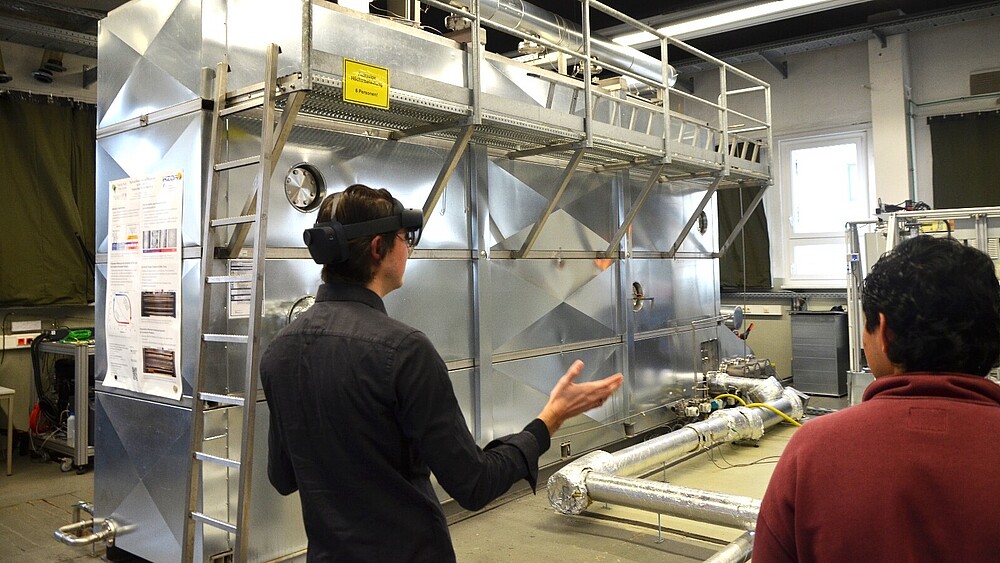
Last November, we welcomed two Mexican mechatronics students, Juan González Morales and Jorge Valle García from the Tecnológico de Monterrey, to the Zittau/Görlitz University of Applied Sciences. As part of the “Mechatronic Project Work” module, they began an internship here with a topic that seemed both exciting and challenging: using an augmented reality (AR) system to create an interactive and immersive experience in a laboratory setting for students and visitors. Juan and Jorge were supervised and provided with technical support by Mr. Fabian Lindner from the Faculty of Business Administration and Engineering Management.
The thermohydraulics laboratory at the Institute for Process Engineering, Process Automation, and Measurement Technology (IPM) was soon chosen as the “test site,” with the main focus of interest being the large-scale test facility there known as the “Zittauer Flow Channel” (ZSW). Juan and Jorge paid many visits to this lab, established close contact with the lab director, Mr. Frank Zacharias, and were given access to technical reports, experimentally recorded measurement data, and technical documentation. Together, they then compiled the information that would be relevant for a virtual lab tour and of general interest.
After completing the 3D scan of the thermohydraulics laboratory, both had access to a virtual 3D model of the laboratory and the ZSW. Within this model, anchor points could be placed in specific locations, which in turn could be linked to textual information, photos, or videos.
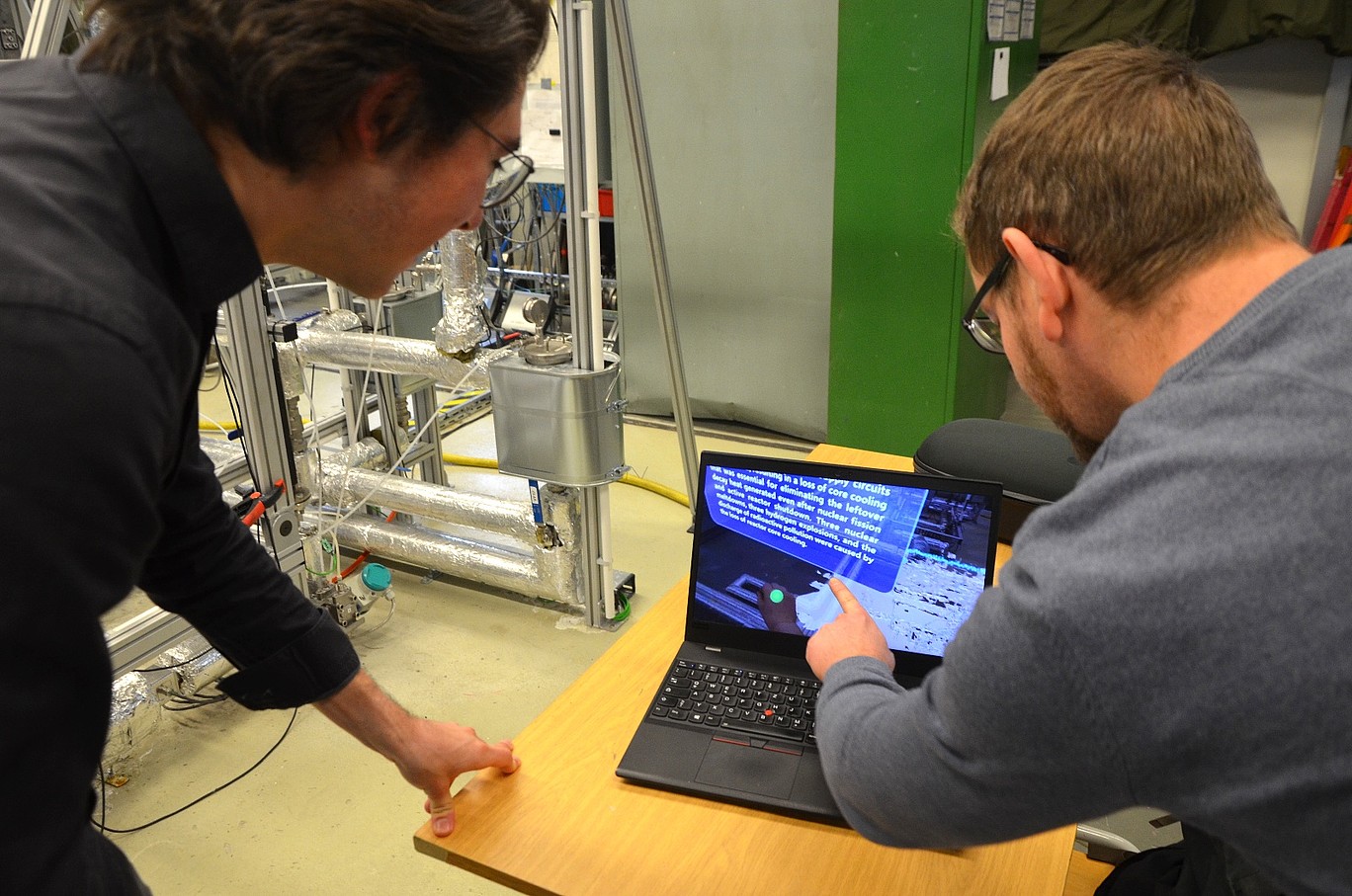
The AR application was implemented in the programming language C# and Unity, a runtime and development environment that enables the creation and execution of interactive real-time 3D content. Even in the early stages of development, both students recognized the need to correctly link the virtual and real environments: The positions of the lab visitor had to be identical in both the real and virtual 3D environments. However, a practicable solution was soon found.
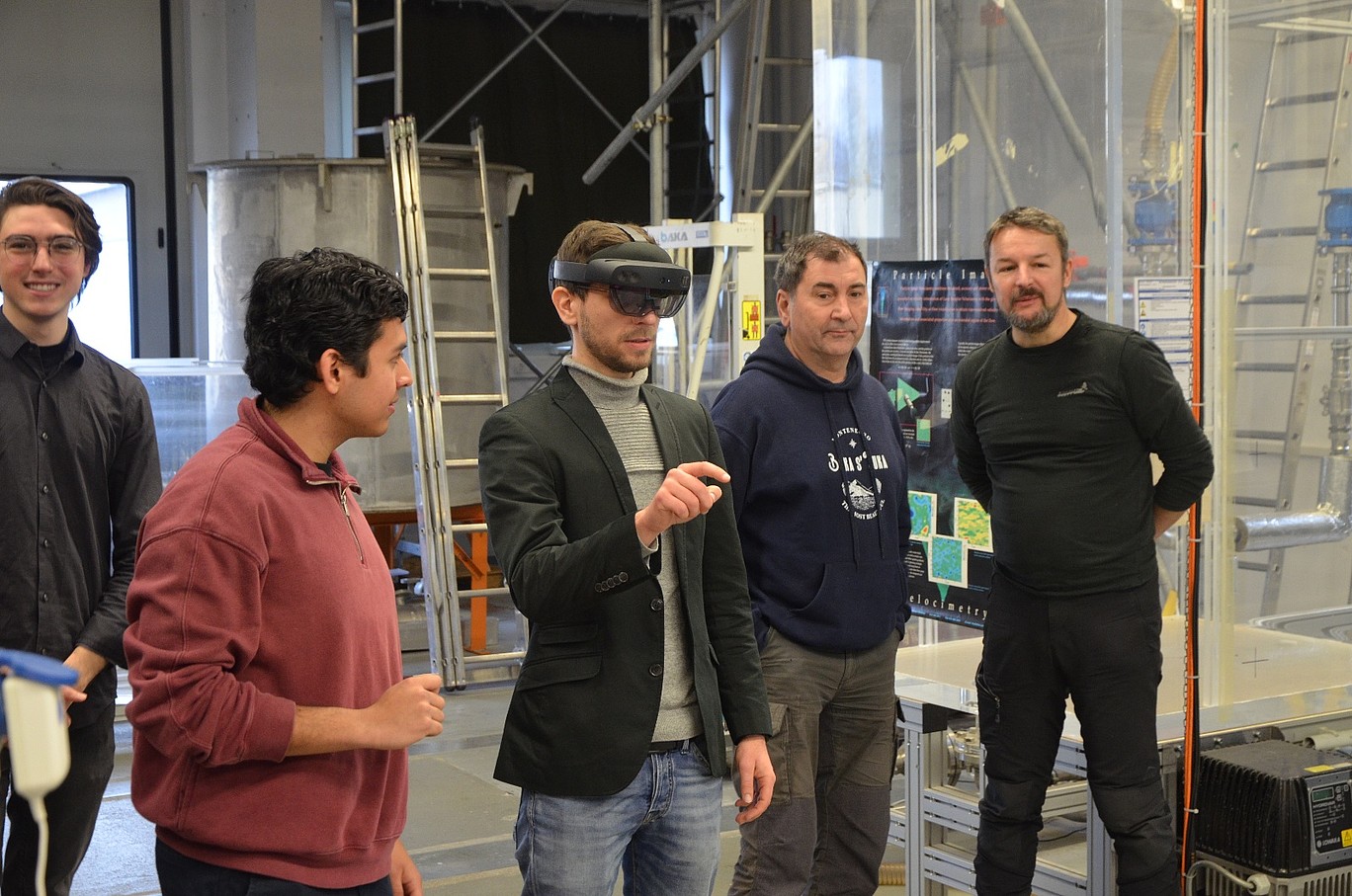
Juan and Jorge were finally able to present the results of their work to a very interested audience on January 15. The whole thing was demonstrated in practice on site in the thermohydraulics laboratory: equipped with an AR headset, visitors were able to take a tour of the 3D model of the laboratory and interactively call up technical data on all components of the Zittau flow tank. This live demonstration, which all attendees were able to try out for themselves, was impressive and generated a lot of enthusiasm.
We would like to thank Juan and Jorge for this great work, which will be further developed at the HSZG in the future and will soon find many practical applications.
Text & Picture: André Seeliger

First floor
1st floor