The European Union as daily happiness and task
Why the members and relatives of the HSZG are celebrating Europe Day on 27.04.2024 and celebrating with their Polish and Czech colleagues and neighbors in Zittau.
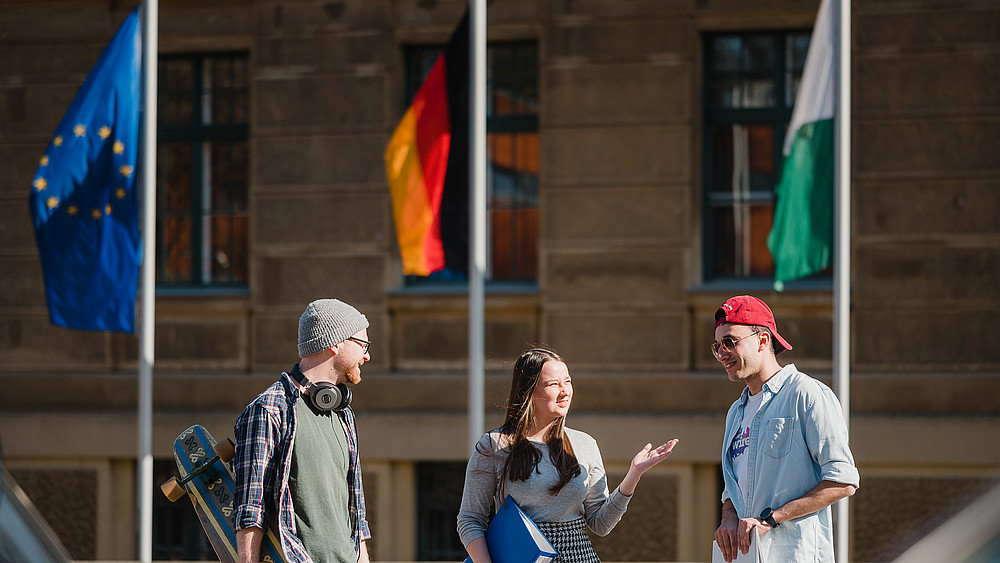
The European Union, founded in 1957 with the Treaties of Rome, experienced another momentous occasion in 2004. Ten Eastern and Southern European countries, including Poland and the Czech Republic, formally joined the Union following a long and often arduous accession process. This not only marked the completion of an important phase in the post-socialist developments in East-Central Europe since 1989, but also represented another significant step toward institutionally overcoming the division of Europe that had existed since World War II. The European Union was no longer a Western European project; since then, it has been able to claim that it is rooted in and represents all of Europe.
On April 27, 2024, we will celebrate Europe Day as the 20th anniversary of the accession of the East Central European states—and, of particular significance to us, the countries of Poland and the Czech Republic.
Since its founding in 1992, the University of Zittau/Görlitz has regarded itself as an important academic institution in the tri-border region formed by Poland (Lower Silesian Voivodeship), the Czech Republic (Liberec Region), and Germany (Eastern Saxony, Görlitz District). However, with the accession of Poland and the Czech Republic to the EU in 2004, new opportunities for transnational regional communication and cooperation were opened up that had previously been out of reach. These opportunities include not only exchange programs for students, faculty, and researchers (e.g., through the EU’s Erasmus program), joint classes / courses, workshops, and conferences, as well as the establishment of bilateral or even trilateral degree programmes, as is the case, for example, with the Technical University of Liberec (such as the international management degree programme). In addition, over the past few decades, collaborations have been established in the fields of scientific research and the transfer of knowledge into practice, ranging from Mechanical Engineering and Electrical Engineering to computer science and economics, as well as the humanities and Social Sciences. In this context, the European Union supports early-career researchers through various program lines and instruments (e.g., through ESF-funded doctoral positions or early-career researcher groups), scientific networking, and projects in both basic and applied research (for example, through the EU Horizon program or the ERDF, i.e., the European Regional Development Fund). Recently, the first call for proposals was issued by the EU’s Just Transition Fund (JTF), which provides substantial funding to support research and innovation in the context of regional structural change in Europe’s coal-mining regions. The Zittau/Görlitz University of Applied Sciences successfully participated in this round; the first projects will begin shortly.
In general, our university and our region have benefited greatly for many years from exchange institutions and EU funding programs. In this context, the EU and the tri-border region serve not only as a space and a source of resources for teaching, research, and knowledge transfer—without which academic life would be far poorer. The tri-border region and European integration are also key topics of teaching and research at our university, as well as at the universities near the border in our neighboring countries. Topics such as cross-border mobility and energy supply, joint sustainability strategies, transnational economic regional development, and issues of intercultural education and understanding, as well as joint political projects for the future, are of great interest to us and are being explored together with colleagues from Poland, the Czech Republic, and other EU member states.
Celebrating the European Union in Zittau on April 27 and highlighting the opportunities and successes to date—without which not only academic life but also economic, social, and cultural life in our region would be far less innovative and attractive—certainly does not imply an uncritical attitude toward the current orientations, regulations, and programs of the EU or its individual member states. This also applies to the academic sector. However—unlike the political platforms of right- and left-wing populists—our criticism —does not call into question the EU’s overwhelming achievements, above all as a framework for peace, freedom, and solidarity in Europe; rather, it aims to use this foundation to better resolve existing problems in the coming decades—for example, in the areas of migration policy, overregulation, or sustainable economic and financial policy.
In doing so, our daily task in this tri-border region is to take the initiative directly on the ground, develop practical solutions, and explore—through transnational model projects—what might be conceivable and viable beyond existing rules and routines.
We look forward to the next twenty years of working together in and for the European Union and its people.
Visit us at the Europe Festival in Zittau on 27.04.2024, find out about our work in Europe and talk to us about all this. We would be delighted.