
On the trail of truth
As part of the research project "Metadoxia and Truth", a textbook has now been published in the renowned Edition Metzler by Springerverlag.
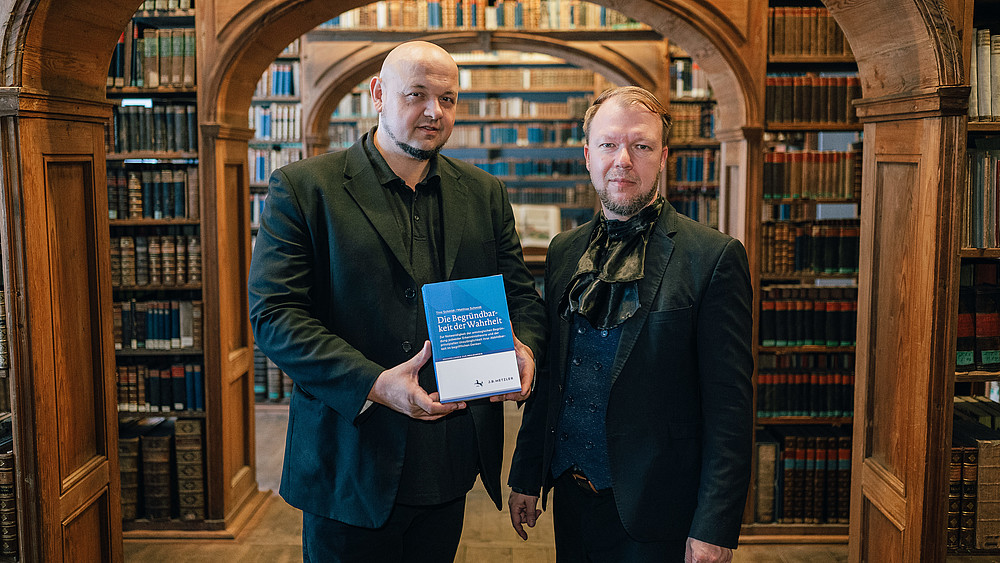
Some projects do not culminate in a project report, but rather in a textbook. As part of the research project “Metadoxie and Truth—On the Objective Justifiability of Knowledge in the Post-Factual Age,” a textbook has now been published by Springer in the renowned Metzler series.
In the book *The Justifiability of Truth*, Tino Schmidt and Prof. Matthias Schmidt examine the complex question of whether and how knowledge can be objectively justified in the age of post-factual debates. It demonstrates that the search for an ultimate truth remains a cornerstone of philosophy, despite the widespread recognition that reality can only ever be perceived through the subjective filters of our minds. The authors take on this challenge by exploring the fundamental structures of human thought and demonstrating how these structures enable us to develop conceptual notions of truth in the first place. Hardly any serious scientist today would claim to possess ultimate truths. For we have no “objective” standard of comparison from which we could deduce how accurately our minds represent reality, since we can only ever perceive it through the medium of our minds.
This book demonstrates how the notion of ultimate truth nevertheless fundamentally shaped the development of philosophy—especially among thinkers who never explicitly addressed the question of truth. For in our thinking, we always implicitly assume that our concepts are at least symbolic forms of the reality they represent. Precisely for this reason, this book examines the pre-conceptual foundation of thought that enables humans to develop conceptual representations in the first place—and what consequences this has for the limits and possibilities of all scientific theory-building.
For the first time, theories of truth are presented in an accessible overview from three different perspectives: historical-critical, epistemological-systematic, and cognitive-scientific. They are placed in relation to one another in order to derive trends in future developments in the philosophy of science from the historical connections within the history of philosophy—going beyond a purely specialized philosophical perspective. Coherence theory, pragmatic theory, redundancy theory, semantic theory, deflationary theory, disquotation theory, and minimalist theory are systematically contrasted with this view. Above all, the authors aim to initiate a debate on the limits and possibilities of the philosophy of science and offer a comprehensive overview of theories of truth that extends far beyond a purely philosophical perspective.
First floor