
DC-LabSaxony goes live
Universities and research institutes in Saxony are collaborating to conduct research on the DC power grids of the future.
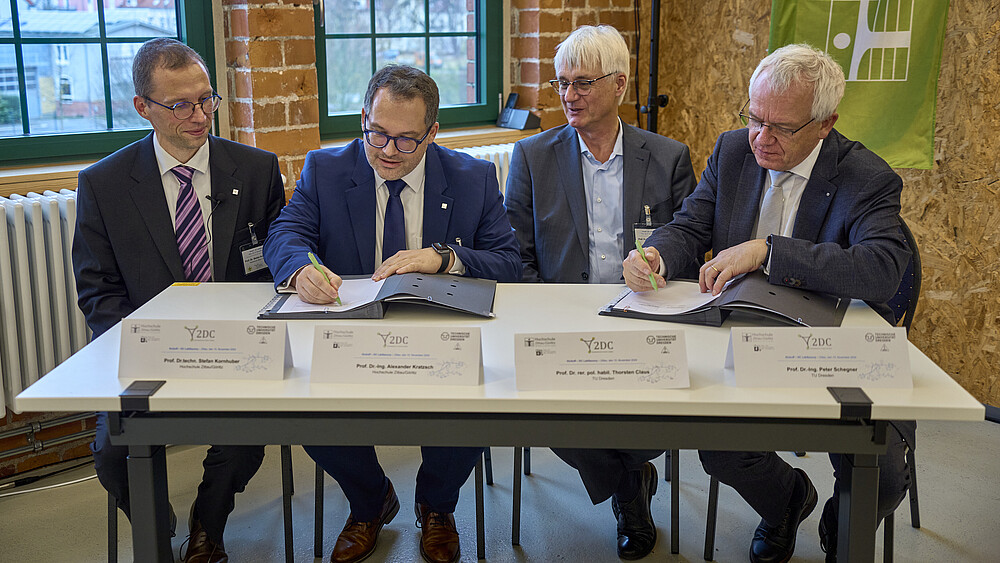
With a clear vision for the future of energy supply, the Technical University of Dresden and the Zittau/Görlitz University of Applied Sciences officially launched the “DC-LabSaxony” project on November 15, 2024.
The goal of the project is to explore the potential of medium-voltage direct-current grids and to develop sustainable solutions for high-power applications. The ceremonial signing of the cooperation agreement took place at the Zittau campus.
Prof. Dr. techn. Stefan Kornhuber, the professor in charge at Zittau/Görlitz University of Applied Sciences, explains:
The DC-LabSaxony is the starting point for extensive research in the field of DC technology in the three-country region. The transition to renewable energies and changes in user behavior present us with new challenges. DC grids offer forward-looking solutions for the energy transition, particularly in the integration of storage systems, e-mobility and the supply of industrial plants.
”Funding for this unique DC medium-voltage laboratory is secured through the Just Transition Fund (JTF) and co-financed by the Free State of Saxony. The new research facility in Zittau will advance basic research on direct current technology while also serving as a development and testing platform for regional companies.
In his welcoming remarks, State Secretary Dr. Andreas Handschuh (Saxon State Ministry of Science, Culture, and Tourism) praised the project:
It is a really great success for the research location Zittau that the DC-LabSaxony project was able to score points in the fiercely contested competition for JTF funding. A total of 6.3 million euros can now be invested, including in new equipment, but of course also in bright minds who will now drive the project forward. I wish everyone involved every success.
”Prof. Dr.-Ing. Alexander Kratzsch, Rector of Zittau/Görlitz University of Applied Sciences, emphasized:
The laboratory not only opens up new scientific opportunities for us, but also strengthens the economic competitiveness of the region. I am grateful to everyone involved for bringing this idea to this point with so much commitment and energy over the past few years.
”As part of the event, the Technical University of Dresden, the Technical University of Chemnitz, Zittau/Görlitz University of Applied Sciences, and the Fraunhofer Institute for Machine Tools and Forming Technology (IWU) also signed the official memorandum of understanding for the Saxon DC Campus.
The Saxon DC Campus is intended to establish itself as a center of excellence for the entire direct current power supply system—from generation through distribution and storage to consumption. In addition to researching the transition from existing energy systems to DC grids and DC utilization, the initiative will also examine economic, socioeconomic, and environmental issues. The expertise of the four Saxon research institutions will be pooled to strengthen regional research and increase the international visibility of direct current technologies from Saxony.
The DC Campus will offer research staff, students, high school students, and industry partners a state-of-the-art research and training infrastructure. In addition to research, the campus will provide a space for future startups and business locations that will benefit from proximity to academic expertise and the availability of highly qualified professionals. A planned new Master's degree programme will enable students to be specifically integrated into scientific projects and prepared for the challenges of the future.
With the establishment of DC-LabSaxony and the long-term vision of the Saxon DC Campus, groundbreaking technologies will be researched that not only promote Saxony’s economic strength and innovative capacity but also enable the transition to an efficient and environmentally friendly energy supply.





1st floor