
There's pressure on it - autoclaves as pressure cookers for the building materials industry
Researchers at the HSZG, TKG Görlitz GmbH and the engineering firm ERTECH are defying the currently difficult conditions to work on future sealing systems for autoclaves.
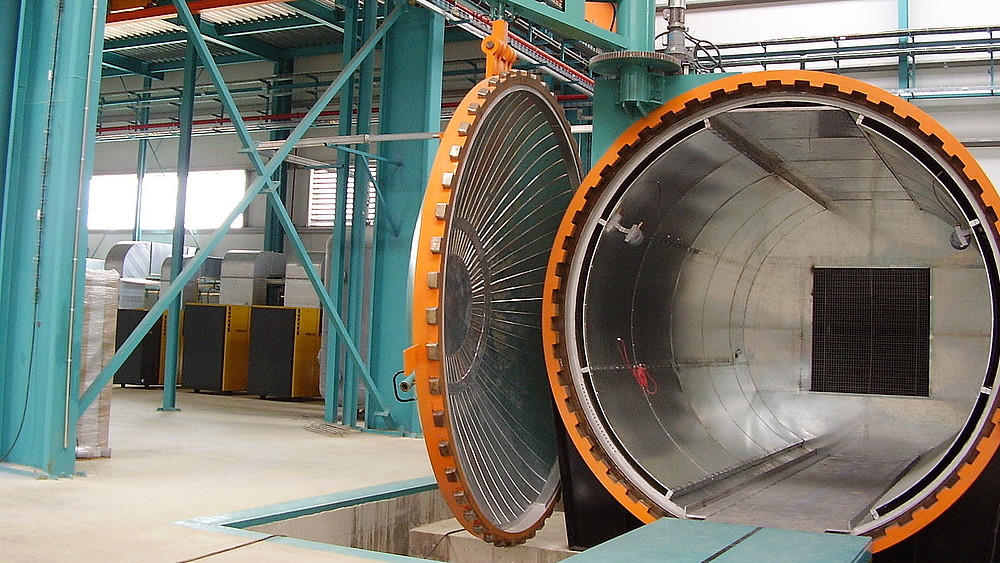
This news article about the research collaboration between the Institute for Process Engineering, Process Automation, and Measurement Technology (IPM), Turbinenkomponenten Görlitz GmbH (TKG), and the engineering firm ERTECH has been sitting in the virtual drawer since the end of February. Since then, events surrounding the rapid spread of COVID-19 in Germany and around the world have brought many other priorities to the forefront. A month later, we’re taking this opportunity not only to present the project here but also to ask scientists Thomas Gubsch and Torsten Klette (IPM) how their research is going while working from home.
Autoclaves are containers in which high pressure and high temperatures prevail. They are used for a wide variety of purposes: in cooking as a pressure cooker, to sterilize medical devices, or to “bake” building materials such as aerated concrete or sand-lime brick—just as in this project. This application requires large systems measuring up to 3 m in diameter and 50 m in length, in which pressures of up to 16 bar and temperatures of up to 210 °C are maintained for several hours. To maintain these pressures over the long term, the autoclave door requires a reliable seal. Until now, these massive seals have had to be laboriously replaced after a certain period of use.
This is where TKG’s idea comes into play. The goal is to develop a novel, fully automated, and low-wear closure system. This would achieve what is so urgently needed for the successful structural transformation of Upper Lusatia—TKG is transforming itself from a contract manufacturer into a component developer and manufacturer.
The development of the new door seal is to be made possible, among other things, by a sophisticated measurement system for monitoring the internal condition of the autoclave and the closure system. And this is precisely one of the core competencies of the IPM at the HSZG. Engineers Torsten Klette and Thomas Gubsch will contribute this expertise as part of the “Autoclave” project. They are also responsible for testing the measurement technology and, not least, for developing a reliable safety concept. The development of the seal geometry and the closure system is being carried out primarily by TKG and the engineering firm ERTECH.
Planning and design of the scaled-down AUTOKLAVEN are already underway. Initial sealing tests are being conducted on it, and the fully automated closure system is being developed. Furthermore, coordination meetings with the authorities as well as the planners from TKG and ERTECH have already begun.
In particular, the development of the safety concept based on the measured values inside the autoclave is very important. This is because an uncontrolled release of steam and condensate if the door were opened too early would endanger human health.
It works in the favor of the two engineers and their partners in their research that they are currently still in the first phase of the project: planning. Thus, when transitioning to the new conditions of working from home, the focus was on quickly migrating workflows to digital tools for collaborative work and communication. With a weekly team meeting via the Free Conference software, they’re “making just as good progress as we did during in-person meetings,” says Torsten Klette. Using the Micro Focus Filr file service, the necessary files are securely stored on the university server yet remain accessible on mobile devices. And thanks to internal coordination via Microsoft Teams, they have found a solution that supports what is currently the most critical aspect of their project: transparent and clear coordination in task allocation.
Over the course of the project, the findings are being tested on increasingly larger test benches, starting with the dimensions of a cooking pot and extending all the way to an industrial-scale prototype. “And we’re right on schedule for that,” writes Thomas Gubsch on behalf of the team when asked. And who knows—maybe one day Hagenwerder will be producing complete autoclaves, developed in collaboration with the university of applied sciences Zittau/Görlitz.
Text: Martin Kunack, Kristin Sprechert (Saxony⁵)
- Duration: 31.12.2019 - 31.12.2021
- Project management: Mr. Rothweiler (TKG), Prof. Kratzsch (IPM)
- Project management: Torsten Klette, Thomas Gubsch
- Funding: EFRE technology funding 2014 to 2020


Upper floor
Upper floor
2nd floor