
Dovetailing technology and social innovation
HSZG Forschungstransfer has a strong presence at the 18th Lusatia Conference of the DGB in Cottbus.
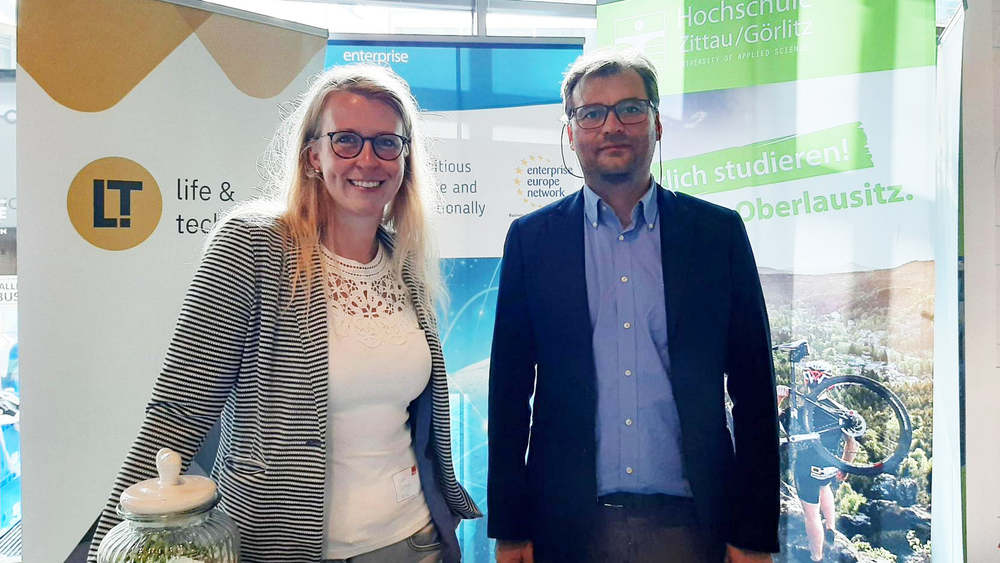
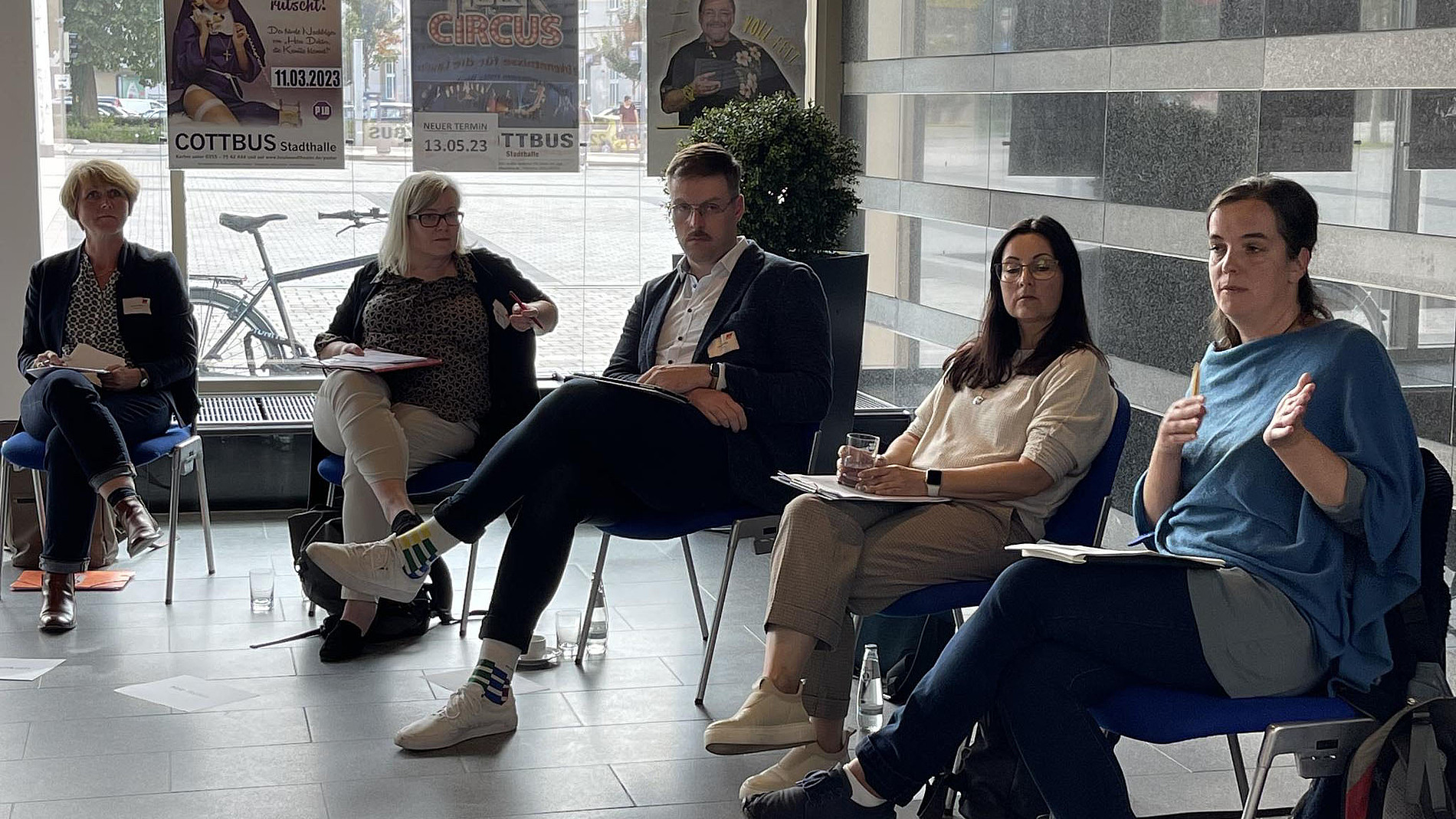
Cottbus, September 1, 2022 – Politics meets reality, listens to the people, and incorporates much of what it hears into its decisions—it was in this spirit that the 18th Lusatia Conference of the German Trade Union Federation took place on September 1, 2022, in Cottbus. Presentations and expert forums on the topic “Revitalizing the Region – New Perspectives for Lausitz” drew over 300 participants from the worlds of politics, business, research, and labor unions. The HSZG was well represented by a presentation from Dr. Julia Gabler on the panel discussion titled “Change Is Female” and through the transfer projects Lausitz – Life & Technology and Enterprise Europe Network, which had a booth at the “Market of Opportunities.”
In her contribution on gender equality in the structural transformation of Lusatia, Julia Gabler highlights the important role of women in the context of sustainability: in Lusatia, they are establishing decentralized structures, a regional circular economy, and participatory organizations, and promoting models that balance care work and paid work. Michael Kellner, Parliamentary State Secretary at the Federal Ministry of Economics and Communications, emphasized—with reference to the conference program—the need to strengthen and involve stakeholders within the structural transformation process in order to achieve the goals outlined by the DGB (see position paper) and the panel participants. “This perspective is often overlooked, yet it is so important.”
Leonie Liemich, project coordinator for the Lausitz – Life & Technology (L&T) Alliance, presented innovative R&D projects from (Upper) Lusatia. Interested conference participants were thus able to learn not only about opportunities for energy savings through more efficient waste heat utilization concepts but also about non-formal continuing education programs for workers in the region.
"For us, the focus at this conference was clearly on the intersection that we not only want to promote technological projects for the economic development of the region through R&D project approaches, but also to interlink these with social innovations in the region. Always with the aim of opening up new ways for the region and its people to change structures in the world of work and life with confidence." Leonie Liemich, Project Coordinator Alliance Lausitz - Life & Technology
”Tobias Schlüter, a project member of the Enterprise Europe Network, which is affiliated to the HSZG, provided information about the current work and transfer between industry and research institutions as well as their potential in the area of international networking.
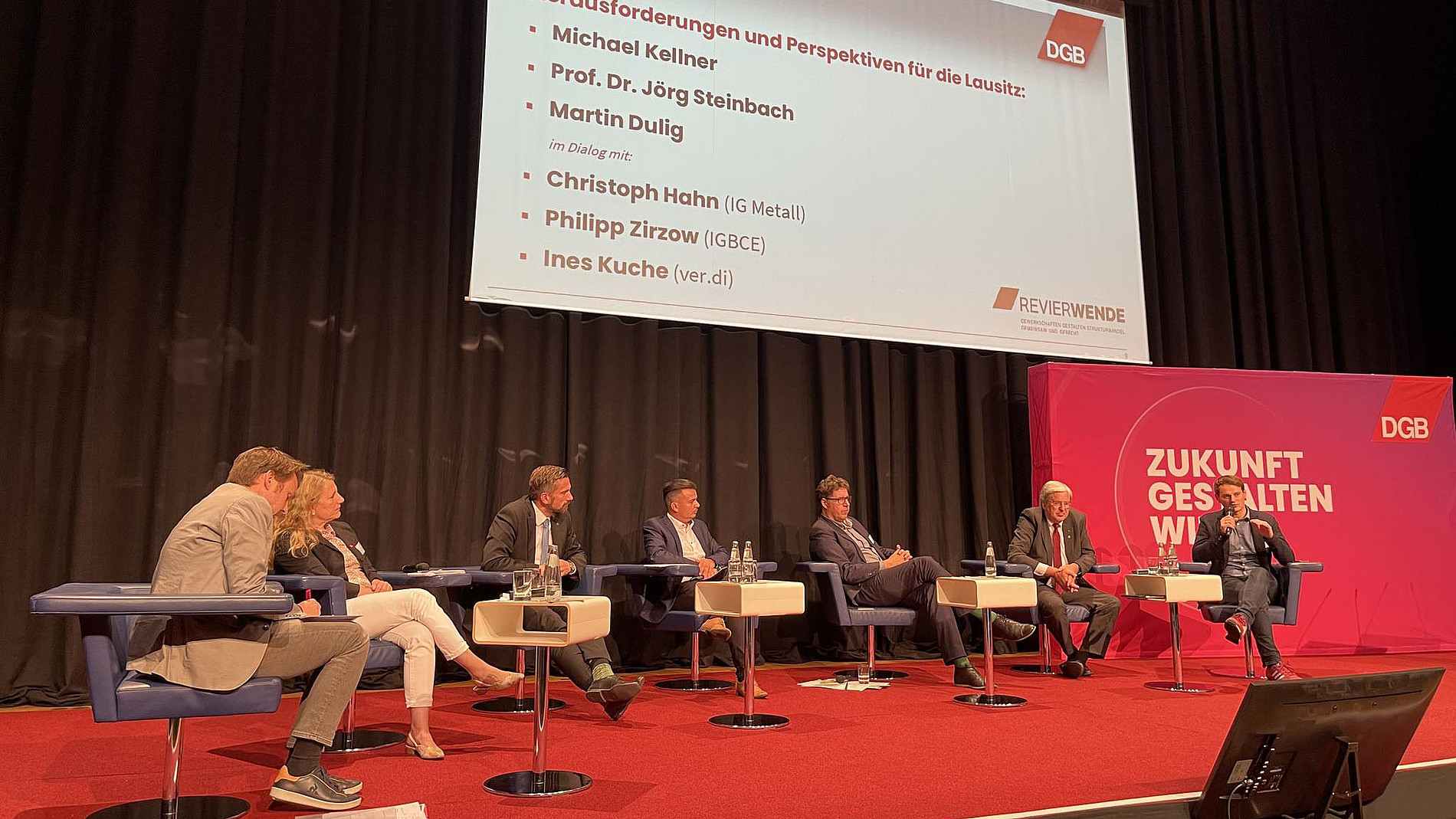
In a policy paperthe trade unions took a stand for Lausitz and the energy transition. The paper states that the coal phase-out and the Structural Strengthening Act are good foundations for structural change in the interests of employees, even in these times of change. " Structural change can only succeed with reliable framework conditions for the economy and opportunities for employees to participate," says the DGB. What is needed now is sustainable and rapid relief for the population in the face of galloping inflation and energy costs. The DGB trade unions' position is that, among other things, crisis profiteers should be asked to pay, commuters should be supported, energy prices for basic consumption should be capped and municipal companies and public utilities should be stabilized.
As guests, the conference participants welcomed Michael Kellner, Parliamentary State Secretary at the Federal Ministry of Economics and Communications, Martin Dulig, Deputy Prime Minister of Saxony and State Minister for Economic Affairs, Labor and Transport, Jörg Steinbach, Brandenburg's Minister for Economic Affairs, Labor and Energy, and Stefan Körzell from the Executive Board of the DGB.
Michael Kellner, Parliamentary State Secretary at the Federal Ministry of Economics and Communications: "Lausitz is and will remain an energy region. The highly qualified specialists we need for the energy transition live here. We want to phase out coal by 2030 and quickly enter the hydrogen industry. The importance of battery technology will also continue to increase with the ramp-up of renewable energies. With new forms of energy, we are offering the people of Lausitz planning security and long-term prospects for a region worth living in."
Martin Dulig, Deputy Prime Minister and Minister of State for Economic Affairs, Labor and Transport in Saxony: "Successfully shaping the energy and climate transition is a major challenge for everyone involved. We must now carefully examine which concepts work, both in terms of security of supply and the affordability of energy. The burden must be distributed fairly. At the same time, innovative technologies need to be established. Green hydrogen in particular can untie the Gordian knot of the energy transition and create secure, sustainable jobs. We want to make further progress here. Lausitz is an energy region and should remain so."
Brandenburg's Minister for Economic Affairs, Labor and Energy, Jörg Steinbach: "Strong employee associations are an important factor for social and economic development in Brandenburg and, of course, in Lausitz. The common aspiration of employees and the state government is and remains to ensure 'good work'. Structural change offers a great opportunity to develop a low-emission, future-proof Lausitz energy region in which, among other things, a competitive regional hydrogen economy is created. The balance sheet is also very good in other fields of action - the expansion of the ICE maintenance plant in Cottbus or the cathode production in Schwarzheide stand for the creation of new and well-paid industrial jobs. And the establishment of new institutes and scientific facilities in the future Lausitz Science Park gives us the opportunity to tap into innovation potential and establish new value chains together with existing commercial enterprises."
You can download the original texthere.

4th upper floor
2nd upper floor