
News
The Weimar Triangle Visits HSZG
On Weimar Triangle Day and the European Day of Languages, the Görlitz campus of Zittau/Görlitz University of Applied Sciences became a place for encounters, multilingualism, and cross-border exchange.
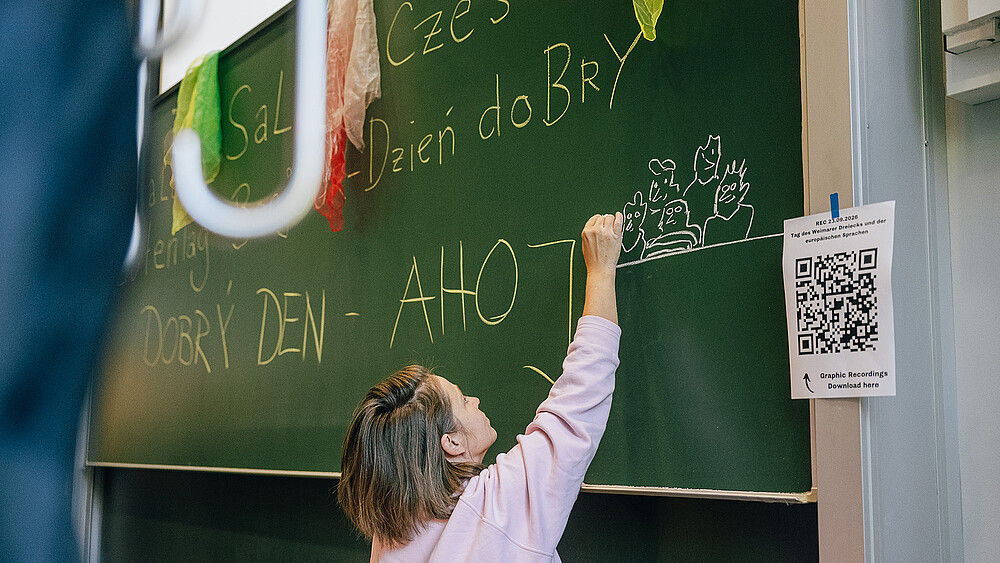
“Bonjour,” “Dzień dobry,” “Guten Morgen,” and “Dobrý den”: Even the greetings made it clear what the event on the Görlitz campus on September 23 was all about. High school students, college students, and other guests came together to learn about languages, strike up conversations, and experience Europe in a very hands-on way.
The campus’s location right on the Neisse River gave the day special significance. Zgorzelec lies on the opposite bank; Germany and Poland meet here face-to-face. Rector Prof. Dr.-Ing. Alexander Kratzsch highlighted this proximity in his welcoming remarks:
Water doesn't really separate us. And the bridges we build bring us together.
”Experience Europe in Everyday Life
The program demonstrated in various ways how cross-border encounters can work. Young people from the region helped organize parts of the day themselves, learned about neighboring languages, and engaged in conversation with representatives from various institutions. Musical performances, workshops, readings, and creative activities offered diverse approaches to language and culture.
The program included, among other things, performances by students from Zgorzelec as well as initiatives promoting German-Polish and German-French cooperation. In this way, Europe was not discussed in abstract terms, but became a concrete reality through encounters, language, and shared activities.
Languages Open Up New Perspectives
The event combined the concept of the Weimar Triangle with the European Day of Languages. Founded in 1991, the Weimar Triangle symbolizes cooperation between Germany, France, and Poland, as well as political and social understanding that transcends historical divisions.
Multilingualism therefore played a central role. When you learn another language, you not only acquire new words, but also gain new perspectives and access to other ways of life. This is an essential part of cross-border understanding.
For Zittau/Görlitz University of Applied Sciences, this concept is closely tied to its location. In this tri-border region, Germany, Poland, and the Czech Republic come together in a small area. Cross-border cooperation is therefore part of everyday life in studying, teaching, and campus life.
Prof. Alexander Kratzsch summed up this idea in his welcoming remarks:
A united Europe is not built solely through treaties and political declarations. It takes shape where people talk to one another, learn from one another, and work together to get things done.
”A Network That Transcends Borders
The Weimar Triangle Network in Saxony organized the event and provided the framework for a jointly developed program. The Zittau/Görlitz University of Applied Sciences served as the host and, along with numerous other partners, contributed its own presentations.
After stops in Dresden, Chemnitz, and Görlitz, the Weimar Triangle and European Languages Day is set to continue in Leipzig in 2027.




1st floor