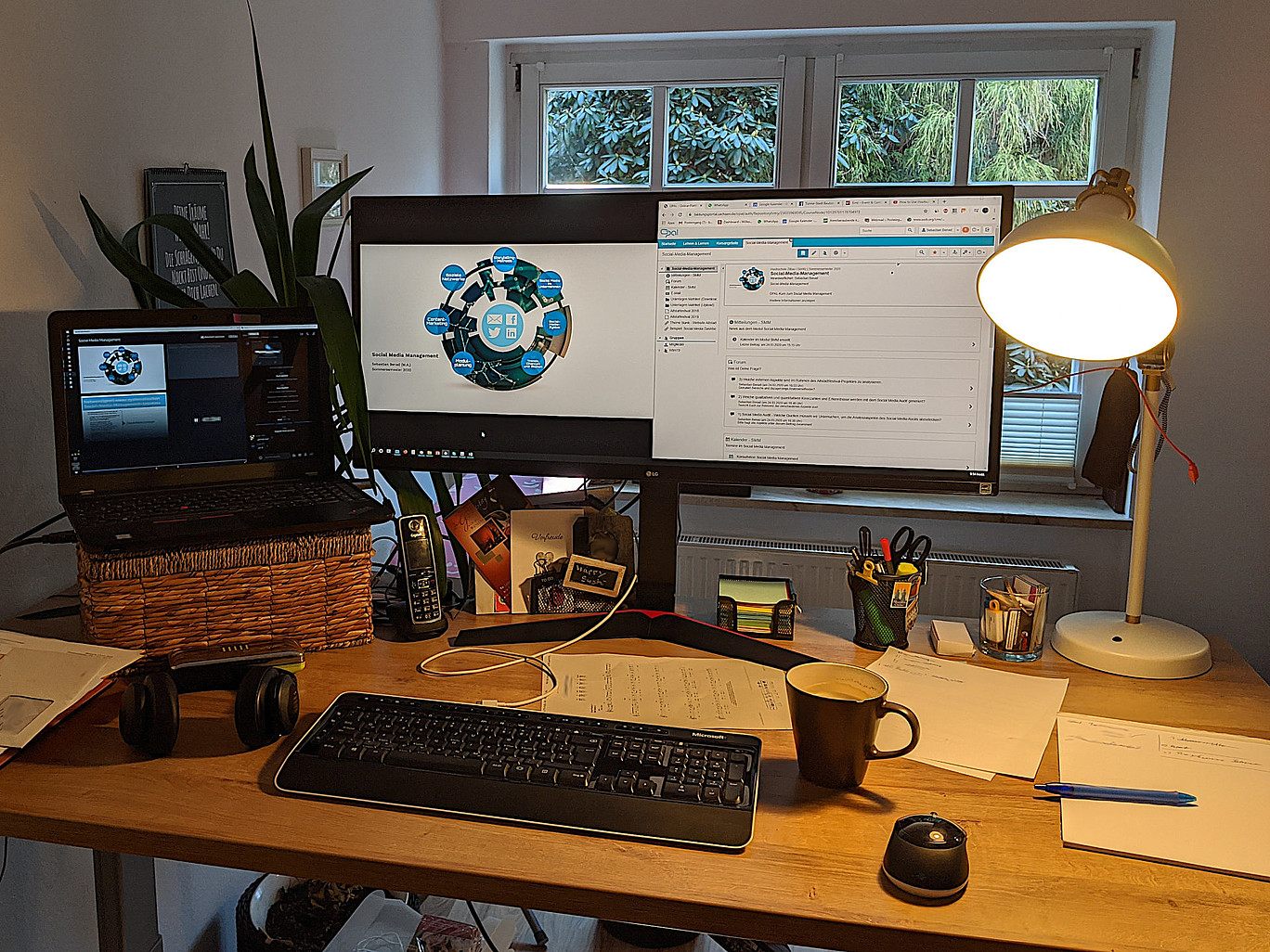
It's 7:30 a.m. on March 16, 2020 - the alarm clock rings. Quickly get dressed, have breakfast and off to university - stop. Not today. Because face-to-face teaching at Zittau/ Görlitz University of Applied Sciences has been suspended. From now on, everything will take place online. Lectures, group discussions and even exams will take place at home - on the computer via video chat. Anything goes in today's lectures - whether it's sleepy in bed, at breakfast or at your desk. The lecturer speaks on the screen. He starts the lecture as a monologue. At the end, he answers questions. The students' microphones remain silent. Otherwise it would be too distracting with all the background noise, slurping coffee or biting into a crispy bread roll. That sounds like a relaxed lecture.
Learning like in Australia
E-learning has been part of everyday life there since the 1950s. The geographical conditions demand it. Because where "just down the road" sometimes means a 600km drive, students and lecturers come together online. A system that works and a possibility that the Faculty MK is currently testing. Albeit for different reasons. The consequences of the coronavirus pandemic mean there is no other option. "Social distancing" is now part of our reality. Students living in Poland and the Czech Republic are no longer allowed to cross the border into Germany. In order to enable teaching and learning to continue, the Faculty of Managerial and Cultural Studies is rapidly converting its teaching to e-learning. A solution that will perhaps be retained after Corona? After all, the future is online.
F-MKdigital- is that the future?
Each class has its own virtual room where lecturers and students meet according to the timetable. Lecturers give lectures and call up students' preliminary examination results. Self-study tasks are evaluated and discussed online. Lecturers make scripts and presentations with assignments available to students via the OPAL learning platform. PowerPoint presentations with sound are also made available via digital channels. Flexibility and understanding are very important to both students and faculty staff these days.