
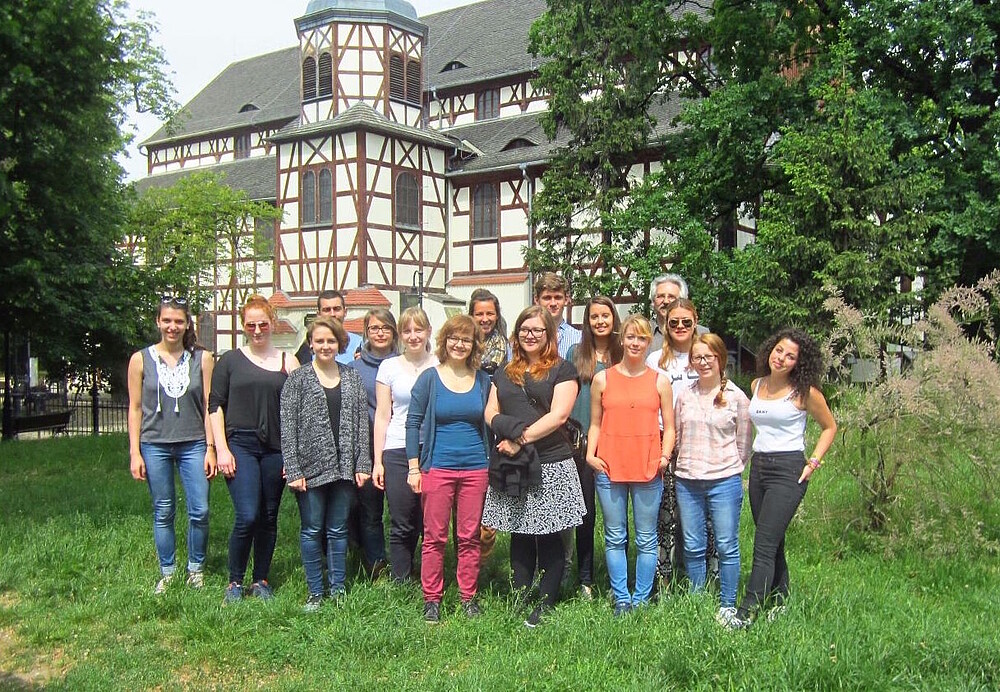
How can peace be shaped, how was discord shaped? What answers did the 17th century have, what answers did the 20th century have? As part of Professor Matthias Theodor Vogt's class / course "Cultural History II", we, the students of WKb15, got to know a whole range of places in neighboring Lower Silesia that gave us food for thought for our future profession as cultural managers.
In Jauer, after the Peace of Westphalia in 1648, the Protestants were able to overcome the resistance of the Catholic Emperor and build a so-called peace church. However, the conditions were practically impossible: one cannon shot away from the town; without the use of stone or metal; to be built in one year; all building materials laid down on the building site beforehand. With the help of the Wrocław fortress builder, the citizens of Jauer erected a half-timbered building, simple on the outside but impressive on the inside, which could hold many thousands of worshippers.
In the former concentration camp Groß Rosen, the horror of this labor camp was conveyed to us through lectures given by our fellow students. The camp was owned by the SS. They exploited the prisoners in the quarry so mercilessly that they only survived a few weeks on average. This extermination through labor, based on the inhumanity of human dignity, took place just seventy years ago! There were branch camps of Groß Rosen in Görlitz and many other places in Upper Lusatia; a barrack from the Görlitz subcamp was recently discovered just a few meters from our university. We were able to understand the suffering of the people in Groß Rosen in the exhibition with many personal stories that we could relate to.
On the site of the former concentration camp, we listened to a poem by Alfred Margul-Sperber. He was a Jewish author who came from Bukovina, the land of beeches. He wrote his poem "In the Name of an Extermination Camp" not about Groß Rosen, but about Buchenwald, when after the war the horror of the information about Buchenwald overshadowed the memory of his homeland and darkened it:
I forgot for a long time that it was near Weimar.
I only know that people were burned there.
For me, this place has a special ring to it,
because my home is called Buchenland.
An enchanted life, an unforgettable day:
The beech forest - I remember it clearly,
How I lay in its clearing as a boy,
And a white cloud floated in the blue...
O shame of time that destroys my dream!
Remembering so bewitched in its bond,
That when my ear hears this name now,
I can no longer think of childhood,
Because a nightmare creeps into my dreams,
A frightening thought devoid of all sense:
Was that white cloud there perhaps
not also the smoke of burnt people?
What would a poem about Groß Rosen look like? Here, too, a wonderful place name - darkened by inhumanity and silence.
Schweidnitz is again only a few kilometers away. Here, the second, even more famous Friedenskirche (Church of Peace) with over 7,000 seats has been preserved. It is also listed as a UNESCO World Heritage Site. In terms of cultural history, it is a kind of counter-counter-reformation, more triumphant than Jauer and an equally impressive testimony to the search for social peace.
At the end of the afternoon, we reached Kreisau Castle. It was here that the resistance to Hitler had formed, and young people from the nobility, churches and trade unions reflected on the foundations of a post-Hitler Germany that was committed to the dignity of every human being. Most of the members of the Kreisau Circle were executed by the Nazi regime. But their legacy is still alive - it is our German constitution.
We then spent the night in the current European Capital of Culture, Wroclaw. At night we experienced a lively metropolis, the next day an exciting city tour.
What can art, what can cultural managers contribute to inner and outer peace? How much courage does it take to want and dare to do the right thing against the emperor and the chancellor? How much courage does it take to be a cultural manager today in times that are considered difficult and yet are far easier than during the Thirty Years' War and under the Nazi dictatorship? From our university in Görlitz, it is hardly more than a stone's throw to investigate these questions and answer each one for yourself.
Text and photo: Karoline Sprenger; Nadine Czerwenka
Excursion leader:
Prof. Dr. phil. Dr. habil. Univ.-Prof. h.c. Matthias Theodor Vogt
Area of appointment Cultural policy, cultural history, intercultural cooperation
Area: Görlitz G IV 2.22
Phone: +49 3581 374 - 4363
E-mail: m.vogt@hszg.de