

Matthias Theodor Vogt, university lecturer at the Faculty of Managerial and Cultural Studies at the Zittau/Görlitz University of Applied Sciences, gave an interim summary of the research project "Social Cohesion, Political Aesthetics and Cultural Semantics" at the opening of this year's November conference. He published the opening speech as an essay for the journal LITTERATA (https://www.mironde.com/litterata/category/essay) as follows. Vogt states that the confusion between the parties caused by the failure of the exploratory talks offers a great opportunity before the Federal Republic abolishes the establishment of equivalence of living conditions as a state goal and Article 72 of the Basic Law
1. the "Trump-America" and the "Clinton-America" send their regards
The division of the United States in the 2016 presidential election into a majority of 54% of the population in Clinton America and a victorious minority of 46% in Trump America is a much-discussed phenomenon. In the meantime, the outcome of the election has had an impact on a significant part of the security alliances, the global economy and the cultural orientation of many states.
The New York Times has translated "The Two Americas of 2016" into two graphics. They show the sheer continental mass of Trump's territory. With the coastal-dominant Clinton, the same area appears as a large empty mass, the "Great American Ocean".
www.nytimes.com/interactive/2016/11/16/us/politics/the-two-americas-of-2016.html
Fig. 2: "The Two Americas of 2016". Source: New York Times Nov. 16, 2016.
2 The division of the Federal Republic on September 24, 2017
The results of the federal elections on September 24, 2017 also reveal a divided country. This division of the Federal Republic does not follow an East-West pattern. Rather, the decision is based on the division between metropolitan areas and dependent regions.
Beyond the metropolitan areas, decisive parts of the entire German population acted in the form of disapproval of the ruling parties provided for by the Basic Law - they voted with their ballot papers. The all-German periphery used the existing legal system for a protest vote outside the bloc posing as popular or bourgeois parties. As the SPIEGEL gleefully noted, these were in particular East Frisia and the "Bremer Loch" as well as the south of Hamburg; the "Fuldaer Bucht", the "Straße von Göttingen" and the "Iserlohner Becken"; Aachen-Land, the Ost-Eiffel and the "Saarländische Riviera"; Bavaria along the Czech border; the "Große Nord-Ostdeutsche See".
The correspondence between the 2017 map of divisions and the map of net migration, which has been apparent for a long time, is striking (which is why the year 2012 was deliberately chosen here). The regions of migration losses colored in deep red are even partly congruent with the areas mentioned above. The regions with slightly negative to slightly positive balances are marked in light red; the winning regions in yellow; an important part of the large cities with more than 100,000 inhabitants and the metropolitan areas with more than 500,000 inhabitants in light green; the only dark green metropolis was (and is) Leipzig.
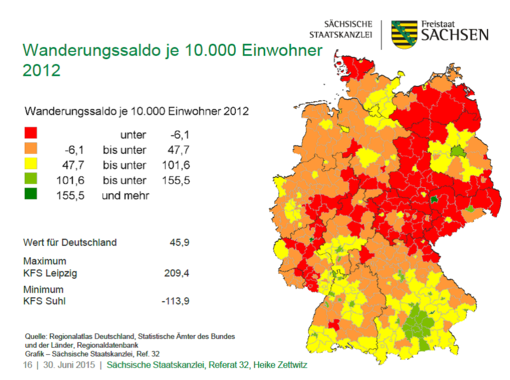
Fig. 3: Net migration in 2012 Source: Saxon State Chancellery 2015
Germany's national wealth is currently being destroyed to a large extent. Some have invested in areas where real estate can only be sold at a high loss; others are buying apartments in areas where prices exceed their lifetime income.
Between 2012 and 2013 alone, prices for detached and semi-detached houses in Northeim in Lower Saxony fell by 14 percent, while property prices in the Uckermark, the Eifel district of Bitburg-Prüm and the Oberspreewald-Lausitz district all fell by 10 percent in the same period, while the Sankt Wendel district in Saarland lost nine percent. Of the five losing districts in the German real estate market, three were in the west and two in the east.
Politically speaking, it is therefore not surprising that citizens no longer trusted the mainstream parties in the 2017 general election. What is surprising is that citizens still believed the bourgeois parties in the previous federal election in 2013 and that their anger at the lack of overall control of the entire area has only now broken out.
3 Refugees as indicators of future swarm movements
The so-called swarm movements are most blatant among those who have fled to Germany. As of October 2015, around 50% of the 215,000 registered people from the eight non-European asylum countries were living in just 33 of the country's 402 urban and rural districts. In accordance with the co-ethnic networks, the FAZ graphic shows some other focal points, for example Saarbrücken, but essentially the refugees follow the preferences of German internal migration marked in yellow and green above.
http://media0.faz.net/ppmedia/aktuell/wirtschaft/3800834366/1.3947878/default/hq/syrer-ziehen-in-andere-staedte.jpg
Fig. 4: Spatial distribution of registered employable persons from the eight non-European countries of asylum, October 2015. Graphic: Frankfurter Allgemeine Zeitung.
As Alexander Smoltczyk from SPIEGEL observed in his story "Refugees in the provinces", which was initially conceived as a Christmas story and has since been highly decorated,[1] however - in stark contrast to the refugees' co-ethnic centrifugal moments - it is precisely the smaller communities that manage to integrate them effectively and sustainably: the anonymous Syrian has become a neighbor with a name. The study "Ankommen in der deutschen Lebenswelt" (Arriving in the German living environment) examines these much better chances of integration in the much-maligned provinces[2].
4. the concerns of the majority of 69% of German citizens
With such maps in mind, six weeks before the Bundestag elections, the CDU/CSU parliamentary group leader Volker Kauder wrote under the heading "Rural regions must remain worth living in":
"Let's take a look into the year 2067 and imagine what Germany could look like in 50 years' time: a country with a few mega-cities, including perhaps Berlin or Hamburg, bursting at the seams. But desolation in the rural regions. Dying villages with deserted schools and a few pensioners left behind who can barely support themselves. Deserted landscapes that only attract a few hikers. For me, such a scenario would be a nightmare. For me, Germany would no longer be Germany if it were only characterized by conurbations. In my eyes, Germany is a country of diversity - in terms of landscape and culture.
Kauder thus gave those affected a good reason not to vote for those responsible for this development, insofar as none of the bourgeois party programs had even come close to addressing the concerns of the majority of 69% of German citizens from communities of less than 100,000 inhabitants, who in principle would have changed the constitution.
The fact that only 15% of Germans live in metropolitan areas with more than 500,000 inhabitants and a further 15% of Germans live in large cities with between 100 and 500,000 inhabitants is neither conveyed by the media nor does it play a significant role in major political decisions. The title "rural areas" of the seventh and final department in the Federal Ministry of Agriculture does not even remotely do justice to the reality of life for 69% of those entitled to vote. The term "rural area" is stigmatizing. At best, in blue metropolitan skyscrapers close to the sky and with no connection to the ground, one can get the idea that middle and small town dwellers would feel addressed by it. 2% are farmers and 98% are non-farmers. However, the vast majority of Germany's gross national product is produced in medium-sized and small towns, and not in the big cities. The social sciences have known for 50 years that the waves of innovation originate in the smaller towns and are merely distributed via the capital cities. The English call the dependence of Abbey Road on the creativity of the provinces the Liverpool effect. Perhaps Berlin's party leaders should listen to more Beatles and attend more conferences where sources of urbanity are discussed.
On September 24, 2017, the fact that Germany's spatial planning dates back to 1933 came back to bite. Its ideas of centralization mean that the financial resources of smaller municipalities are significantly lower, making them much less attractive for the young and, incidentally, also for the old - see their massive influx to Berlin. As if the costs for a school system or sewage supply were not significantly higher with a lower population density than is the case in Kreuzberg.
In this way, German spatial planning bears a significant share of the responsibility for the ultimate failure of the bourgeois parties in the 2017 federal elections. It is long overdue to use political and scientific means to take a central look at the structures and perceptions of social belonging in the country's rural districts. Anyone who no longer has a local savings bank, shopping facilities, a doctor or a school doesn't just feel marginalized, they are objectively marginalized. To the edge of the republic.
5. the almost non-existent interest of science and politics
in the future of our republic as a whole
A few days before the 2017 Bundestag elections, the keys are handed over for the Futurium Berlin, which is dedicated to the challenges of the Anthropocene. In the third year before its opening, 15 million euros have been earmarked for this in the federal government's Section 30, Title Group 685 60-165[3].
In contrast, what about the interest of science and politics in the problems outlined at the beginning in the background of the Bundestag elections and thus in the futurum of our republic? There is no serious village science in the Federal Republic. There is little academic discourse on small and medium-sized towns in urban studies and hardly any in economics and law. The topic of rural districts and cohesion from a normative perspective has yet to be addressed.
Hardly any significant funds flow into the regions beyond the metropolitan cities that could contribute to the enhancement of intellectual life and have indirect social effects. For example, 15 percent of Saxony's citizens live in Upper Lusatia on the Polish and Czech borders, and 14 percent of Saxony's taxes come from them. However, only 2.13 percent of state spending on science went back to Upper Lusatia in 2007.
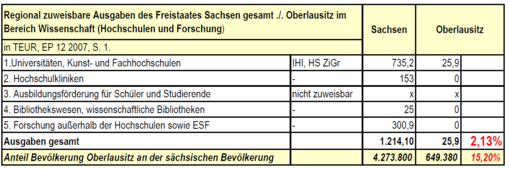
Fig. 5: Expenditure of the Free State of Saxony as a whole and Upper Lusatia in the field of science (universities and research) in kEUR, EP 12 2007, p. 1 From: Matthias Theodor Vogt in collaboration with Philipp Bormann, Andreas Bracher, Vladimir Kreck and Katarina Markovic-Stokes: Serbski ludowy ansambl | Sorbisches National-Ensemble. Edition kulturelle Infrastruktur Volume 1. Frankfurt am Main 2009. p. 69.
In other words, the people of Upper Lusatia support Saxony's and the federal government's scientific institutions in Dresden, Leipzig and Chemnitz with six-sevenths of their tax revenue. Establishing "equivalence of living conditions" in the sense of Article 72 of the Basic Law would look different. What has been described here for the field of science applies to a similar extent to numerous other policy areas, starting with the unequal distribution through the state financial equalization system, which puts smaller municipalities at a severe disadvantage. The protest from the periphery is home-made.
Instead of continuing to build glossy institutes next to Berlin's main railway station, the question should therefore be asked: where, if not within this province itself, would it be better to think about fundamental questions of social cohesion and thus about nothing less than the future of our republic?
How the federal administration deals with initiatives from the Bundestag could be studied on November 8, 2017, when the Federal Ministry of Education issued its decree on research into social cohesion almost a year after the Bundestag budget resolution. The BMBF timetable is so elaborate that the scientific work is expected to begin on June 1, 2020. In other words, exactly at the time when politicians will need advice for the next general election. In this way, the executive is slowing down the legislature and deliberately leaving its need for knowledge unsatisfied. The citizens will not be happy.
6. diminishing returns to scale when appropriate sizes are exceeded:
a century-old finding in economics
From a jurisprudential point of view, the question is whether, due to the changed economic foundations of the Federal Republic, the establishment of "equivalence of living conditions" within the meaning of Article 72 of the Basic Law has become obsolete in the meantime and whether a new constitution should follow the proposals of the Dohnanyi Commission (2004) to abolish villages and small towns. Now, however, for the whole of Germany, including Central Hesse and Saarland.
An analysis of this question represents an extraordinary challenge for the economic, social and cultural sciences. The logic of returns to scale is generally known: When producing one million copies of, say, a car, lower research and development (R&D) expenses etc. must be allocated to the individual car; the return per car sold thus turns out to be higher. Since 1921, however, economics has also been aware of the diseconomies of scale, the diminishing returns to scale. Above a certain threshold point (the minimum long run average cost LRAC), the yield decreases again. In terms of the national economy, the question is whether the collateral damage of the so-called growth core policy is not far more significant than its benefits. This in turn needs to be examined from a financial and economic perspective, i.e. also taking into account the social and cultural costs and benefits.
i.ytimg.com/vi/YkKYlAmPqyw/maxresdefault.jpg
Fig. 6: Diseconomies of Scale. Source: Mark Seccombe,
What happens to a democracy that hardly exists in the public eye due to municipal mergers and district mergers? In which the municipal level only exists on paper and identity-forming encounters are replaced by identitarian phrases? It is obvious that the field is left to populists[4] when the public sphere is derived from national narratives and cannot be created in the autonomy of local discourse communities. Self-serving technocratic administrative mechanisms undermine the basic democratic principle of our republic. What has German science currently presented on the resources of recognition among young people in rural communities?
The horseshit of Saxony's CDU policy in recent years has been its primarily technicist approach and the lack of a soft power strategy for the Free State and for the Saxons. On September 24, 2017, the Saxon CDU lost first place to the AfD after 26 years of unchallenged dominance in the second votes. You can now either send citizens to the polls until this becomes a nationwide phenomenon. Or we can examine the susceptibility of voters to populist simplifications with the necessary sobriety. Then it will quickly become clear that the West German model of Rhineland capitalism with its social partnership is no longer compatible with the algorithmized economy in the East since reunification and in the West since the turn of the millennium.
7 The algorithmization of the Federal Republic at the expense of the rural area
In its 2017 study "values-visions-2030", the Heidelberg Society for Innovative Market Research identified a number of so-called megatrends that play a key role in the scientific penetration of the above-mentioned problem areas:
(1) Algorithmization
(2) Utilization
Self-utilization instead of self-realization
Converting life into "social currencies"
(3) Design / engineering
Shifting boundaries of physical and mental performance
(4) Fragmentation ("patchwork ego"/ "dividuum"
dynamic alliances in the digital world, instead of clearly defined social analog groups
(5) Re-localization
Re-rooted in the local
Numbers 2 to 4 of the Heidelberg megatrends can all be seen as the result of a systemic transformation of our society through number 1, the algorithmization of our republic. The Heidelberg team counters this with a return to local roots as number 6. However, the question arises as to whether the so-called swarming of young people to the swarm cities is not an escape from those spaces that lie outside exponentially modelable algorithms and are therefore fundamentally unsuitable for certain economic forms.
Dijkstra, winner of the Turing Prize in 1972, developed a basic form of the algorithm that increasingly determines our lives today. Represented as an edge-weighted graph, the rapid sequence of arithmetic operations can be visualized as follows:
Fig. 7: Dijkstra algorithm, edge-weighted graph.
"One small step for a man, one giant leap for mankind," said the first man to set foot on the moon. For the then Deutsche Bundesbahn in 2002, the transition from distance-dependent fixed price calculation to so-called relation prices for the connection between two long-distance tariff points depending on a variety of parameters was a small step in terms of business technology. it had spilled over from the neoliberal UK. For the Federal Republic of Germany, however, relative rail prices were a quantum leap. For the smartphone-savvy rail passenger, access to the long list of algorithmized price plans seems to offer advantages.
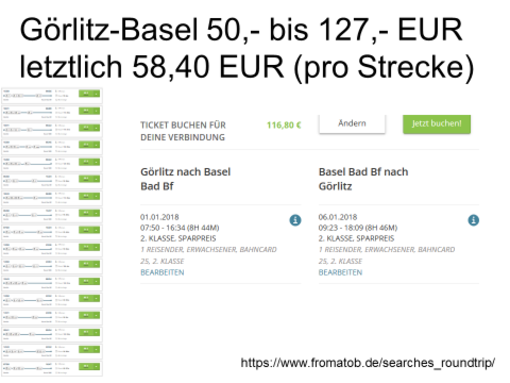
Fig. 8: Algorithmic calculation of rail prices using the example of fromato.de (2017). Graphic: M. Vogt 2017.
However, the result of handing over corporate responsibility to self-functioning algorithms can currently be seen in Lufthansa prices: the management declares itself powerless in the face of its own software, which has driven up prices by 50% in some cases due to the excess demand over available seats following the Air Berlin bankruptcy. Orwell is not a dark fantasy, but has become a crude reality at the same time as the general election.
The mathematics of algorithms, on the other hand, is based on exponentiality. Only in that overabundance of potentialities that Carl de Marcken (2011) analyzed in his groundbreaking study on the Computational Complexity of Air Travel Planning and declared to be no longer controllable by humans,
Under the heading of algorithmic accountability, there are now serious concerns about the extent to which the use of algorithms is compatible with the basic assumptions of our legal system. Frank Pasquale, professor of law at the University of Maryland, takes the view that algorithms can also be stopped by legal means. "Some data practices are simply too invasive to be permissible in a civilized society." Algorithmization, without the state regulating the market, is fundamentally incompatible with German federalism, on which the social support and impressive economic performance of our country are based, as it cannot take effect in the less densely populated parts of the country and thus creates second-class status for the citizens concerned. Internet provision, which excludes many craftsmen from the public application system due to a lack of sufficient upload speeds, is just one of countless examples.
8. showing the centralization mania its bare bottom

Fig. 9: Dresden Residential Palace, Great Palace Courtyard, detail west. Photo: A. Buch 2017
In art-historical terms, the citizens have shown their buttocks to the political elite, whose centralization mania is in clear contradiction to the requirements of the Basic Law - like the memento for the Saxon electors in the northern atrium of the Dresden Residenzschloss.
The party-political confusion caused by the failure of the exploratory talks offers a great opportunity. Berlin could use it to give the constitution-amending majority of 69% of Germans in towns and municipalities with fewer than 100,000 inhabitants the attention that the Basic Law has promised them since 1949. And which is now falling victim to a misunderstood obedience to algorithmization.
When, if not now, would the time be ripe for decisive reflection and action? The failure of Jamaica offers a historically unique opportunity in the history of the Federal Republic.
Contact
Prof. Dr. phil. Dr. habil. Univ.-Prof. h.c. Dr. h.c. Matthias Theodor Vogt
Faculty of Managerial and Cultural Studies
Phone: 03581 374 - 4363
E-mail: m.vogt(at)hszg.de
[1] Smoltczyk, Alexander (2017a): Refugees in the province. Behind the Eagle's Nest, there is Mecca. Der Spiegel 2/2017. Smoltczyk, Alexander (2017b): Tour of Germany. Germany's bright side. www.spiegel.de/video/smoltczyk-3-wochen-deutschlandreise-fluechtlinge-video-1732509.html
[2] Matthias Theodor Vogt, Erik Fritzsche, Christoph Meißelbach: Arriving in the German lifeworld. Migrant enculturation and regional resilience in the One World. European Journal for Minority Issues Vol. 9 No. 1-2 2016.
[3] The budget states: "With the Futurium, an exhibition and communication center is to be created on Kapelle-Ufer in the capital city of Berlin, where future-oriented developments in science, research and innovation will be presented and discussed. Pioneering developments will be presented and discussed in permanent and temporary exhibitions, laboratories and events with the support of industry and research organizations." (BMF 2017, EP 30 BMBF, p. 46).
[4] Marchart, Oliver: "The criticism of populism is meaningless". Interview Beate Hausbichler, Standard Vienna, August 9, 2017