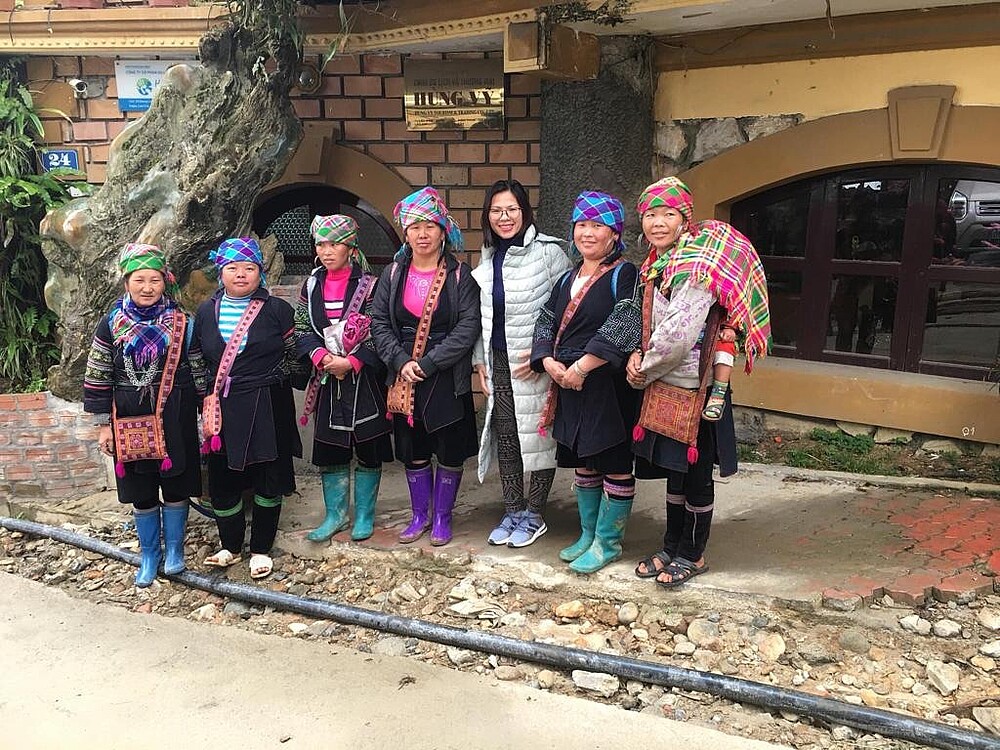
After a restful and comparatively cold night, we started the day with excitement. Instead of air conditioning, the heating was now running in our hotel rooms. Some of us were lucky enough to have a balcony and were hoping for a nice view. The night before, we couldn't really see anything of Sa Pa as we had only arrived in the dark. In the morning, however, it wasn't much different as there was thick fog. This was due to the location, which is at an altitude of 1,600 m. There was a varied breakfast buffet and, to everyone's amazement, even cheese. This is extremely unusual in Vietnam. Most of us had become accustomed to fried noodles, soup and rice, the typical Vietnamese breakfast, and while we waited outside the hotel for our tour guide, we came into contact with the H'Mong people for the first time. This is an ethnic minority that lives in the area around Sa Pa. The women wore traditional colorful clothes and carried baskets full on their backs, as well as some of their small children. They greeted us in good English and asked where we were from. They told us to remember them, because we would meet them again. A bus finally took us to the starting point of our hiking tour.
Hiking is a student's passion
We started our hiking tour with our previously created evaluation forms for the location analysis in hand. One German and one Vietnamese student worked in pairs. The initial shyness of the Vietnamese was gone and we were able to exchange a lot of information. It is very interesting to see how different student life is in another country and what the young Vietnamese want, and as promised, the same women were waiting at our starting point that we had already met outside our hotel in Sa Pa. They accompanied us throughout the hike and told us a lot about the region, their lives and were also very interested in ours. Once again, we noticed the cultural differences, as the distance between us was minimal. Once again, the Vietnamese came very close to us and often touched us on the arm. It was a fine line between friendliness and intrusiveness.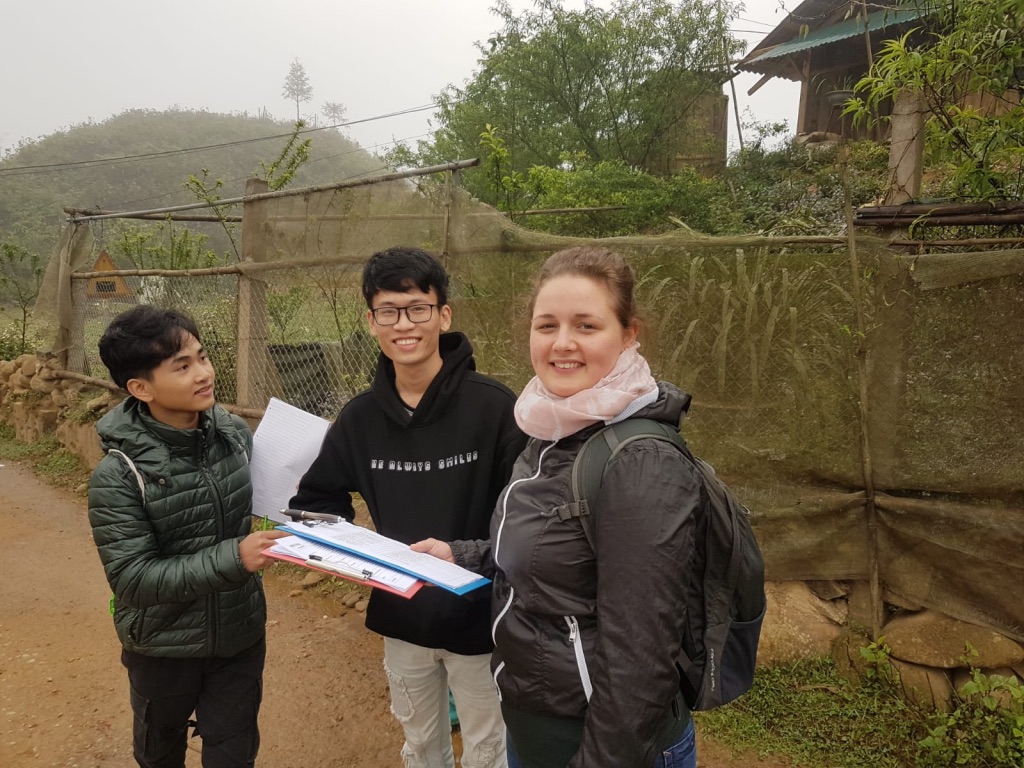 Unfortunately, we couldn't enjoy a clear view due to the constant fog. Nevertheless, we were able to gain some insights into the wonderful nature of this region and so we experienced a mystical day. In addition to the typical rice terraces, we discovered numerous areas where artichokes are grown as well as grazing buffaloes.
Money, money, money
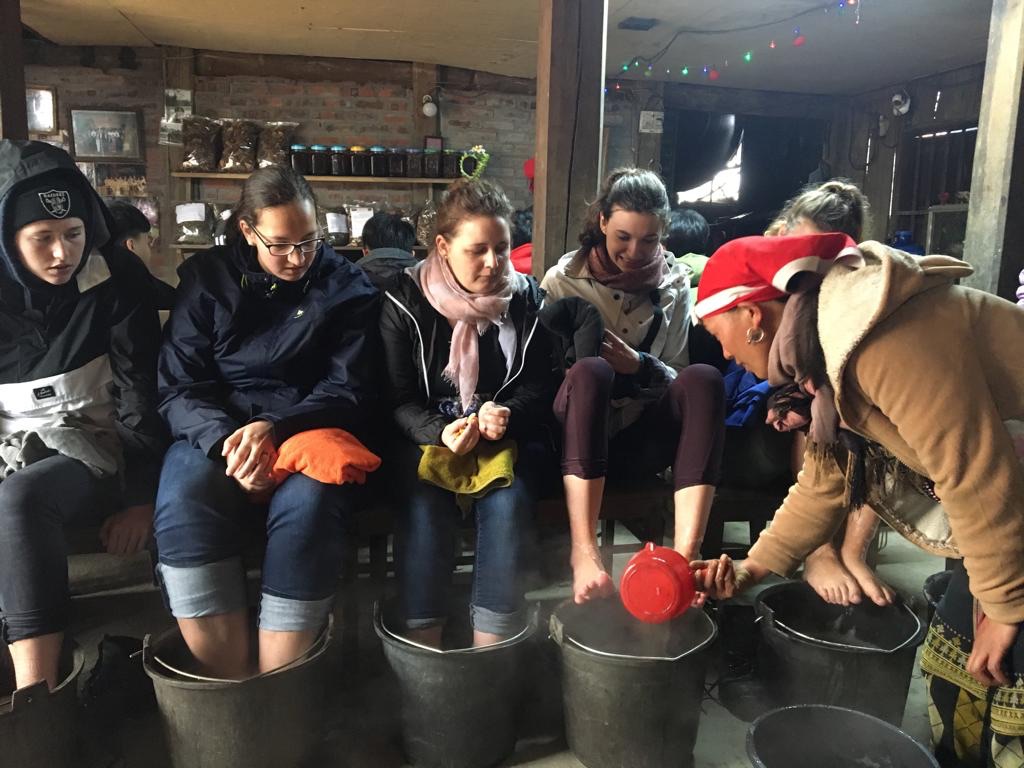
In addition to agriculture and the sale of home-made products, tourism is an important source of income in the province of Lao Cai. We visited very simply furnished houses of the locals as well as some local homestays. In the first homestay, we recovered a little from the steep climb. The H'Mong women took down their baskets to reveal homemade products. They were wildly praising them and we all realized a few things. It turned out that the small talk at the hotel and the hiking companions were basically advertising for themselves. A variety of different self-sewn bags, tablecloths and cushion covers with embroidered patterns or indigo prints were for sale. Of course, we couldn't resist and we all bought a lot. The knowledge that the proceeds from the sale would stay in the H'Mong villages was yet another reason to buy one more souvenir, and when we arrived at our destination, the village of Ta Phin, a typical Vietnamese lunch awaited us. After a very tasty meal, we visited another homestay on the upper floor. This one was very spartanly furnished. Downstairs, the room had been remodeled in the meantime. Where we had eaten just a few moments ago, there were now rows of chairs and buckets. These were filled with hot water and herbs. We stuck our bare feet in and enjoyed the benefits. Our lecturers, who had raved about the herbal bath from the previous year, had not promised too much.Last exchange, travel sick Vietnamese and a forgotten suitcase
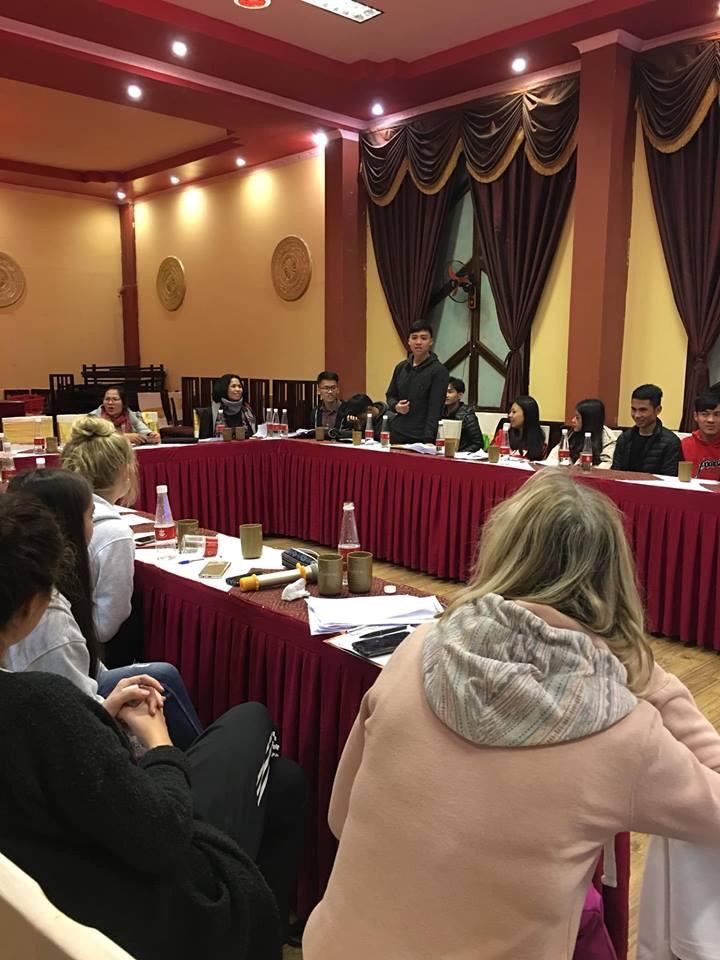
 Once again, we packed our suitcases and enjoyed one last breakfast in Sa Pa. Today we were off to the last stop on our trip, the capital Hanoi. But before we set off on the five-hour bus journey, we brought our joint project to a close. In a huge conference room of the hotel with a great view of the green inner courtyard, all participants of the summer school came together once again. Our last joint class / course took place over the next three hours. First of all, the Vietnamese students presented the Pestel analysis that had previously been prepared in Thanh Hoa and together we summarized the most important risks and opportunities. We were able to learn a lot from the results, as a lot of exciting information about Vietnam and the Sa Pa region in particular was presented. For example, all children from ethnic minorities are allowed to attend school and university free of charge.
Last but not least
In small groups, we summarized the results of the evaluation forms from the location analysis carried out the day before. From this, the strengths and weaknesses of the region could be derived, which were presented by each group in the different categories. Due to a lack of time, the evaluation forms were unfortunately not revised in advance and therefore not adapted to Vietnamese standards. This made us extremely aware of how different the standards can be in two countries. For example, there are mainly homestays in the places we investigated and no typical hotels as we know them. These generally do not have a traditional reception. We also didn't find any museums there, as our hike took us through the region as a living museum itself. In preparation for the summer school in October, when the Vietnamese students and lecturers come to Görlitz, there was a small homework assignment for everyone at the end. To round off the project, recommendations for action and strategies now need to be derived from the strengths, weaknesses, opportunities and risks identified. These should serve to expand and improve the offers for community-based tourism in the region around Sa Pa.