In this interview, Erasmus+ intern Anastasiia Mazurchenko talks about her research on digital skills and her stay in Görlitz at the Faculty of Managerial and Cultural Studies.
Author: Verena Nowatzky
Images: Anastasiia Mazurchenko, HSZG
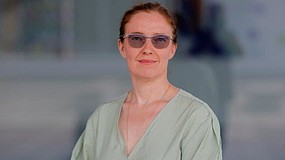
Mgr. Anastasiia Mazurchenko is a final-year doctoral candidate in philosophy at the Faculty of Economics of the Technical University of Liberec (EF TUL, Czech Republic). She graduated from the University of Economics in Katowice (Poland) and the Vinnytsia Institute of Trade and Economics at the National University of Trade and Economics in Kiev (Ukraine).
While conducting student research projects at EF TUL, she focused on the topic of digital skills in the business of Czech companies and digital skills at universities. In this context, she spent a research stay as an Erasmus+ intern at the Faculty of Managerial and Cultural Studies at the HSZG from mid-March to mid-June 2022. We asked her about it.
Why did you apply for an Erasmus+ internship at the HSZG and who supervised you?
At my home university, it is compulsory to complete a research stay abroad in order to obtain the academic) degree "Doctor of Philosophy". From the outset, my preferred destination was Germany, ideally a university in Saxony, because you don't have to travel far to immerse yourself in the atmosphere of international cooperation and experience the culture of another country.
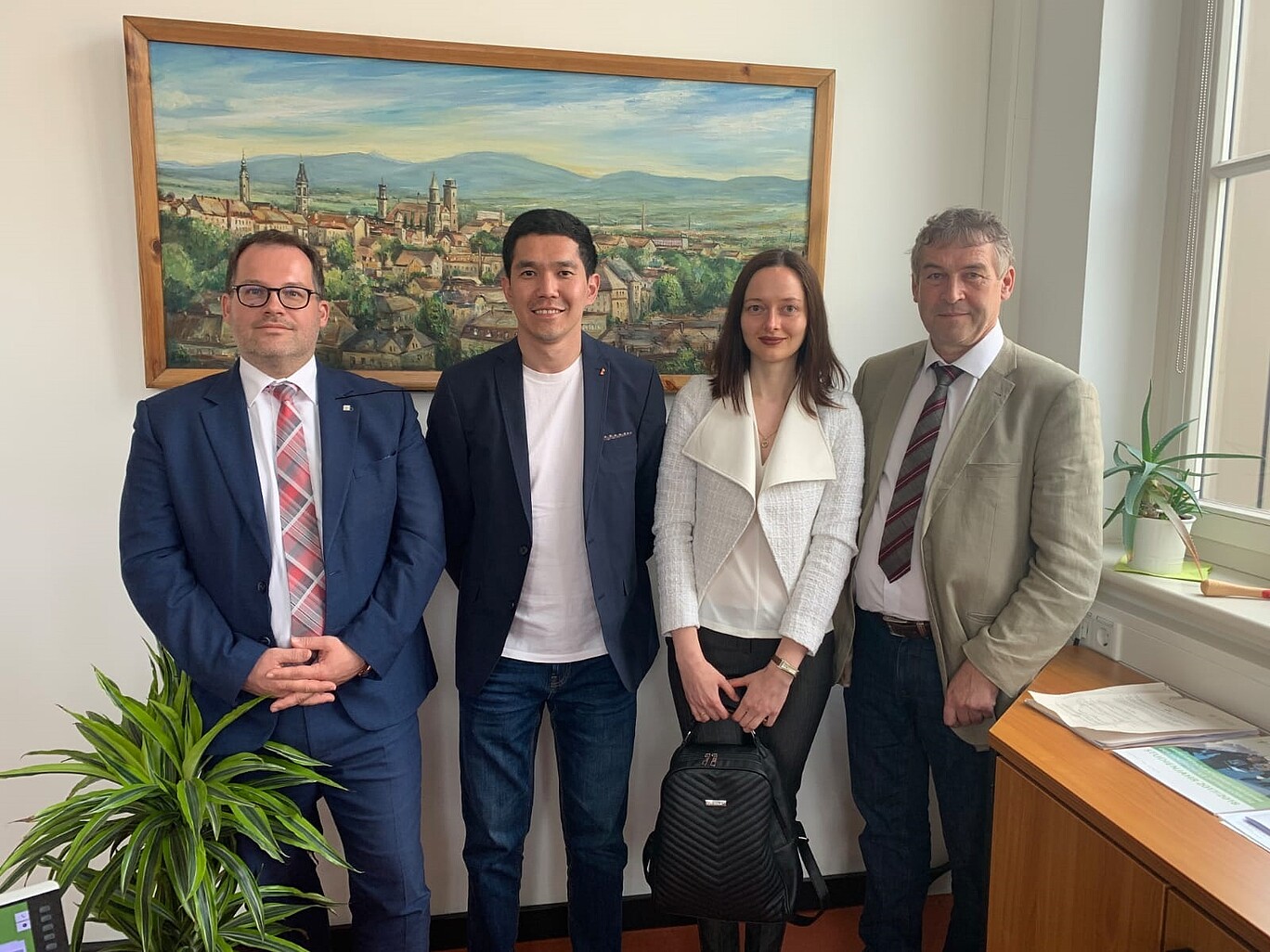
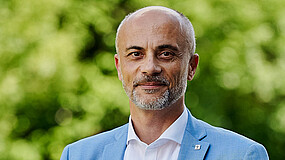
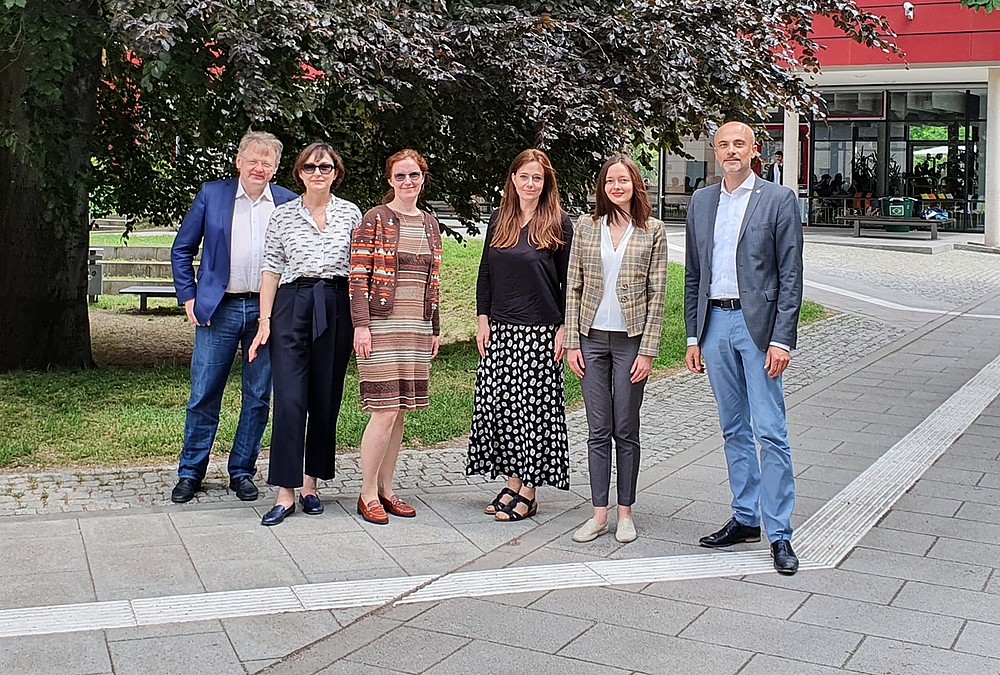
I am glad that the management of the Faculty of Managerial and Cultural Studies at the HSZG, and in particular the Department of Human Resources Management headed by Prof. Dr. Falk Maiwald, showed interest in my research focus and candidate profile, which made this collaboration possible. At a meeting in May at the campus in Görlitz, my doctoral supervisor at the TU Liberec, doc. Kateřina Maršíková, Ph.D., who is also the Vice President for International Affairs at TUL, met with my German colleagues and the International Office.
Have you ever participated in an Erasmus+ program before?
Yes, during my Master's degree in Poland, I spent a semester at Mendel University in Brno between 2016 and 2017. I also took part in the International Study Program Week of the SHARPEN project in Lithuania in March 2019 as part of the Erasmus+ program. Translator's note: SHARPEN = SMEs Human Resource Attraction, Retention and Performance Enhancement Network. This positive experience has motivated me to try again if the opportunity arises.
What were your main tasks during the internship at the HSZG?
My main task was to conduct a quantitative empirical study on the digital competence of teaching staff at the HSZG (professors, lecturers with a specified function, research assistants, laboratory engineers with teaching duties). This included the design of a questionnaire tailored to the specifics of the university and the implementation of an online survey. The data was then analyzed anonymously using descriptive statistics and presented scientifically to the Vice President for Education and International Studies and her staff team as well as to the Faculty Council of Managerial and Cultural Studies. I also prepared a research report for the University Management and the Center for E-Learning of the HSZG. As part of the internship, I conducted a small study on behalf of the International Office and the HR department on the extent to which HSZG employees (both academic and administrative) are interested in continuing their education through online language courses. Completely unplanned, but very important and valuable for me, was the opportunity for me as a native speaker to help the International Office with written communication with refugees from Ukraine who were interested in studying or working at the HSZG.
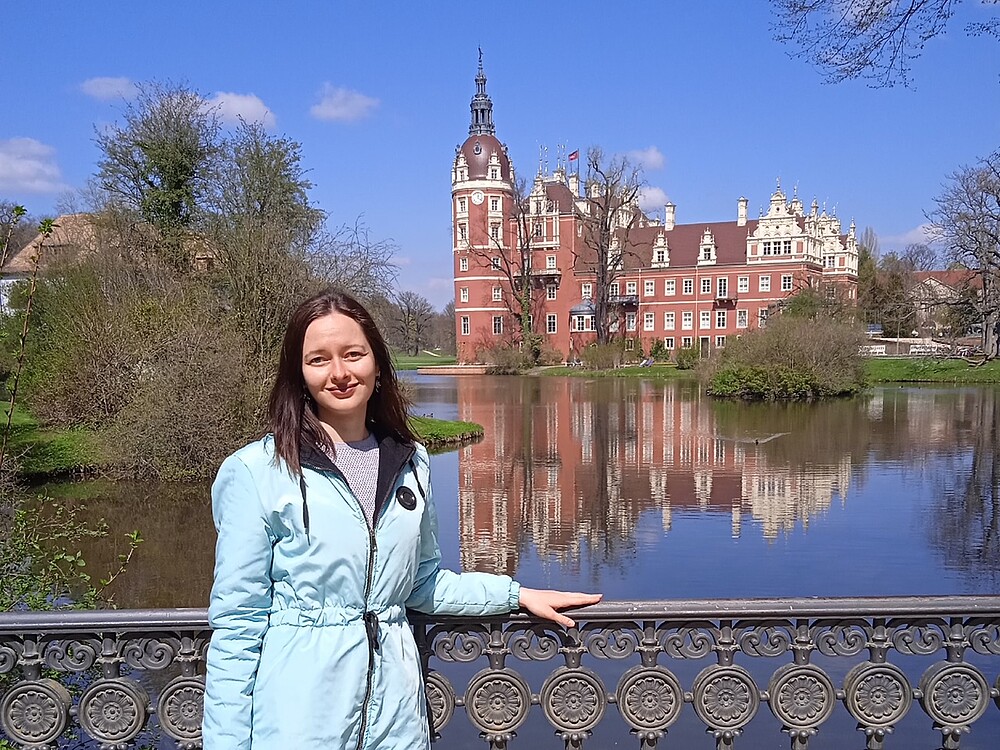
Of course, I also explored the region around Görlitz and as far as Dresden. A highlight for me was Muskauer Park with its castle.
Why do you think developing digital skills in the workplace is timely?
New jobs are emerging and the way in which work tasks are performed is changing. As a result, digital skills are becoming essential in order to be able to act efficiently and participate in modern society. By digital skills, I mean the ability to use digital technologies responsibly, independently and appropriately in a work, learning or social context. Given the fact that new digital technologies are emerging and penetrating relatively quickly into various areas of companies and the economy, developing employees' digital skills is becoming a long-term task and part of lifelong learning. Since the training of skilled workers takes place directly in colleges and universities, the education sector acts as an intermediary between them and future employers - and they expect a high level of digital skills.
What digital skills do you think are most in demand for the work of university teachers?
It is no surprise that the COVID-19 pandemic has placed higher demands on teachers due to the need for online teaching in colleges and universities. My research at EF TUL in 2021 showed that teachers there felt the greatest need for digital skills for teaching, data analysis and digital project management. Through my research here at the HSCG, I was amazed at the possibilities of digital technologies that teachers at the HSCG have and use, especially for online teaching and contact with students. The creation and efficient distribution of digital teaching materials is very important to the lecturers at the HSZG. However, I also found evidence that the workload of staff at both universities is a noticeable obstacle to the further development of teachers' digital skills. Considering the benefits that digitization can bring to the work of teachers in general, I believe that in the long term they will make even better use of the potential to compensate for any deficits.
Did the Erasmus+ internship at the HSZG meet your expectations? What advice would you give to other students who are considering an Erasmus study visit or an Erasmus internship here?
At the beginning, I was a little worried about how my stay here would be, as I don't speak any German at all. However, this fear was unfounded as the people around me, from my academic supervisor to my colleagues at the university to my neighbors in the dormitory, spoke English with me, so I was able to feel comfortable. Of course, you won't be able to do without German in official institutions, e.g. when visiting the residents' registration office. However, you shouldn't let leaving your comfort zone stop you and it pays off. This internship has been a unique opportunity for me to collect international data that I can incorporate into my doctoral thesis.
I would also like to emphasize the high level of competence and professionalism of my supervisors and colleagues with whom I was lucky enough to work, as well as the cooperation made possible between the TU Liberec and the HSZG. And I was pleased that I was able to learn a lot about the university and its international relations in a conversation with the Rector of the HSZG, Prof. Dr.-Ing. Alexander Kratzsch.